









![From the campfire stories to the head-to-head STOL competitions, this is backcountry aviation in its purest form. [Credit: Tony Cruz]](https://planeandpilotmag.com/wp-content/uploads/2026/01/IMG_1384-1.jpg)

Approximately 260 nm south west of Boise, Idaho (KBOI) and 33 nm north east of Reno, Nevada (KRNO) sits a general aviation gathering like nowhere else. It’s a meeting of the backcountry, off-airport minds, STOL Drag adrenaline junkies, and believe it or not, average Jims and Janes.
This is the High Sierra Fly-In, and it takes place on the Dead Cow Lakebed in the Nevada desert the first week of most Octobers.
Known as the birthplace of the infamous STOL Drag racing series, the event is where founder Kevin Quinn and a dedicated team of friends, family, and volunteers invite pilots, racers, and even the FAA to the area for a fly-in that will leave you on the edge of your seat.
“My version of STOL is real life,” said Quinn. “It’s landing on top of these mountains, getting a cool view, and having a cup of coffee with good people. But we had the lake bed, with all this space. And honestly, the short takeoff and landing stuff just started getting boring. I wanted to do something different.”
For Quinn, a larger-than-life, highly motivated personality with a history in the extreme sports and heli-ski industry, the mere idea of wanting more was all it took to change the course of STOL history.
“Cory Robin was out here with me one day, and I looked over at him and asked him if he wanted to race,” said Quinn. “He was in his Wilga and I was in my 180. Cory said, ‘You wanna do what? You wanna race?’ Yeah, let’s race,’ [I said.] Let’s go put some cones out.
“So we put cones down, hopped in, and raced down. I don’t know who won or lost. He probably kicked my [butt]. If I remember correctly, he came over the radio and said turn around, let’s go back! So we powered up and went back!”
After shutting down, Quinn and Robin slapped each other on the back and debriefed on the erratic idea they had just put into motion.
![There's a large campfire every night for attendees of the High Sierra Fly-In. It's easy to make new friends and discuss a shared passion for backcountry aviation. [Credit: Ryan Cleek]](https://planeandpilotmag.com/wp-content/uploads/2026/01/CLK8582R.Cleek-Stol-Air-Race-Plane-and-Pilot-1024x682.jpg)
“There were a few others here, and after a bunch of trials and tribulations, we came up with 2,000 feet being the perfect distance,” said Quinn. “It wasn’t just about having a fast airplane. It came down to pilot skill set. We had to figure out how to manage all that power, where we were gonna retard the throttle, slip, and slow down. Then it really hit us. Holy cow, we’re drag racing our airplanes. Let’s call this STOL Drag.”
In the decade since its conception, STOL Drag has taken off like wildfire. With the FAA-approved series stretching far and wide, racers always find their way back home to the High Sierra Fly-In for the championship run, which was claimed yet again by Steve Henry in YeeHaw, a highly modified Just Aircraft Highlander.
Although the High Sierra STOL Drag championship features the most talented racers going head to head for the prized dead cow skull, championship belt, and trophy, first-time competitors are always welcomed and encouraged. However, each new racer must attend and pass a two-day, FAA-accredited STOL Drag pilot training course and qualify prior to each race.
“People are a little unsure of us,” said Quinn. “They think, who’s this bunch of cowboys, but when they learn how serious we are about what we’re doing and the curriculum, training, and safety that takes place behind the scenes, that’s when we gain the respect.”
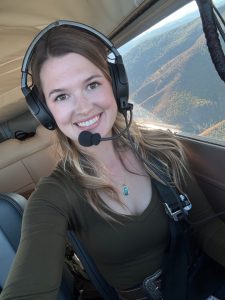
Annie Vogel, a first-time STOL Drag competitor and A-1C Aviat Husky pilot, traveled to the High Sierra Fly-In all the way from Collingwood, Ontario. Prior to the start of the fly-in, Vogel was able to put her skills to the test.
“Practicing on grass strips in Canada will only take you so far, so getting the chance to run everything on the lake bed was very helpful,” said Vogel. “The environment, the pressure, and the coaching all added something I just couldn’t get at home. I’d done a lot of prep beforehand, which definitely helped, but the course pulled everything together and made me feel more settled going into my first race.”
Levi Noguess, another first time STOL Drag competitor, flew Legend Aircraft’s demonstration NOMAD to the event from Sulphur Springs, Texas.
“I’ve done a lot of STOL flying,” said Noguess. “But it was always the traditional STOL competitions. At High Sierra time doesn’t matter. It’s a double-elimination bracket race, so if you lose twice, you’re out. It’s all about whose tail is completely down and stopped first.”
![Levi Noguess flew to the playa from Texas in Legend Aircraft's NOMAD. [Credit: Tony Cruz]](https://planeandpilotmag.com/wp-content/uploads/2026/02/CLK2973R.Cleek-Stol-Air-Race-Plane-and-Pilot-1024x682.jpg)
Although flying competitively wasn’t new to Noguess, being placed against Henry, the undefeated STOL Drag world champion, for his first STOL Drag race certainly was.
“Isn’t this just ridiculous,” Noguess said jokingly. “I thought, well, it’s just automatic. This will be my first elimination. I’m gonna get stomped. But it was kind of cool to be at High Sierra racing alongside the name of all names for STOL Drag. And here I am, a rookie in a borrowed airplane.”
The borrowed NOMAD, one of only three flying, and Noguess placed ninth in a lineup of 18 racers.
While the STOL Drag championship on Saturday is the pinnacle of the event, there is far more to the High Sierra Fly-In than adrenaline-fueled airplane drag racing.
For Nick and Megan Beamer, who flew their polished stock Cessna 170A into the event from Yuba City, California, their repeat visits to the lake bed serve multiple purposes.
“It’s all about the people you meet up here, the airplanes that you get to see, and just being in the great outdoors up here in the High Sierra,” said Nick Beamer. “What’s not to love? It’s just amazing.”
![Nick and Megan Beamer flew their polished Cessna 170 into High Sierra from Yuba City, California. Enthusiastic pilots proudly display their American spirit across the playa. [Credit: Cayla McLeod]](https://planeandpilotmag.com/wp-content/uploads/2026/01/CLK4758R.Cleek-Stol-Air-Race-Plane-and-Pilot-1024x683.jpg)
For Noguess, it’s also about the camaraderie, particularly once the sun sets.
“There’s a humongous fire every night,” he said. “You just run into so many people. In fact, that’s where I ran into you. We were standing 2 feet apart and didn’t even know it at first.”
Although Beamer would like to tell pilots to fly out to experience the High Sierra Fly-In for themselves, he offers a word of caution.
“You need to be familiar with mountain flying,” he said. “The weather can be unpredictable, and there’s no real airports around here to give you a nice current update on the weather. Off airport experience would also be really helpful because this is different from a gravel or a turf strip that’s an actual airfield. It’s not an actual runway. You have to be able to do your spot landings really well and be able to pick out where to land.”
Even with proper preparation, Noguess, echoes the sentiment that the temporary runway can be difficult to spot.
“I couldn’t see the runway at first, so I was very thankful to be following Trent Palmer and a few of the other guys in,” he said. “They didn’t have the flags and typical markings up due to all the rain, but the only thing I could make out was the scaffolding control tower. And I studied this, and looked at maps and pictures, but I still couldn’t exactly make it out.”
The “STOLTAM,” Quinn’s version of a NOTAM, offers pilots flying into the event an arrival procedure and other points of note.
“It’s kind of like flying into Oshkosh on the FISK arrival,” said Noguess of the annual EAA AirVenture in Wisconsin. “There’s a little farmhouse and other points you have to hit before coming in.”
Once the runway is in sight, Noguess maintains this isn’t the time to let your guard down.
“It’s kind of similar to landing on glassy water,” he said. “The runway is very featureless, so you have to take your clues. It’s a non-event for backcountry pilots, but if you’re used to landing on actual runways all the time, that could be a problem.”
![Cathy Page is one of many talented STOL Drag competitors. She flies her CubCrafters FX-2 Carbon Cub named Luna C off airport regularly. [Credit: Ryan Cleek]](https://planeandpilotmag.com/wp-content/uploads/2026/01/CLK1416R.Cleek-Stol-Air-Race-Plane-and-Pilot-1024x682.jpg)
Although backcountry pilots will be more familiar with the off-airport sight picture, the airplanes won’t know the difference.
“There’s people that bring in Cherokees, 172s, and there was even a Cirrus or two,” said Noguess. “Mark Patey brought his Pilatus and the lake bed handled it just fine. The day prior there was an inch of water on the runway, but it was super-hard packed. I didn’t even sling any mud.”
Known for its normally dusty and windy conditions, 2025’s High Sierra Fly-In was a rarity.
“This was a light event, with about 400 to 500 people less than normal, due to weather, but I’m not upset about that,” said Quinn.
Pilots flew in from far and wide only to be met with torrential downpours the first day, stranding some at paved airports all around Nevada. Campers, trailers, motor homes, and passenger vehicles of all shapes and sizes were left stuck, stranded, and without a way in until later in the day on Friday, if they were lucky enough to be towed out of the rough and primitive washboard roads.
Vogel was camped out with her husband prior to the deluge.
“It was definitely a thing,” she said. “I ended up meeting a bunch of friends stuck on the side roads, and we had a great campfire and dinner out there with plenty of drinks. I went to Round Hole Spring one of the days, which was fun.”
Pilots brave enough to land before the playa was completely dry were faced with dodging wet clay-like puddles and ruts full of sticky, lake bed goo.
“No matter the conditions you landed in, when you get home, you have to wash the airplane right away,” said Beamer. “Get that dust and dirt off there because it can be very gritty, and you don’t want that stuff sitting in your flight controls and on your airplane. So a good wash, a good wipe down, and a good cleaning. You can’t ignore it.”
![Whether you're in a purpose-built Carbon Cub or a classic Skywagon, High Sierra is the ultimate proving ground for backcountry pilots. [Credit: Tony Cruz]](https://planeandpilotmag.com/wp-content/uploads/2026/01/IMG_1612-1-1024x682.jpg)
Unlike EAA AirVenture and other larger, more corporate type fly-ins that lack the character and mud or dust of the playa, self-reliance and independence are crucial at the High Sierra Fly-In. Although a fellow pilot might be able to bail you out in a pinch, attendees need to be prepared to be entirely self-reliant.
“I’ve seen it go from beautiful sunny skies to dark and treacherous in just minutes,” said Beamer. “You really need to be prepared with all the gear and some hefty tie-downs for your airplane [because] the winds can get pretty nasty out here.”
Although there are portable toilets and toilet paper, along with a food vendor or two, it is in your best interest to be prepared for anything, including emergency situations.
“Ambulances will not be coming out to the playa,” said Quinn. “Look out for yourself, and if something comes up, work on getting yourself out as soon as possible. CareFlite is on standby, but that’s the only thing getting out to the lake bed quickly.”
To a lesser degree, consider the everyday, not-so-luxury essentials. Baby wipes for makeshift showering, water for brushing teeth, dehydrated food for camping, backup chargers for the essentials, and plenty of layers for hot days and frigid nights are a few, simple things that should make the list.
Attendees should make sure to purchase tickets and merchandise ahead of time on the High Sierra website (highsierraflyin.com). Note: All the T-shirts and hats were already sold out on Saturday, And if you’re flying in, make sure to read, print, and understand the STOLTAM before arrival.
“All I know is the there and now,” said Quinn. “…So I don’t know about next year, but let’s work hard right now to fly safe and have fun, so we can plan a next year.”
This article first appeared in the January/February 2026 issue of Plane + Pilot magazine.