










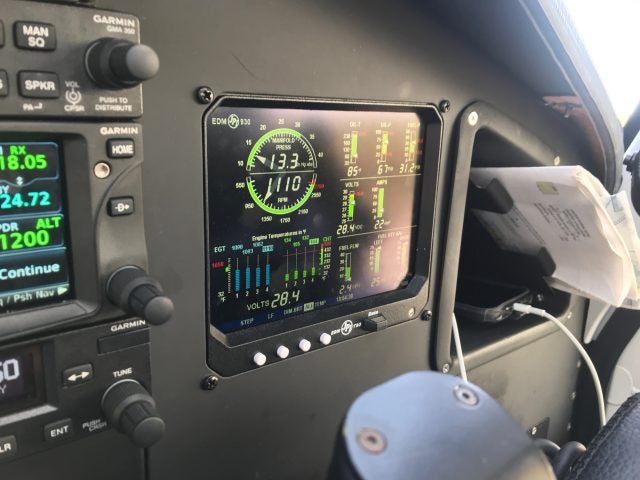
Unlike most 180-hp trainers, the V1.0 has a constant-speed prop attached to its Lycoming IO-360 mill. The constant-speed prop does add some complexity to the training while also giving the student an opportunity to better understand just how piston-powered planes’ powertrains work, the concept of a constant-speed prop requiring a greater understanding of what a propeller does and how we use it to our advantage in different phases of flight. The power controls are lever style with colorful anodized handles and, again, they look overbuilt…in a good way. The quadrant also houses the big trim wheel, which is in an easy-to-reach location.
The flaps are big and powerful. With 45 degrees of throw in an already-big-winged, slow-flying plane, there’s probably not much reason to use all the flaps unless your intended runway is really short or you’re just showing off. The flap switch has no built-in stops. You kind of eyeball it, letting the motor run until the flap position indicator is just about right.
There are a couple of exotic touches in the controls. The yokes are giant, and both front seaters need to be careful not to get knees in the way, and the rudder pedals/brakes are elevated off the floor to an unusually pronounced height. One’s technique might need to be modified to take that into account.
I was warned that taxiing the V1.0 would take some planning to get the turns right. I found that not to be the case at all. Its steering is done with differential braking, and after a few seconds, I’d forgotten that I was supposed to remember something about it.
Likewise, on takeoff it’s a piece of cake. The rudder is large and comes alive early in the takeoff roll. It was a warm day, and with about half fuel and two aboard, we were neither particularly light nor heavy, and the V1.0 kind of elevated in that way that planes do when they simply must go flying right now. And we were airborne.
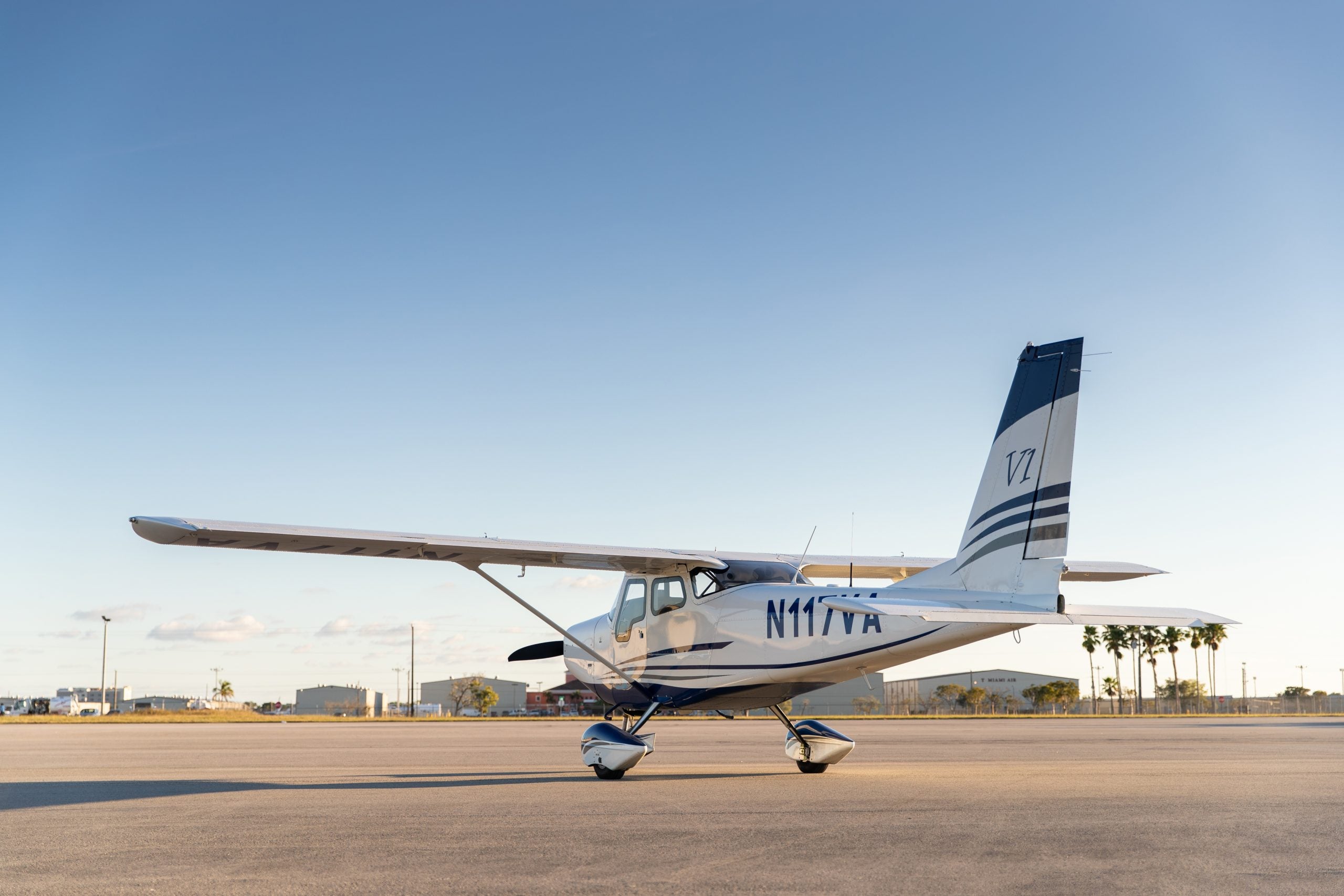
The V1.0 has a shortish wing, just 32 feet and change in span, with a wide chord and thick airfoil. The result is an airplane that can slow down nicely, climbs great and has book numbers in cruise that are better than the Skyhawk.
In flight, this little Italian single is an absolute delight. From shortly after liftoff, it just cries out to be flown, and Ramon was just fine with me flying it. We did Dutch rolls, steep turns, slow flight, stalls dirty and clean, and power on and power off. Aerodynamically, it’s as honest as the day is long. And it is not a feet-on-the floor kind of airplane, and I love that about it. In order to do coordinated turns, you need to use rudder, and the amount of rudder and the timing of its application change depending on which direction you’re turning. It’s not a plane that needs a lot of rudder, but it needs some. This, in my opinion, is exactly the thing that new pilots can benefit from, an airplane that requires you to use the rudder, because only then can you train a pilot to use it when it’s necessary, like when the chips are down.
Not that the V1.0 is a hard airplane to fly. Far from it. The feel is delightful. Again, like Mooneys, it features pushrod controls for silky smooth hand flying. You need to know how to use a constant-speed prop, which takes a little training, some knowledge of the system and some attention to detail, all traits you want to teach new pilots. And you need to know how to use the rudder. Ditto to that one.