










At 27, I think I’ve mastered the art of being cautiously optimistic, with a healthy dose of skepticism thrown in for good measure.
Over the years, I’ve lost friends and mentors in the aviation business to aircraft accidents, climbed into airplanes with people I probably shouldn’t have, and flown aircraft I didn’t entirely trust.
As a result, I tend to approach new airplanes, products, and opportunities with a bit of caution. So, when CubCrafters unveiled its turbine-powered Carbon Cub ULT in July, my usual reservations were quick to surface, especially knowing there was a good chance I’d be among the first to fly it.
Granted, with a couple hundred hours spent flying various airplanes across the CubCrafters lineup, I was already familiar with the brand, the people behind it, and the airplanes themselves. I knew what the manufacturer was capable of building, and quite frankly, I absolutely adored those happy-faced airplanes.
But a turbine-powered Carbon Cub? That was an entirely new matter.
So, when Jackie Burch of CubCrafters reached out with an invitation to Yakima,Washington, to try the ULT on for size, I was thrilled. But I’d be lying if I said I wasn’t a bit anxious. The thought of climbing into a preproduction aircraft with just over 100 hours on it, should be enough to heighten any of our aeronautical decision-making senses.
It’s Turbine Time
I’ll be frank. I came into this demo looking for every opportunity to pick apart the ULT, which stands for “Utility Turbine.”
Like so many of you, I was naturally concerned about turbine lag. Not to mention whether that extra foot of cowling would make the airplane feel uncharacteristically heavy. But my biggest concern was complexity.
Would my 200 hours of piston powered Carbon Cub experience be enough to make me feel comfortable in a turbine powered airplane within only a few hours of flight time?
So naturally, that was among the first questions I asked CubCrafters vice president Brad Damm on the morning of my arrival.
“Well, you’re just going to have to find out,” he said.
Not exactly the reassurance I was looking for.
Fortunately for Damm, I had developed a level of firsthand trust in CubCrafters that I haven’t quite developed with many other manufacturers. While his answer wasn’t particularly comforting, I was willing to give him the benefit of the doubt.
With a plan of attack set and briefing behind us at the manufacturer’s main office, Damm and I drove over to the CubCrafters show hangar, home to the ULT, an NXCub, and two Piper J-3 Cubs scheduled to be given away next year as part of the Jim Richmond Backcountry Aviation Foundation raffle.
I couldn’t help but laugh at the contrast. Who would’ve thought two little J-3s would eventually share a hangar with a nosewheel Cub and another powered by a turbine?
“All right, would you like the honor of putting jet-A in a Cub?” Damm asked as he pulled the fuel barrel to the front of the hangar.
“Well, that’s something I never thought I would hear,” I replied.
Donning a pair of black rubber gloves, I climbed atop the Alaskan Bushwheels and topped off both 22-gallon wing tanks, all the while inhaling the unmistakable smell of a fuel I’d spent my entire flying career being taught to keep far away from—in my usual, piston-powered GA flying contexts, of course.
With fueling complete, Damm pushed the ULT out of the hangar, and I climbed into the back seat for a familiarization flight. Working our way line by line through the checklist, I watched as Damm walked through the unfamiliar starting procedures from the front seat.
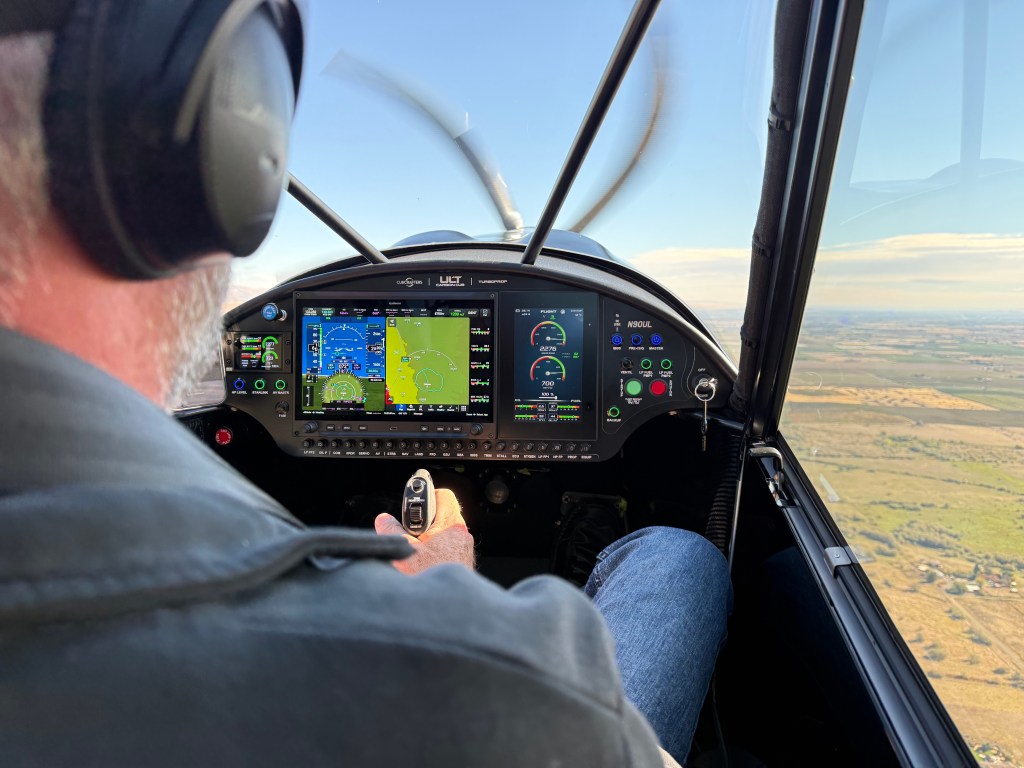
A few things looked familiar, including the integrated battery backup system (IBBS), avionics master, fuel pumps, and a somewhat familiar ignition and key. But that was about where the similarities ended.
Instead of switches, the ULT featured backlit buttons, while the lighting controls and some of the circuit breakers had swapped places. Although it took me a moment to get my bearings, I quickly grew to appreciate the new buttons and overall cockpit layout.
In addition to a few cockpit switcheroos, there was an entirely new addition—a dedicated Starlink button on the left side of the panel, controlling the aptly named “Backcountry Wi-Fi” system housed in the left wing.
However, the most noticeable change to the panel was the dedicated display to the right of the Garmin Axis, used specifically to monitor the Turbotech TP-R90 engine.
Watching from the back, I grinned as Damm pressed the green start button, and the turbine roared to life. I closed my eyes, letting the unmistakable whine of the turbine prop wash come over me. For a moment, I could have sworn I was in a TBM or Kodiak, not strapped into the aft sling seat of a Carbon Cub.
Reaching high and to the right, Damm closed the window and door, and we were on our way.
First Feel
“The run-up is simple,” said Damm as he applied 50 percent power, indicated by a simple bar on the bottom of the Turbotech engine display. “You just have to go to 50 percent for five seconds, make sure everything is in the green, and then you’re done.”
“Wow,” I said as I felt the Carbon Cub attempting to levitate as Damm stood on the brakes.
Admittedly, I had anticipated some shaking, rattling, and general discomfort at 50 percent power. After all, this was still a preproduction, tube-and-fabric airplane with a turbine strapped to the front. But to my surprise, there was none. The airframe handled the turbine’s power with ease, something I found particularly reassuring as we entered Runway 27 at Yakima Air Terminal/McAllister Field (KYKM).
As Damm lined up on the centerline, he reached up and to the left, engaging the flap handle. From there, he smoothly advanced the power, and I listened to the strangest combination of two worlds colliding. A tube-and-fabric taildragger had mated with a turbine powerplant.
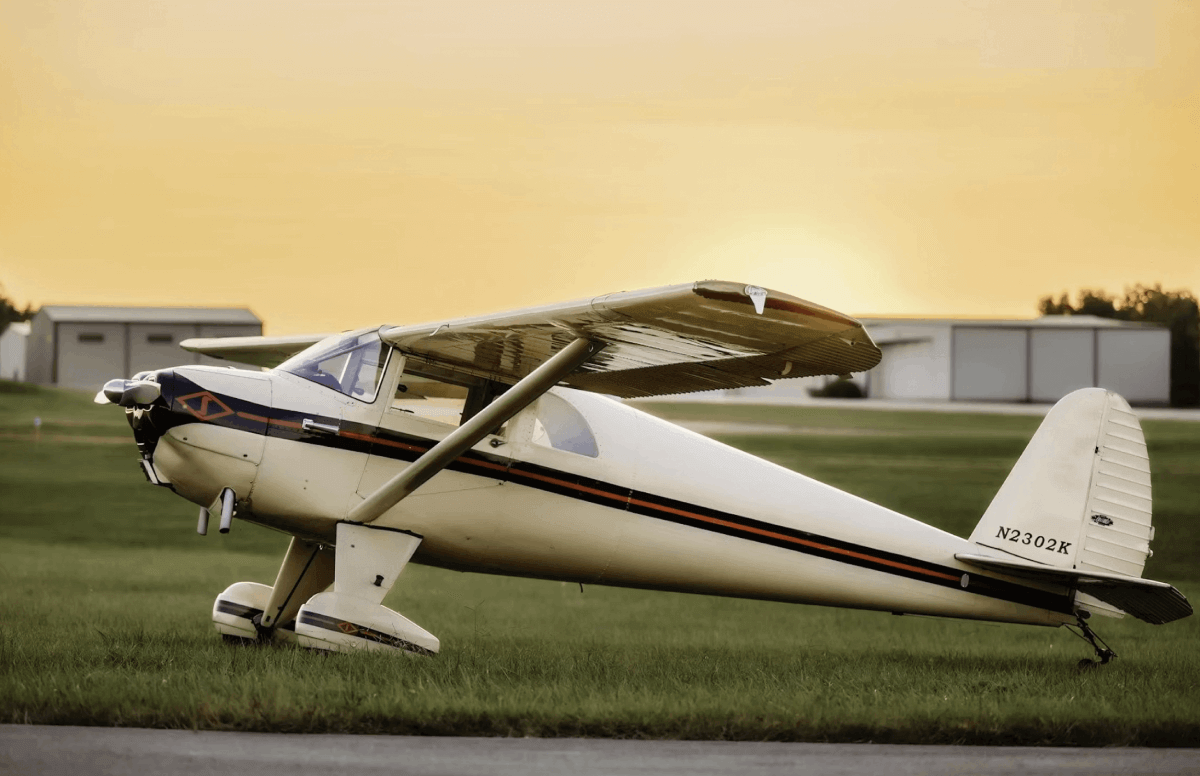
Although it has been done before, in a turbine-powered Luscombe and even a Great Lakes in many years past, it was still a world I never would have dreamed up.
Within about “three Mississippis” of applying full power, Damm eased back on the stick, and we rotated around 41 mph. To be honest, I hadn’t even noticed him bring up the tail. I was too preoccupied with experiencing one of the weirdest, coolest sensations I’d felt in a long time.
On paper, the Turbotech is minimally rated for 141 hp, which might not sound particularly earth shattering, especially in the world of high-performance, backcountry airplanes. But as Damm explained horsepower alone doesn’t tell the whole story.
“We care about thrust,” he said. “It is thrust that moves aircraft, and turbines in general can make more thrust with less horsepower because they have more torque. Torque is the actual twisting force that is applied to the propeller through the shaft, and the more twisting force you can generate, the more blade area you can have on a propeller, and thereby the more thrust you can make.
“In this case, the Turbotech engine has something like 20-25 percent more torque than a comparably sized piston engine.”
In other words, there’s more to the ULT’s performance than its horsepower rating might initially suggest. After experiencing the turbine’s takeoff performance firsthand, I was beginning to understand why.
Looking over Damm’s right shoulder, I studied the engine display as he told me about the various indications, all of which were still in metric units, that will be converted to imperial units before the airplane is delivered to customers.
One important distinction was that the throttle percentage displayed at the bottom of the screen didn’t necessarily correspond to the engine’s output in kilowatts, shown in the upper right corner of the engine display.
“Kilowatts is just the metric unit that corresponds to horsepower here in the U.S.,” Damm said. “It sounds more exotic, but each is just a measure of the potential work an engine can do over time.”
That distinction became particularly interesting later in the flight as we climbed to higher altitudes, as the Turbotech does experience some power loss with altitude, although Damm noted it’s only about 1.5 percent per every 1,000 feet.
After five minutes of full power, which the turbine is rated to, Damm pulled back on the power, and we cruised along the Yakima Valley to a nearby grass strip.
Sitting in the back seat, I kept waiting for more instruction from Damm in preparation for my transition to the front seat. More “watch for this” or “be careful of that.” But there was simply nothing else to add. Pick your power setting, burn as much or as little fuel as you’d like (at 95 percent throttle power we were burning 43 liters per hour, or roughly 11.4 gph), and fly the airplane. No propeller adjustments, caution ranges to dance around, or complicated engine management procedures. Just the same straightforward flying experience I’d come to expect from a Carbon Cub.
As we neared the grass strip, Damm began his descent and entered the pattern in typical Cub fashion. Around 75 mph on downwind, a notch of flaps abeam the imaginary numbers, 65 mph on left base, and around 58 mph, or slightly slower, on short final.
Again, since I was sitting in the rear sling seat as an observer, I wasn’t exactly in a position to pick up on any distinct handling differences. That is, until we started getting down toward treetop level.
It was here that I felt Damm add a touch of power, and I began to realize that flying the turbine-powered ULT might require a little more thinking ahead than what I was accustomed to in a piston-powered Carbon Cub. I wouldn’t necessarily describe what I felt as a lag in power response, but rather a sweet spot in the throttle that would take some getting used to. A little too much input could result in more power than intended, and unlike the relatively familiar throttle response of a piston-powered Cub, the turbine seemed to demand a slightly more deliberate touch.
Touching down in a nice, three-point attitude, Damm brought us to a stop before spinning the airplane around for another takeoff.
Following another uneventful, Cub-style departure, Damm asked if I’d like to see a power-on and power-off stall.
My answer was an enthusiastic yes.
I was particularly curious to see whether hanging a turbine on the nose of a Carbon Cub would turn the airplane’s typically uneventful maneuvers into something a little more aggressive, or perhaps a little less forgiving.
Pulling back on the power, Damm raised the nose, and waited for the break. Around 43 mph, the airplane stalled in a familiar and forgiving fashion. Adding power and bringing the nose back to the horizon, the recovery was also exactly what I expected.
Although I wasn’t recording our power-on stall to confirm the exact speed at which the airplane broke, I can confirm that it, too, was a nonevent. Admittedly, though, it was considerably more uncomfortable than the power-off stall, mostly because the nose felt like it was pointed straight at the moon.
“Alright, I think you’ve seen everything you need to see from back there,” Damm said. “Are you ready to climb up front?”
“Absolutely, let’s do it,” I replied.
With that, we headed back to Yakima, where Damm made another uneventful landing on Runway 9 before taxiing back to the hangar so we could swap seats.
My Turn
With me now settled into the front seat and Damm standing outside the airplane, he walked me through the turbine’s start-up procedure. From start to finish, the process took about two minutes. Although, as I became more comfortable and confident with the procedure later in my training, I found that I could have the turbine up and running closer to the one-minute mark.
With the fuel selector positioned to the fullest tank, I reached up to the right side of the panel and pressed the IBBS button, followed by the precharge button, which I held for 10 seconds. Still holding the precharge button, I pushed the master and backup button and waited for the electronic control unit (ECU) to power up.
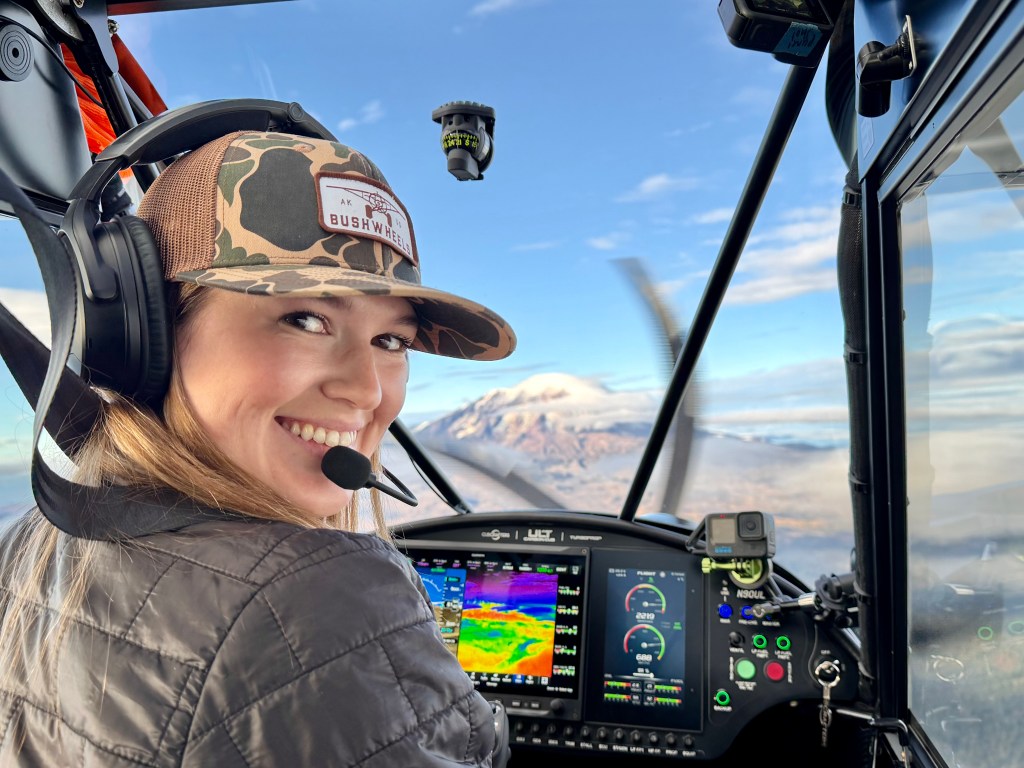
From there, I turned the key to the on position, verified that the battery was indicating between 26 and 27 volts, checked for any warnings or annunciations on the display, and confirmed that the exhaust gas temperatures (EGTs) were below 450 degrees. After ensuring the ventilate button was off, I switched on fuel pumps one and two, looking for an indication between 7 and 8 psi.
With everything looking good, I held the stick back and pressed my toes firmly against the tops of the brakes and held down the green start button. From there, I watched as the Turbotech engine monitor automatically cycled through its six start-up stages.
“You’re in flight mode, you’re on target, and you have no warning annunciations,” Damm said as he climbed into the back seat.
Laughing like a little schoolgirl, I reminded myself that it was just an airplane. And not just any airplane, but one modeled after ones I already had a couple hundred hours in. Still, as the turbine whined and purred its rhythmic tune, I couldn’t help but grin.
As I taxied between the hangars toward the run-up area, I immediately noticed one distinct difference beyond the unfamiliar sounds coming from up front. This Carbon Cub had significantly better forward visibility than its piston-powered siblings.
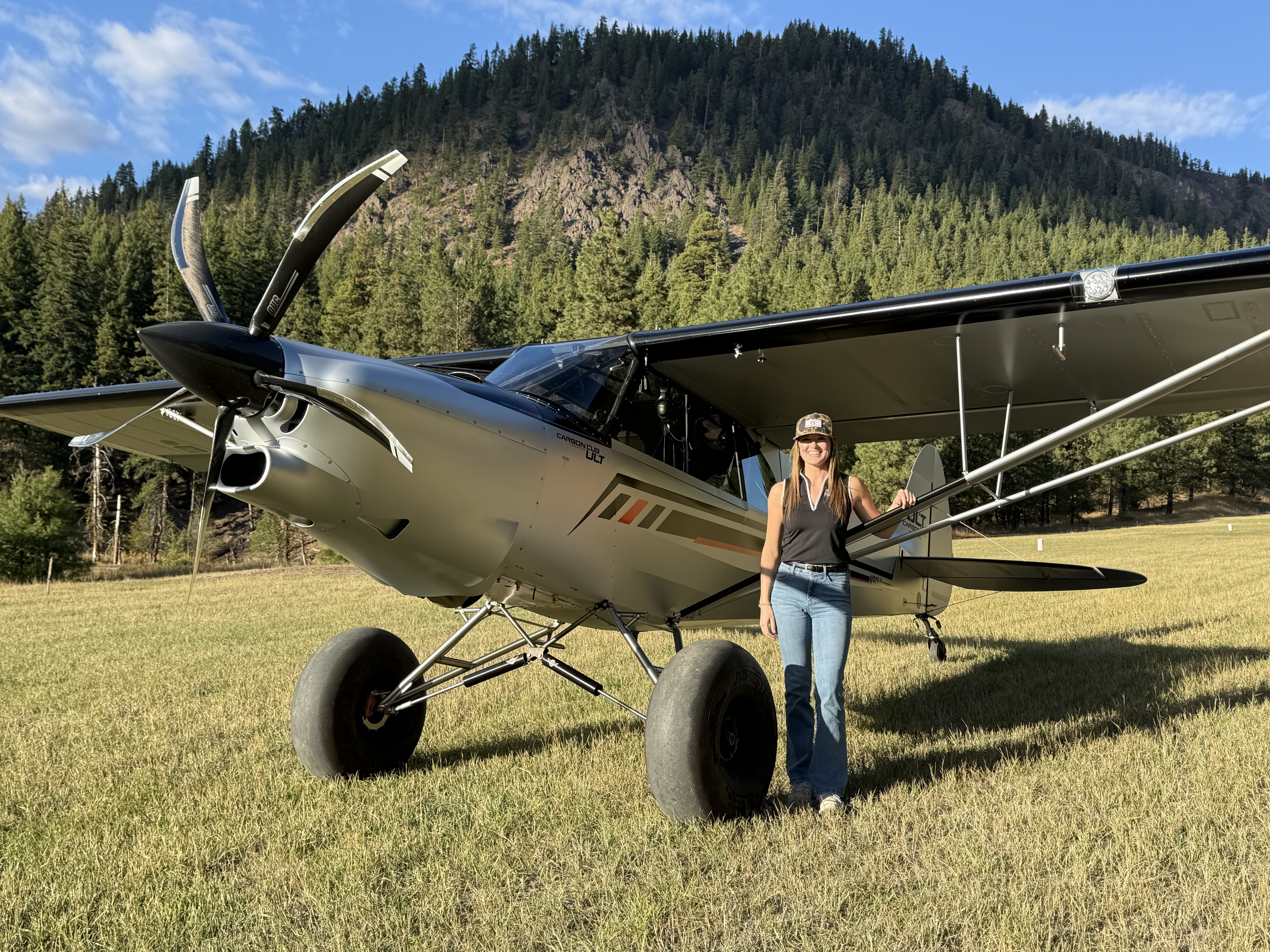
At 5-foot-4, I could almost entirely avoid S-turning while taxiing, something I certainly can’t say for the vast majority of my other Cub time. The ULT’s cowling is noticeably sleeker and narrower along the sides, without the large air inlets found on traditional piston-powered Carbon Cubs. The difference in visibility was remarkable.
Aside from the additional visibility, and a throttle that felt just a touch more sensitive than what I was accustomed to, the airplane taxied and handled exactly like the Carbon Cubs I already knew.
Once we reached the run-up area, Damm once again gave me a rundown of the procedure, which, honestly, I have a hard time even calling a run-up.
“Alright, hold the brakes really hard, and just take it up to 50 percent power for five seconds,” Damm said from the back seat.
As Damm instructed, I firmly held the brakes, slowly advanced the power to 50 percent, and monitored the engine indications to make sure everything stayed in the green.
Five seconds later, with no warnings or annunciations, the run-up was complete.
After checking the flight controls, picking up the ATIS, and contacting ground, I taxied toward Runway 27.
With my takeoff clearance secured, I added a notch of flaps, lined up on the centerline, and gave the rudder pedals a quick tap-tap to straighten out the tailwheel.
“All right, are you ready to go?” I asked Damm.
“Let’s do it,” he replied.
With the biggest smile on my face, I slowly applied full power. Rather than staring at the airspeed tape on the Garmin Axis like I did from the back seat, I let the turbine-powered beast tell me when she was ready to rotate.
Within a second or so, I pushed forward on the stick and raised the tail. Although I was expecting the ULT to demand a large amount of right rudder, that wasn’t the case at all. It was the normal rudder input I was used to making in any of the Carbon Cubs I had flown before.
A second or two after raising the tail, I rotated. Though I probably waited slightly longer than I should have, this was a brand-new, preproduction airplane after all, and I was definitely erring on the conservative side.
Climbing away from the runway, I laughed and audibly and enthusiastically announced, “Wow, I’m flying a turbine!”
While climbing up to around 2,500 feet, I let the airplane stay at full power for up to five minutes, however, we did reach our altitude well before the five-minute mark. From there, I pulled it back to around 80 percent power. With 11 knots on the nose, I was indicating a true airspeed of 81mph and burning about 36 liters per hour, which translates to about 9.5 gph.
This was a just fine airspeed to cruise around and get to know the airplane through a series of turns and maneuvers on the way to my first landing at Sunnyside Municipal Airport (1S5).
Setting up for a left downwind, for Runway 07, I flew the pattern the same way I would fly any Cub pattern, just a touch higher and wider to account for not knowing the airplane well, although I felt like I would get to that level of comfortability quickly.
Turning base at around 65 mph, I added the second notch of flaps and slowed to approximately 60 mph on a mile-long final.
Having spent plenty of time in the Carbon Cub FX-3, I was somewhat expecting a similar sensation when I pulled the power back, where reducing power can feel almost like stepping on the brakes.
But that wasn’t the case at all.
As we neared the treetops at the approach end of the runway, I reached high and to my left for the final notch of flaps, bringing our airspeed down to around 55-58 mph.
“Just keep riding that power all the way in,” Damm reminded me from the back seat.
I recalled his earlier advice about the ULT liking just a touch of power carried all the way into a fully stalled, three-point landing. Now, for someone accustomed to pulling the power to idle abeam the numbers or at the runway threshold, that required a little convincing.
But I resisted the urge, held a touch of power, and slowly began my flare.
As I felt the airplane settle, I instinctively added a small blip of power to cushion the landing, only to discover just how quickly a small throttle input could translate into a whole lot more power than I had intended. Rather than fighting the sudden burst of energy, I held the stick back and let the airplane settle onto the runway in a fully stalled, three-point attitude.
Although the landing itself was largely a nonevent, I was eager to go back around for a few more touch-and-goes. Not because the airplane was particularly difficult to land, but because I wanted to get a better feel for that sweet spot in the throttle, especially when making small power adjustments close to the ground. Within another two or three landings, I was already feeling considerably more comfortable with the ULT’s throttle response and how the airplane reacted to those subtle power adjustments.
With a handful of landings under my belt, Damm and I were both feeling confident enough to take things a step further. This time, we pointed the nose toward a short, steep crop duster strip tucked into the foothills along the southern edge of the Yakima Valley.
And this was where things were about to get a little more interesting.
In Its Element
Given my confidence in the airplane and myself was growing, I flew directly over midfield before turning onto a left downwind for the strip. Even from the air, I could tell just how steep the runway was. If it looked that steep from above, I could only imagine how dramatic it would appear as we got closer to the ground.
Turning a tighter base-to-final than I normally would at a typical county airport, thanks to the hills quickly filling my windscreen and a rather angry female voice yelling “terrain!” through my headset, I added another notch of flaps and let the ULT do what Cubs do best—take me somewhere with scenic views and nobody around.
“Everything looks good to me,” Damm reassured me from the back seat as I approached the lower end of the runway, which was distinguishable from the surrounding terrain by little more than a strip of freshly mowed grass.
“Wow, this is steep. I’m going to carry a little more power than I normally would,” I replied, gently nudging the throttle forward while easing back on the stick to settle the airplane into the flare.
Although I wish I had some sexy revelation to report after my fifth or so landing in the ULT, my biggest takeaway was something far simpler: at its heart, this airplane is still very much a Cub. And frankly, I couldn’t have been happier to discover that CubCrafters had managed to introduce an entirely new powerplant without sacrificing the personality and flying characteristics that made me fall in love with the Carbon Cub in the first place.
Looking off to my left, the runway dropped off dramatically into the valley below. Oh, how I would’ve loved to point the nose in that direction and experience the thrill of flying off the side of a cliff. Unfortunately, the wind had other plans. So, resisting the temptation to make a downwind departure just for the experience and thrill, I spun around the ULT and took off toward the hills.
Turning crosswind, I raised the flaps and banked the airplane smoothly, yet aggressively, to the left and climbed around the mountains toward our next destination—Tieton State Airport (4S6), bordering Rimrock Lake and two wilderness areas in the Washington state backcountry.
With the Twin Sisters Mountain Range stretching out in nearly every direction, I glanced down at the Garmin Axis and punched in 4S6. Admittedly, after a few hours behind the new display, it was starting to grow on me. When I first encountered the Axis, I wasn’t exactly a fan, especially being as attached to the G3X as I am. But like most things a little time and familiarity can go a long way, and I was finally beginning to appreciate it.
Cruising at around 6,600 feet with the throttle set to 75 percent, we were seeing true airspeeds of approximately 103 mph with an 11-knot headwind. With about 20 minutes to go before reaching Tieton State, I took the opportunity to engage the autopilot, which took all of a few seconds.
Although some purists might vehemently disagree with the idea of an autopilot in a Cub, I’m here to challenge that thinking. Sure, these modern-day Carbon Cubs are built to fly and be enjoyed like Cubs, but they’re also designed to take you just about anywhere this country has to offer. If that means flying from Texas to Idaho for a summer backcountry adventure, having a capable autopilot along for the ride is a nice tool to have in your toolbox.
With Rimrock Lake coming into view off the nose, I took a moment to soak in the surrounding wilderness and rugged terrain. I couldn’t help but think this was exactly where the ULT belonged.
“See that big gap in between the rocks?” Damm asked as I began to near Tieton State. “Yeah, I’ll go right in between the two,” I replied.
Descending from 6,600 feet, I stared in awe as I guided the ULT into some of the most spectacular scenery I’d seen since my summer adventures in Idaho had wrapped up about a month or so before. With Rimrock Lake stretching out ahead of us and towering rock formations rising well above the ULT, Damm talked me through the approach to the airport, which was still tucked out of sight between the mountains.
“Come around this peninsula, follow the water, and you’ll be on short final,” Damm said as I added a notch of flaps and slowed toward 70 mph.
Rounding my way around the peninsula, I stayed a touch higher than normal, mostly because I had yet to see the runway. But as soon as the edge of the grass came into view, I added the next two notches of flaps and pushed forward on the stick.
At 2,500 feet long, Tieton State offered far more room than the ULT needed. We touched down and rolled out in just a couple hundred feet, and admittedly, I wasn’t even close to exploring the airplane’s limits.
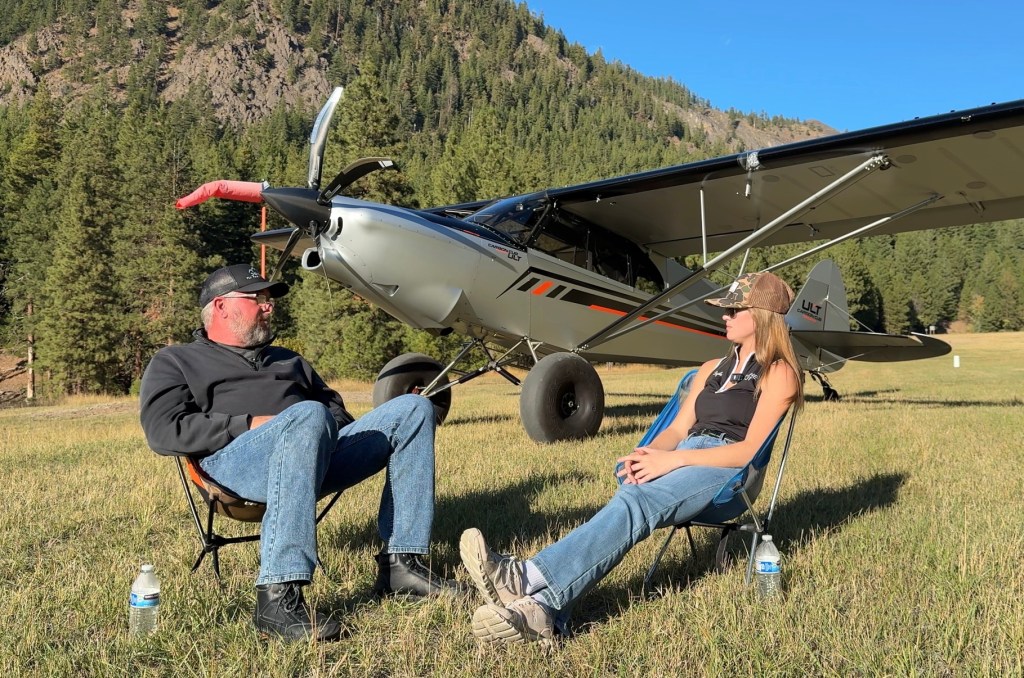
After shutting down, Damm and I hopped out to soak in the scenery and enjoy a few moments of solitude. To me, this is what flying Cubs is all about.
After filming a podcast episode at the airstrip, we hopped back in and made our way toward Mount Adams to check out the glaciers and see if we could spot any mountain goats, which, much to our delight, we did.
Feeling rather small against the massive mountain, I asked Damm how high I might be able to climb to get a better feel for the turbine’s performance at altitude.
“We’ve tested it up to 10,500 feet,” he said.
With that, I pushed the power forward. Having spent plenty of time behind turbocharged piston engines, I found the turbine’s power delivery a bit more gradual than what I was accustomed to. Even so, within five minutes, we had climbed to 10,500 feet.
Once level, we were indicating 95 percent on the throttle, translating to 67 percent power in kilowatts. With a 14-knot headwind coming from the left, we were seeing a true airspeed of 114 mph while burning approximately 31 liters, or just over 8 gallons, of fuel per hour.
Of course, there’s a case to be made for different powerplants depending on the mission, but the ULT’s turbine engine brings an entirely new set of advantages to the backcountry pilot.
For starters, there’s the ability to burn jet-A, which is widely available around the world and a pretty compelling selling point in itself.
Add in the opportunity to start logging turbine time from the day you bring it home, without the need for a turbine-specific type rating or endorsement, the potential reliability advantages of turbine power, and a cool factor that’s almost impossible to put into words, and you’ve got a combination unlike anything we’ve seen in a Cub before. Perhaps most impressively, CubCrafters has managed to pull it all off without sacrificing the familiar handling, personality, and flying characteristics that have defined its airplanes from the beginning.
Sure, there will always be skeptics and purists who question the idea of a turbine-powered Cub. But by pairing a traditional tube-and-fabric taildragger with modern turbine technology, CubCrafters is proving that innovation doesn’t have to come at the expense of tradition.
And apparently, there are plenty of people willing to bet on that idea. With nearly 20 deposits placed on an airplane carrying a starting price of $690,000, the ULT has already attracted its fair share of believers. The catch? Not a single one of those customers has had the opportunity to fly it yet.
So, for those who have put their faith, and a considerable amount of money, in a brand they know and trust, I’m happy to report that after arriving as something of a skeptic myself, I walked away as a ULT believer.