









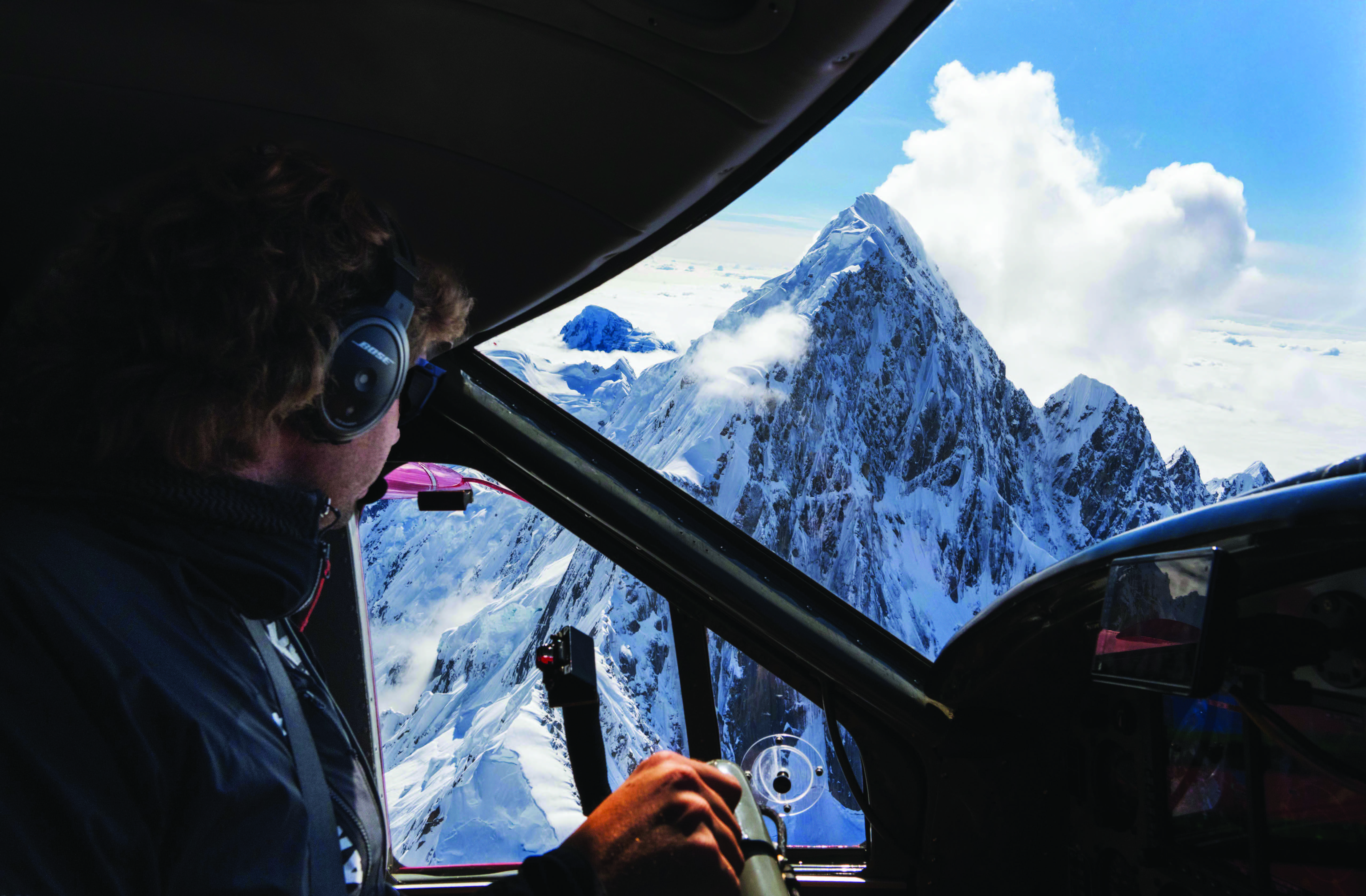

Riley Martin has what many pilots would call a dream job. As K2 Aviation’s chief pilot, his office is the cockpit of a de Havilland Canada DHC-3 Otter with a 750 hp Pratt & Whitney PT6A-34 turbine engine—what many consider the ultimate bush aircraft.
While Martin said the wild, swashbuckling, action-packed, and even romantic images and stereotypes that some people associate with backcountry aviation in Alaska are far from accurate, he added that the challenging weather and terrain of the region make his job especially gratifying. When the daily routine involves flying passengers around mountains and onto glaciers in a well-planned and safe manner, “your skills as a pilot matter.”
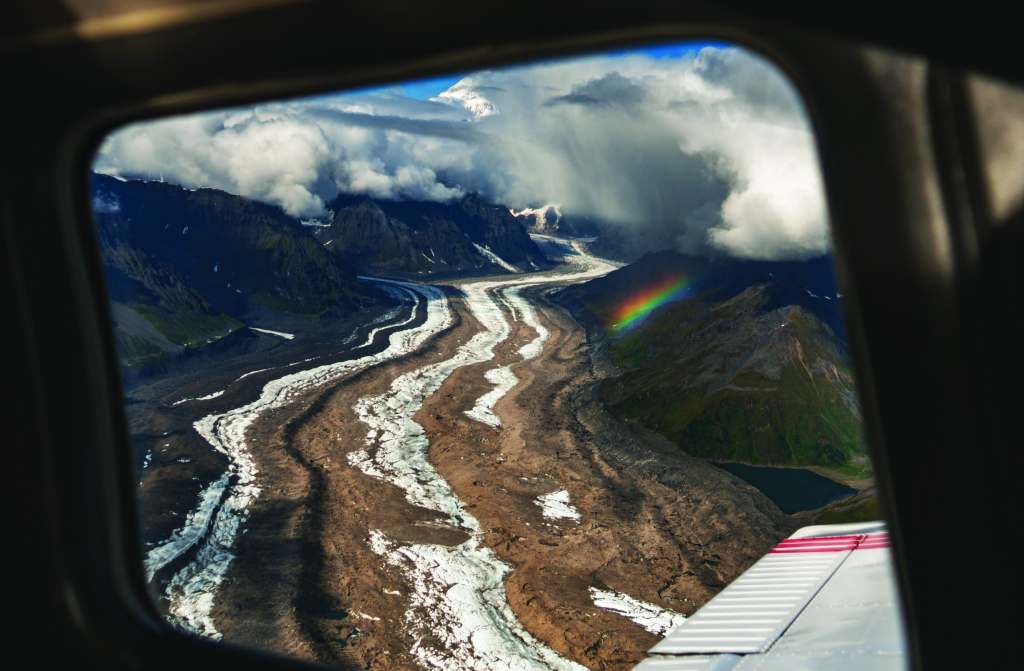
K2 is based in Talkeetna, Alaska, which has long served as a gateway for climbers, tourists, and others visiting Denali, the highest peak in North America at more than 20,000 feet. The Denali National Park & Preserve includes the 600-mile Alaska Range of mountains that includes Denali, 17,000-foot Mount Foraker, and numerous glaciers.
- READ MORE: Meet Alaskan Bush Pilot Stephanie Blanchard
Hank Rust moved his family to Alaska in 1959 and founded Rust’s Flying Service floatplane operation in Anchorage in 1963. His son, Todd, grew up working as a dock hand for the family business before becoming a pilot. After college he worked as an aeronautical engineer for Northrop Grumman and Lockheed Martin.
Rust rejoined the family business in 1983 and now serves as director of operations, overseeing 40 pilots and 23 aircraft. His wife, Suzanne, who began her aviation career working at the National Transportation Safety Board’s Anchorage regional office, is the company’s station operations manager. K2 and Rust’s are divisions of the same company, with K2 handling ski operation in Talkeetna while Rust’s continues the original floatplane business.
In addition to custom charters, K2 offers a range of standard “flightseeing” trips around Denali and surrounding glaciers, from the basic “Denali Experience” to the premium “Top of the World Tour.” The K2 fleet includes four turbine Otters, three de Havilland DHC-2 Beavers, two Cessna 185s, and a Piper PA-32 Cherokee Six. Martin said the Otters are K2’s “workhorses,” with the most power and useful load in the group by far.
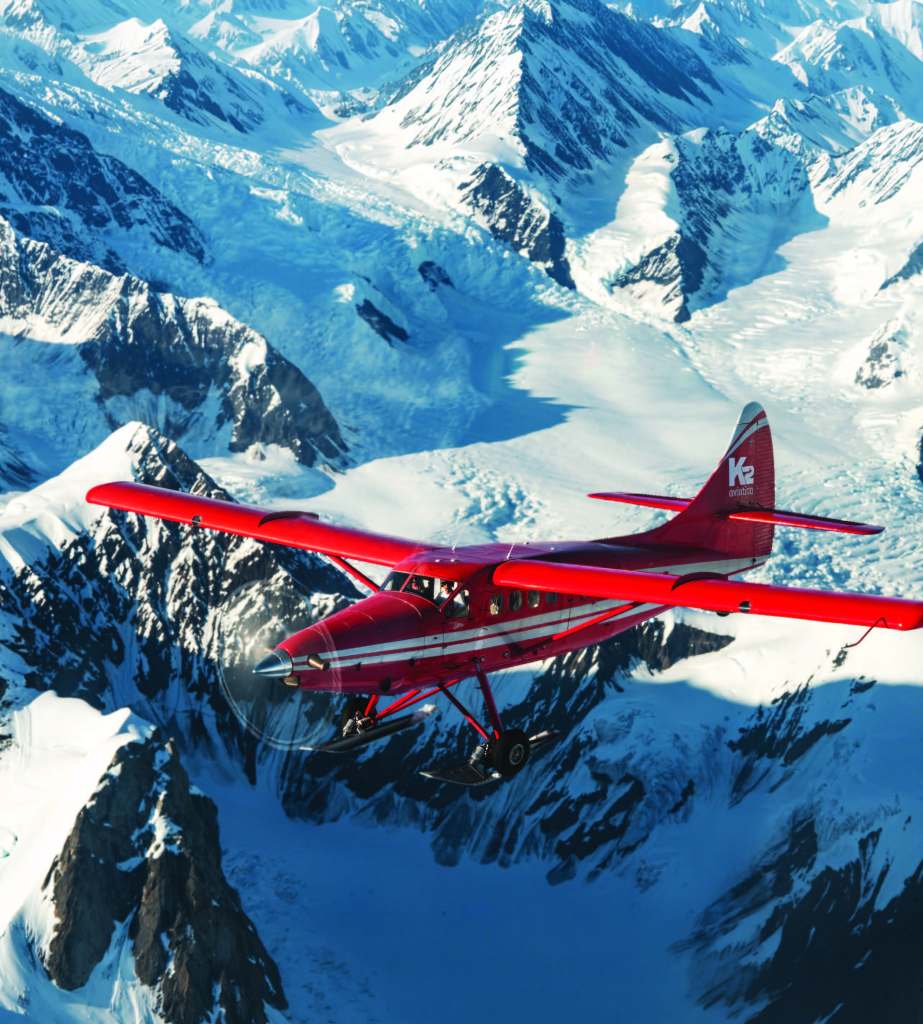
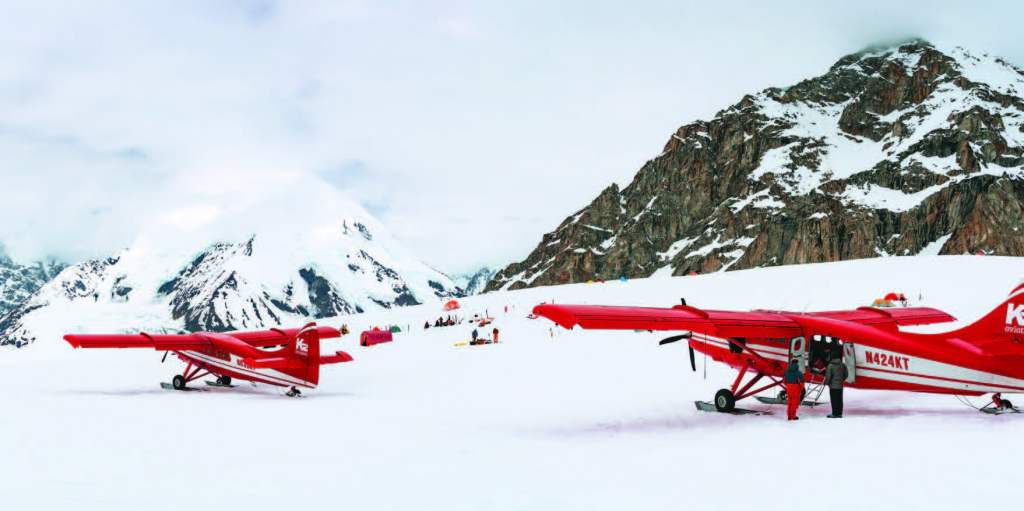
Martin’s typical missions include taking climbers and their gear to the Denali base camp at an elevation of 7,200 feet or flying up to 10 tourists on sightseeing flights, many of which include landings on the Kahiltna Glacier and other glaciers on and near Denali. Such excursions combine several challenging factors for pilots, from flying in mountainous terrain to landing and maneuvering an aircraft on skis over snow-covered and icy surfaces.
Unlikely Path
Martin, who did not grow up in an aviation family and had flown only once, in a King Air on a high school trip, traces the origin of his nonstandard flying career path to a ride with a family friend in a ski-equipped Aviat Husky about a decade ago.
Frustrated by an uninspiring college experience, he was searching for work that felt rewarding and had a future. As the Husky, nimble, rugged and practical, repeatedly took off and touched down on snow-covered fields, often in areas that seemed impossibly constricted and bristling with obstacles, Martin saw the light.
“It was just a really good fit,” he said.
Soon he would characterize flight training in the same way but not before a few twists and turns.
“My original plan was to apply to the UAA (University of Alaska at Anchorage) Merrill Field Part 141 program,” Martin said.
But Part 141, which takes a more prescribed and regimented approach to fulfilling the FAA’s requirements for pilot ratings, is not ideal for everyone pursuing work as a professional pilot.
“I realized that through Part 61, I could get ratings much faster,” he said.
Eventually, he wound up as a CFI instructing some of the pilots from the same 141 class he would have attended.
Martin trained in Cessna 172s and honed his tailwheel skills in a Piper PA-14 Family Cruiser, a type that seems to be extremely rare everywhere except in Alaska. Soon he was flying a Cessna 207, another odd model that is common in Alaska, for an air taxi company in the western part of the state. After building hours there, he applied for jobs at K2 and other tour and air taxi operations in Talkeetna but received no callbacks at first.
He was considering other options when the former chief pilot at K2 gave him a call. The timing was good.
“He asked, ‘When can we meet?’ and I said, ‘How about noon,’” Martin said. “He didn’t realize that I was local.”
Martin believes the fact that he lived in town helped him get that first job with K2. It also benefited him that a pilot shortage had taken hold around 2016-18 following the adoption of a 1,500-hour requirement for new airline pilots coupled with a wave of mandatory retirements. The two factors combined to severely stress the pilot pipeline.
Later, during the post-pandemic hiring boom, when K2’s chief pilot was ready to retire, many other local bushplane pilots had departed for airline jobs. Martin, who was less interested in airline work, found himself with an advantage and earned the promotion to chief pilot.
“That was a case of right place, right time,” he said. “I was the best person who was still around.”
Honoring Tradition
Long before backcountry flying became a growing pastime for adventurous private pilots, it was simply a way of life for Alaskans. In many remote parts of the vast territory, later to become the 49th state in 1959, airplanes have been aiding mobility and industry since the end of World War I.
In many ways, the beginning of aviation’s golden age was the same in the wilds of Alaska as in the rest of the United States and its territories.
During the 1920s, airplanes were front and center in a broad federal plan to provide faster, more-efficient mail service by air. Many of the first aviation pioneers to make names for themselves in rugged Alaska were airmail pilots, and they set the bar for the type of aviators who continue to thrive in the frozen north.
Legendary Pilots
In 1924, Carl Eielson was credited with flying the first official airmail delivery in the Alaska Territory. The route was from Fairbanks to McGrath, a remote-yet-important point in its transportation network.
Like much of the territory then and now, McGrath was sparsely populated and lacked roads connecting it to other communities, yet it served as a hub for supplying the area’s vast, rugged interior.
Aircraft of the 1920s, which now might seem primitive, were technical wonders at the time and represented a major upgrade over its main competition—the dog sled. Airplanes could make trips in a few hours that took days by railroad or dog sled.
Airmail soon led to airlines, which mixed mail and passengers in ever larger, more-capable aircraft capable of covering longer distances. Still, as is true today, much of the air transport in Alaska is done in relatively small aircraft on a more personal basis than in the contiguous states.
Noel Wien is a name that comes up often when discussion turns to the history of aviation in Alaska. Indeed, many consider him the father of Alaskan bush flying. As a pilot, Wien seems to check a lot of enviable boxes. He received his pilot’s certificate in 1925, signed by renowned first-powered-flight pilot Orville Wright, who was an official with the Federation Aeronautique Internationale at the time.
Working for a string of air-transport operators, Wien carved out new routes across Alaska and beyond. He was credited with the first flights from Fairbanks to Seattle, Fairbanks to Nome, across the Bering Strait and beyond the Arctic Circle. He also was the first pilot to fly round trip between Alaska and Asia.
He and his brothers, Ralph and Sigurd, founded Wien Alaska Airways, the territory’s first airline and one of the first in the nation, in the late 1920s. Often called the “Arctic Ace,” Wien later pioneered operations of jet transport aircraft on gravel runways and developed innovative methods for carrying cargo and passengers on Boeing 737 airliners, according to the National Aviation Hall of Fame, where Wien was enshrined in 2010.
Through partnerships, mergers, ownership agreements, name changes, and Noel Wien’s death in 1977, the airline, later Wien Air Alaska, continued into the ’80s.
Talkeetna bush pilot Donald Sheldon is famous for pioneering the technique for landing on glaciers during the 1950s and ’60s. His company, Talkeetna Air Service, ferried hunters, fishing enthusiasts, climbers, and others to destinations not accessible by ground transport. Sheldon also took part in civilian and military search-and-rescue operations and received the Alaska Certificate of Achievement for his work.
Sheldon and his contemporaries did not have souped-up, purpose-built bush aircraft like those available today. He flew Piper PA-18 Super Cubs, Cessna 180s, and Aeronca Sedans. One has to wonder what he might have accomplished with a turbine Otter.
Martin said Sheldon’s story is a big part of Alaskan bush-flying legend. His father-in-law, Robert Reeve, a pilot who later founded Reeve Aleutian Airways, also played a big role in advancing bush flying in the region.
“According to legend, Bob Reeve took a bar top and cut it in half to make skis and used them for landing on glaciers,” Martin said. “Then Sheldon brought the technique to the Alaska Range.”
Both men probably deserve credit for developing the landing procedure,“but Sheldon was a better marketer, and he was by far the boldest pilot.”
Learning the Ropes
Martin uses the storied landing technique daily for dropping sightseers off on glaciers.
“The technique is pretty straightforward,” he said. “You are trying for a nice, tailwheel-type landing, but you are landing uphill, so you have to keep the power on to avoid stopping and getting stuck after touching down. You might find that you need max continuous power to keep the plane moving in deep snow.”
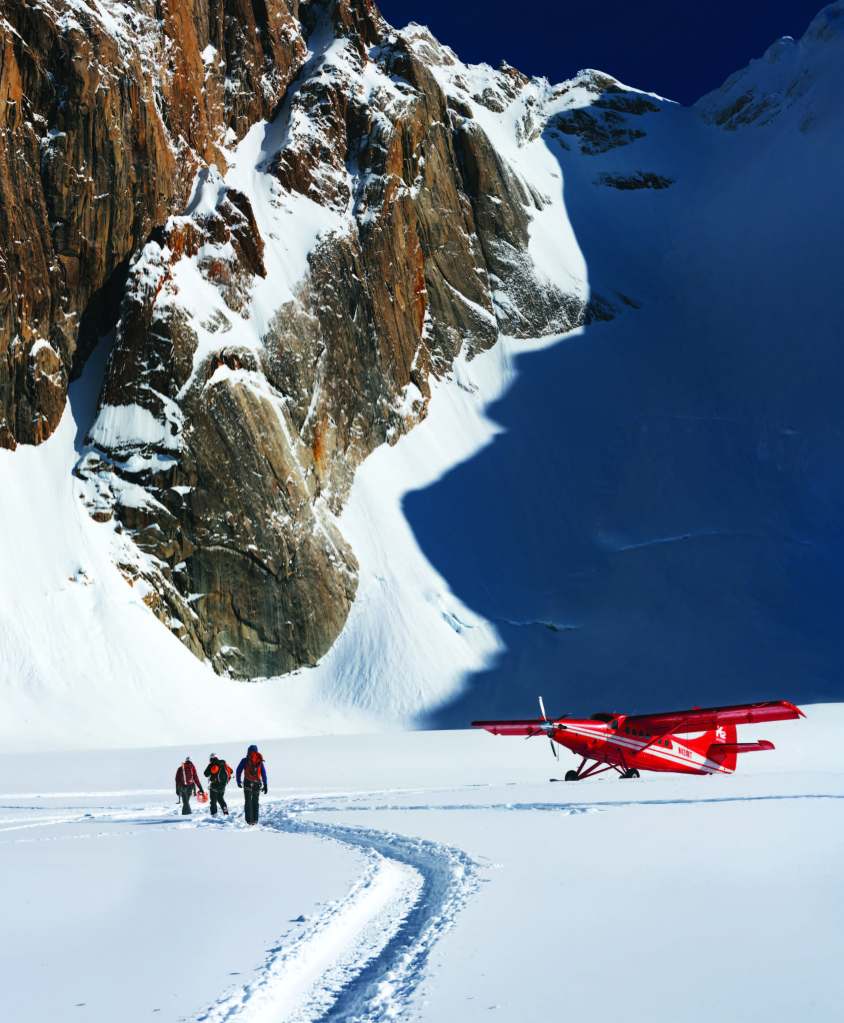
Martin said a pilot should land uphill, make a sweeping turn in the shape of a horseshoe, and take off downhill. They stop to let the passengers out at the top of the turn. Often there are so many airplanes coming and going, using the same path, that a defined track forms, making each landing a bit easier than the last.
When landing in virgin snow, which is rare, the reconnaissance before touchdown is most important to make sure the prospective landing zone is safely clear of crevasses and obstacles.
Destination for Pilots, Others
The historic town of Talkeetna sits at the confluence of the Talkeetna, Susitna, and Chulitna rivers and historically served as a gathering place for the Alaska Native Dena’ina people, who lived nomadic lives foraging and fishing along rivers in the territory’s interior. The area remained a hub of commerce for gold prospectors in the 1890s, riverboat transport in the early 1900s, and railroads by 1915.
Known as a hip, “funky” town, Talkeetna provides lots to see and do and is home to a diverse range of residents, from professional crafters and artists to elite mountain climbers, ice cream makers, and off-the-grid homesteaders. Besides sightseeing flights, the area offers guided hikes, ziplining, and jet boat rides on the Susitna River.
Ode to the Otter
While Martin has flown all of the aircraft in K2’s fleet, he spends most of his time in the turbine Otters which, he said, might represent the “best match between an airplane and its mission in all of aviation.”
Let’s think about how weighty that opinion is. It places the Otter head-to-head with legendary fighters like the North American P-51 Mustang and Grumman F6F Hellcat, the nearly untouchable Lockheed SR-71 Blackbird reconnaissance aircraft, a transport like the Douglas DC-3, which was the first airliner to carry passengers profitably, and the Boeing 737, which has taken that formula to ever-greater heights for several decades.
Martin’s viewpoint also says a lot about an airplane that few people, even pilots, really know well.
If you have not visited Alaska, chances are good that you have never seen an Otter in the wild because they rarely show up anywhere else. Yes, you can find them in the Pacific Northwest, Vancouver, British Columbia, and lesser-known, extremely rugged Canadian outposts, but Alaska truly is the Otter’s stomping ground,
On floats, the Otter arguably has competition from aircraft like the Cessna 208 Caravan. For example, you will not find Otters taking off from New York City’s East River and depositing passengers in East Hampton and Montauk on summer weekends, because the Caravan and the area’s many helicopter air taxis are ideally suited for that route.
Indeed, the Otter’s sibling, the Beaver, is the iconic, do-it-all floatplane in many pilots’ minds.
Strap on skis, though, and the Otter rises to the top. Its taildragger design makes it a natural for nimble ground handling in deep snow, where the Caravan falls short. Even the Beaver cannot touch it.
“I don’t want to upset Beaver people,” Martin said, acknowledging that aircraft’s well-earned classic status. “But when it comes to working the tourist and outdoor-sporting trade in Alaska, the Otter simply does everything a bit better.”
Size and power have a lot to do with the Otter’s success. It carries more people than the Beaver, helping it hit an economic sweet spot for commercial bush-flying operations like K2. The Otter also had its first flight in 1951, just four years after the Beaver’s, suggesting that de Havilland Canada had quickly concluded that it needed a larger, more powerful version.
“The Otter is the sequel to the Beaver,” Martin said.
Just as with movie franchises such as The Godfather, Star Wars,and Spider-Man, sometimes sequels outperform the original.
This article first appeared in the September/October 2026 Issue of Plane + Pilot magazine.