










It’s been 14 years since the Concorde retired, taking supersonic passenger flights with it. Nearly the moment the retirement was announced, people began dreaming up ways to get the iconic fleet back up in the air. Though the Concorde remains earth-bound, Lockheed Martin and NASA may have come up with aplan for carrying passengers beyond the sound barrier.
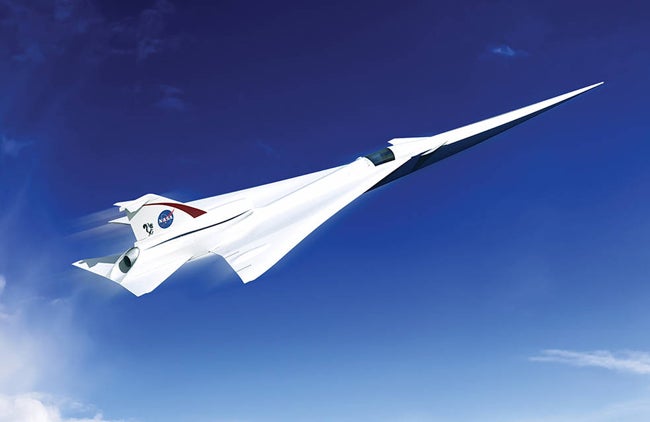
Last month, NASA and Lockheed began the first high-speed wind tunnel tests for the preliminary design of their Quiet Supersonic Technology (QueSST) X-plane. The testing is being done at NASA’s Glenn Research Center in Cleveland using a nine percent scale model. It is scheduled to run for eight weeks and test the model’s performance at wind speeds between Mach 0.3 and Mach 1.6.
The QueSST X-plane will be much quieter than its predecessor. New research and technology will allow the airframe to be shaped specifically so that the shock waves it generates in supersonic flight will be much less audible. According to Peter Iosifidis, QueSST program manager at Lockheed Martin Skunk Works, “Our design reduces the airplane’s noise signature to more of a ’heartbeat’ instead of the traditional sonic boom that’s associated with current supersonic aircraft in flight today.”
The NASA and Lockheed Martin team joins Boom Technologies, Aerion and Airbus, HyperMach Aerospace, and others in the race to have the next supersonic civilian jet up in the air.
Learn more at NASA and Lockheed Martin.