












Sign up for our newsletterfor industry news, reviews and much more delivered to your inbox!
The FAA has released updated guidance on how we pilots are expected to fly traffic patterns, and the updates are fairly extensive and for the most part really smart, too. Here’s a breakdown of some of the biggest changes contained in the new document, Advisory Circular 90-66B.
1. Altitudes: The FAA has long given license to airport operators to set their traffic pattern at non-standard heights. Most patterns for piston planes were 1,000 AGL (or thereabouts) but many were 800 feet and some were even lower than that. The new rule calls for those patterns to all be 1,000 ft AGL unless there’s a good reason for them not to be such as obstacles or competing airspace. Turbines would be at 1,500 feet AGL with similar caveats, and ultralights are to be at least 500 feet the piston planes, so 500 AGL in most cases.
2. Left versus Right Hand Flow: This one, like the new altitude guidance, shouldn’t change anything at airports that already have standard left hand patterns. But for those that have right hand circuits, they need to have a good reason for doing so and they have to let pilots know of the non-standard pattern flow through light signals (which is cute), markings on the ground or thRough publications, etc! The FAA says that it recognizes that many airports already have right hand patterns and the advisory circular didn’t prohibit those. But it does require pilots to fly a left hand pattern unless the right-handed version is in place.
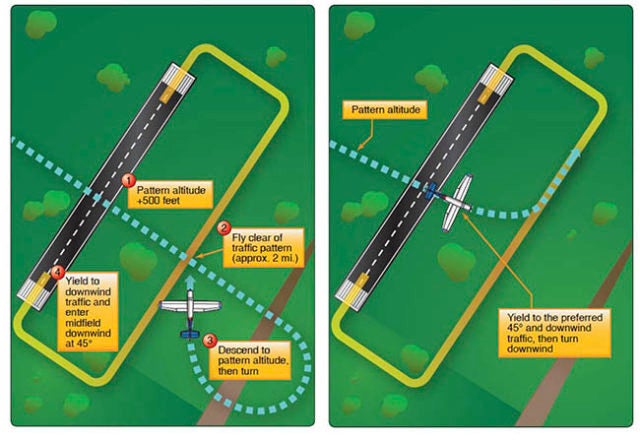
3. Entries: This, again, is a big change. The 45-degree entry is retained, but the procedures for entering midfield are different. The FAA now wants planes to enter at 500 feet above pattern altitude and then make a reverse teardrop to join the downwind, initiating the turn only after descending to pattern altitude. The FAA also lists a conventional midfield downwind entry as acceptable, with the midfield crossing done at pattern altitude. The FAA emphasizes that traffic pattern guidance is advisory only.
4. Straight-Ins: This is a reminder that a straight-in approach is an approved way of entering the traffic pattern and that all aircraft flying a standard pattern should keep a close watch when turning base to final for conflicting straight-in traffic.
5. IFR Traffic: IFR traffic is now expected to work themselves into the traffic pattern, so if there’s traffic in the pattern already, instead of barreling through IFR flights should accommodate VFR traffic already in the pattern. This guidance will probably come under some scrutiny, as there are a number of complicating factors for arriving IFR flights, including the fact that they are still in many cases under positive control and following a clearance. Unless they’ve been cleared for the visual, they are on a proscribed flight plan. As we said, there’s likely some discussion to come up on this one in particular.
6. Crosswind Turn: Airplanes staying in the pattern shouldn’t start the crosswind turn until after they’re beyond the departure end of the runway and within 300 feet of pattern altitude and they shouldn’t join the downwind leg until they’re at pattern altitude.
This is a short list of the many areas of guidance on the new Advisory Circular. To read all about it, check out the full text.