











There are countless stories of heroics stemming from World War II. The “Greatest Generation” fought battles both in the Pacific and Europe. Many never came home. But thanks to one man with a crazy idea, many men who would have otherwise never made it to see the end of the war did, in fact, return home. That would be the one and only Charles Carpenter, but history remembers him as “Bazooka Charlie.”
Carpenter was born in the small town of Edgington, Illinois, in 1912. If such a thing can be predetermined, then it was likely that Carpenter was destined for the skies. On the day he was born, the local newspaper headline read, “Aviation Events Big Fair Feature.” Yet aviation was a long way off for Carpenter. His parents divorced when Carpenter was still a child, and he and his siblings would frequently find themselves working on neighbors’ farms to help make ends meet.
Carpenter still found time for his studies. Books were a happy pastime for him, and upon graduating high school, he turned to teaching history in Moline, Illinois. It was there he met Elda Fritchle. They married in 1940 and had a daughter, Carol, together.
But war was coming for the U.S., and in 1942 Carpenter was commissioned as a second lieutenant in the U.S. Army. Initially assigned to the infantry, he was sure he could do more aloft. He decided to join the Glider Corps, but he found the training took much longer than he anticipated and he was hungry for action.
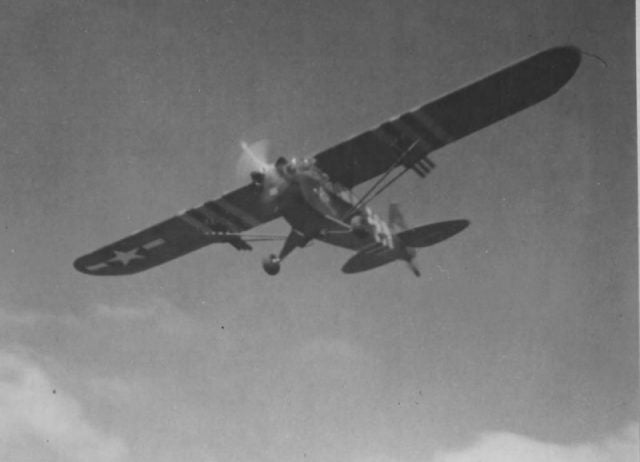
Carpenter arrived in France in 1944, where he was assigned to combat duty with the 1st Bombardment Division. Compared to the P-40s, P-51s, and B-17s that were commanding the skies over Europe, his airplane was nothing remarkable. Carpenter found himself in the L-4 Grasshopper, although it is better known by its civilian name, the Piper Cub.
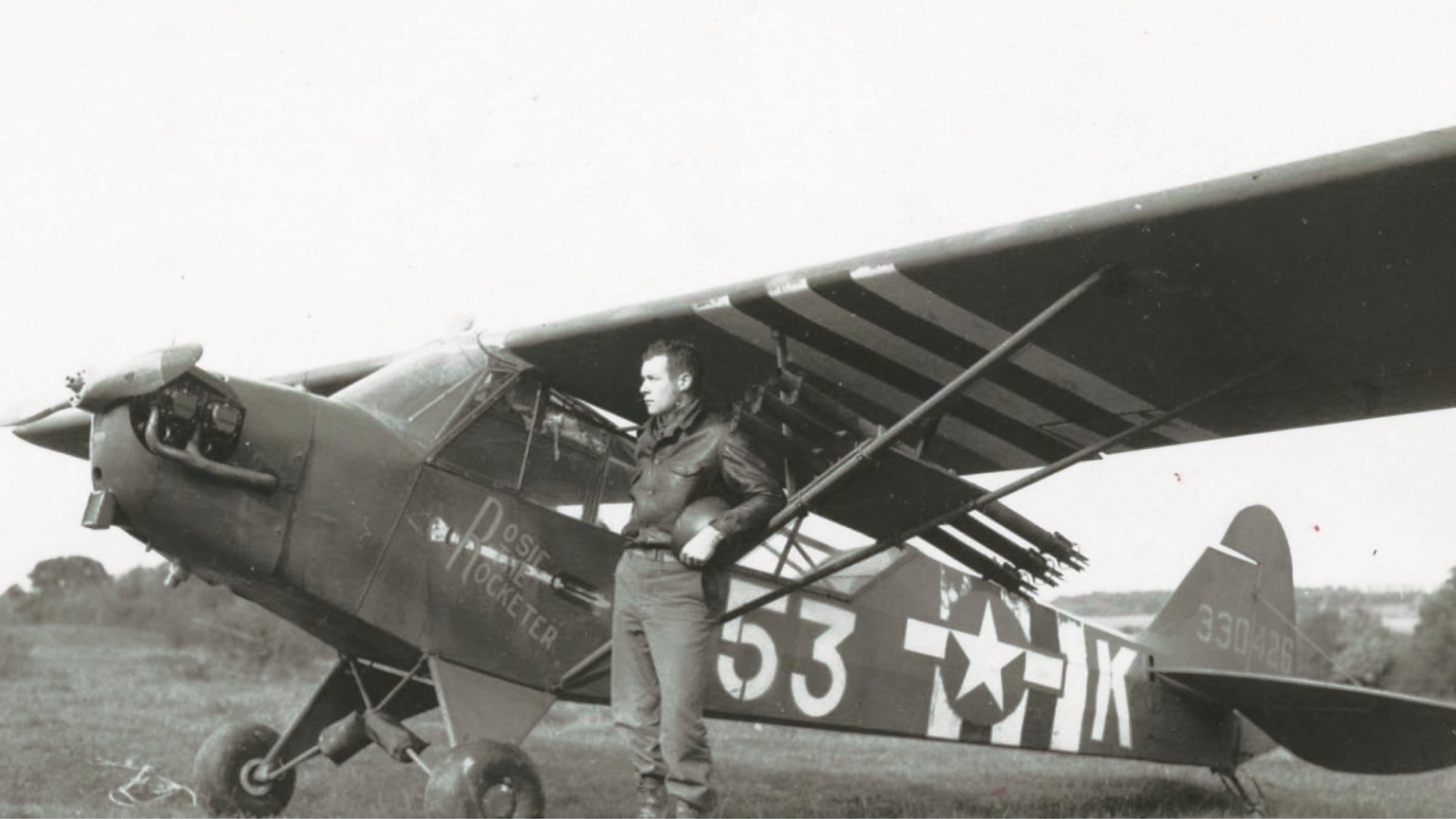
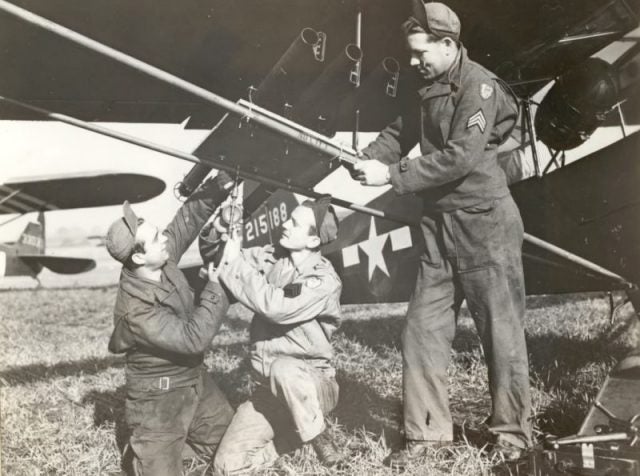
However, Carpenter wasn’t going to let his small, slow airplane keep him from fighting the Germans. He took a page out of other reconnaissance pilots’ books and added six bazookas—three on each wing—to his artillery-spotter airplane. As a play off of the famous “Rosie the Riveter,” he would paint Rosie the Rocketer on the side of his L-4.
Carpenter continued to improve upon the design of the bazookas on his beloved Rosie and flew in the 1944 Battle of Arracourt, where he was credited with knocking out a German armored car and four tanks. Multiple articles in the press back in the States featured his pilot exploits, including ones in Stars and Stripes, The Associated Press, and more. Carpenter also served as the personal pilot for U.S. Army General John S. Wood.
A Hodgkin lymphoma diagnosis in 1945 led to his honorable discharge from the military in 1946. He returned home to his family and began teaching high school history again in Urbana, Illinois.
Although Carpenter was given just two years to live when initially diagnosed, he thrived and worked in Urbana until his death at 53 in 1966.
Carpenter’s cherished L-4, Rosie the Rocketer, found its way back to the U.S. in 2019 and has since been restored to flying condition. It flies now as a testament to the “Mad Major,” as Carpenter’s comrades also called him, and the crazy idea that would save many American lives.
Editor’s Note: This story originally appeared in the October 2023 issue of Plane & Pilot magazine.