










Anytime someone is lucky enough to crawl into a vintage-era warbird cockpit, chances are it’s going to be a good day. If that warbird happens to be a Lockheed VC-121A Constellation, previously flown as the personal aircraft of the 20th century’s most famous American general, Douglas MacArthur, you have the makings of a once in a lifetime opportunity.
Last week at EAA AirVenture in Wisconsin, Plane & Pilot had the pleasure of seeing that exact Connie firsthand as it made its second trip to Oshkosh after undergoing a number of restorations that began in 2015.
Seventy-five years after serving as transport for MacArthur, then supreme commander of the Allied forces during the Korean War, the aircraft still dons the same shimmering metal-and-white paint scheme it wore during those days.
“If you take a look, she hasn’t got a square line on her anywhere,” said flight engineer Jeff Whitesell during an interview in the plane.
After nearly 10 years of extensive restorations, the Connie is more than just airworthy. It sports a completely redone interior that would have made MacArthur jealous.
Seth Hinton, owner of Fighters Rebuild, which oversaw the restoration, told Forbes that getting the plane flying again has been like “restoring 10 or 15 [P-51] Mustangs.”
“There aren’t very many parts laying around, and there’s not a lot of people that know very much about Connies,” Hinton said.
When the aircraft made its first appearance at Oshkosh in 2023, it had just finished returning to airworthiness and having that nostalgic 1950s look restored. On the other hand, the cabin remained gutted, resembling a space that could be used for transporting cargo.
After the 2023 airshow, the aircraft flew to Aerometal International in Aurora, Oregon, for a complete redo of the interior. That revamp was finished just days before this year’s AirVenture.

Originally delivered to the U.S. Air Force, the famed aircraft was one of 10 Model L-749s purchased from Lockheed and designated as C-121As. Serial numbers 48-0608 through 0617 were delivered between December 1948 and the first part of 1949 to Westover Air Force Base in Chicopee, Massachusetts.
Not long after their inclusion in the military, eight of the 10 Connies, including MacArthur’s, began delivering cargo to bases near England and Germany as part of support for the Berlin Airlift. Those planes flew more than 5 million miles during the airlift, making almost continuous crossings over the Atlantic.
Following the airlift, all C-121s were withdrawn from service and returned to Lockheed for makeover into high-speed VIP transports for the Air Force. Original cargo interiors were removed, windows added, and weather radar was affixed to the Connies’ noses. This marked the first time Air Force aircraft were fitted with weather radar systems.
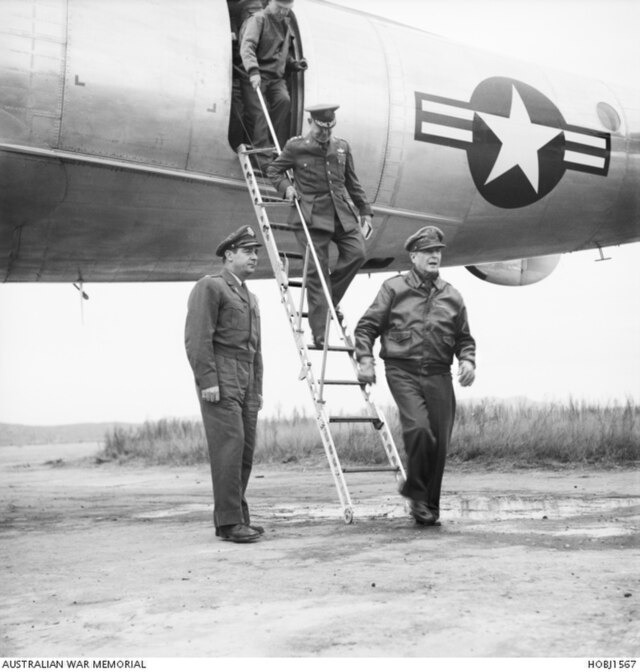
In summer 1950, aircraft 48-0613 was assigned as MacArthur’s personal transport.
MacArthur dubbed the aircraft Bataan after the Battle of Bataan, the first American conflict in World War II following the Japanese attack on Pearl Harbor. At the time MacArthur was commander of the U.S. Army forces in the Far East.
After a valiant four-month stand at the Bataan Peninsula in the Philippines, MacArthur was ordered to evacuate to Australia while his soldiers were forced to surrender. The general vowed never to forget his troops and ended up naming three aircraft, including the Connie, after the battle.
MacArthur used Bataan expeditiously, flying 17 missions over Korean battlefields during his time in command. After a power struggle with President Harry S. Truman, MacArthur was contentiously relieved of duty and flew on the aircraft one last time, back to San Francisco.
Subsequently, the aircraft served as transport for various military personnel before being retired in 1966.
In retirement, most C-121s were sent to Davis-Monthan AFB in Tucson, Arizona, for storage. But Bataan found a new role, flying as a communications hub for NASA during the Gemini and Apollo spaceflight programs.
The aircraft was finally acquired in 1993 by Planes of Fame Air Museum, where it remained on display at the company’s facility in Valle, Arizona, before being sold in 2015 to Lewis Air Legends of Texas, which began renovations.
In addition to leading the restoration effort, Hinton served as copilot on a number of Bataan’s test flights on the journey back to airworthiness.
“It flies great,” Hinton said. “It’s smooth like a jet. At 30 inches of manifold pressure and cruising, it’s smooth as glass and indicates about 210 knots. It doesn’t vibrate at all, and it’s not very loud inside.”