










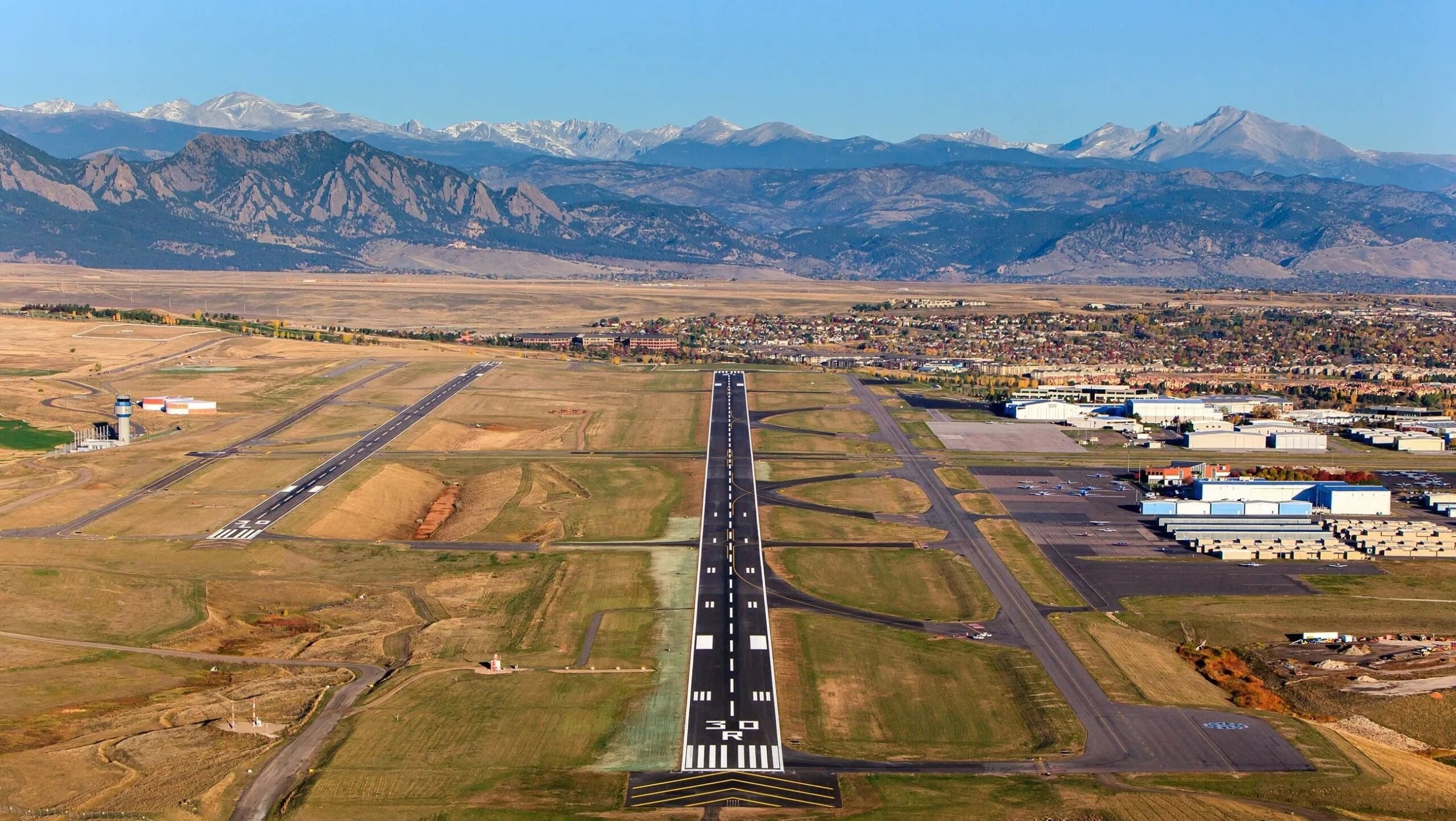

After years of complaints and legal battles from members of the surrounding community, Colorado’s Rocky Mountain Metropolitan Airport (KBJC) has announced it will partake in an FAA-regulated Part 150 noise compatibility planning procedure to address mitigation efforts at the airport.
On July 10, the Jefferson County airport, located in the Denver suburb of Broomfield, hosted its first open house, where it shared with the public its inclusion in the procedure and the methodology going into the study.
According to KBJC director Erick Dahl, the process will take at least two years, with the first phase centered around mapping out where noise is happening at the airport. The FAA uses the day-night average sound level (DNL) noise metric that reflects a person’s cumulative exposure to sound over a 24-hour period. The study aims to establish a noise exposure map and determine incompatible land uses that register a DNL above 65 decibels.
Following the noise exposure map, the airport would move on to phase two and the development of a noise control plan for specific areas. The airport hopes to hold additional open houses to provide data and solicit feedback from the community as the study progresses.
Along with providing tangible results, participation is a show of goodwill from KBJC to community members.
“The fact that they’re open to it and partaking in it is a great step forward,” Colorado State Representative Kyle Brown said. “Just standing here in [the town of] Superior, you can tell we have serious concerns about the noise contours in this area. We have concerns about the impact that noise is having on the community.”
In 2023, over 400 Rock Creek subdivision homeowners sued Jefferson County, alleging that noise pollution, due to increased operations at the airport, had led to decreased home values. The Boulder County District Court dismissed the lawsuit in March, ruling that while the county had the authority to impose noise restrictions, the court did not have the authority to force the county to take such measures.
“The fact that the defendants could impose noise restrictions does not mean that the court can order them to do so,” the court said. “Any such order would constitute local regulation of an area preempted by the federal government.”
Additionally, last year it was reported that the town of Superior commissioned its own noise study on the airport that used controversial aircraft data to track sound levels. Conducted by the firm Hankard Environmental of Colorado and Wisconsin, that study gathered ADS-B data to determine if an aircraft was taking off, landing, performing touch-and-go operations, or overflying the airport.
Commonly referred to as “Jeffco,” the airport was built in the 1960s, more than 20 years before residential development of towns like Superior and Louisville, Colorado. Between 1990 and 2023, operations at the airport have increased by 98 percent, with the population of the surrounding community growing by 72 percent in the same time frame.
Supporters of the airport note that it adds around 5,000 jobs and injects $1.4 billion into the local economy.
“Our goal is to be as good of a neighbor as we can,” Dahl said. “[We want] to listen to what people are saying and try to figure out how we can minimize what impacts we can and to the degree that we’re able to.”