










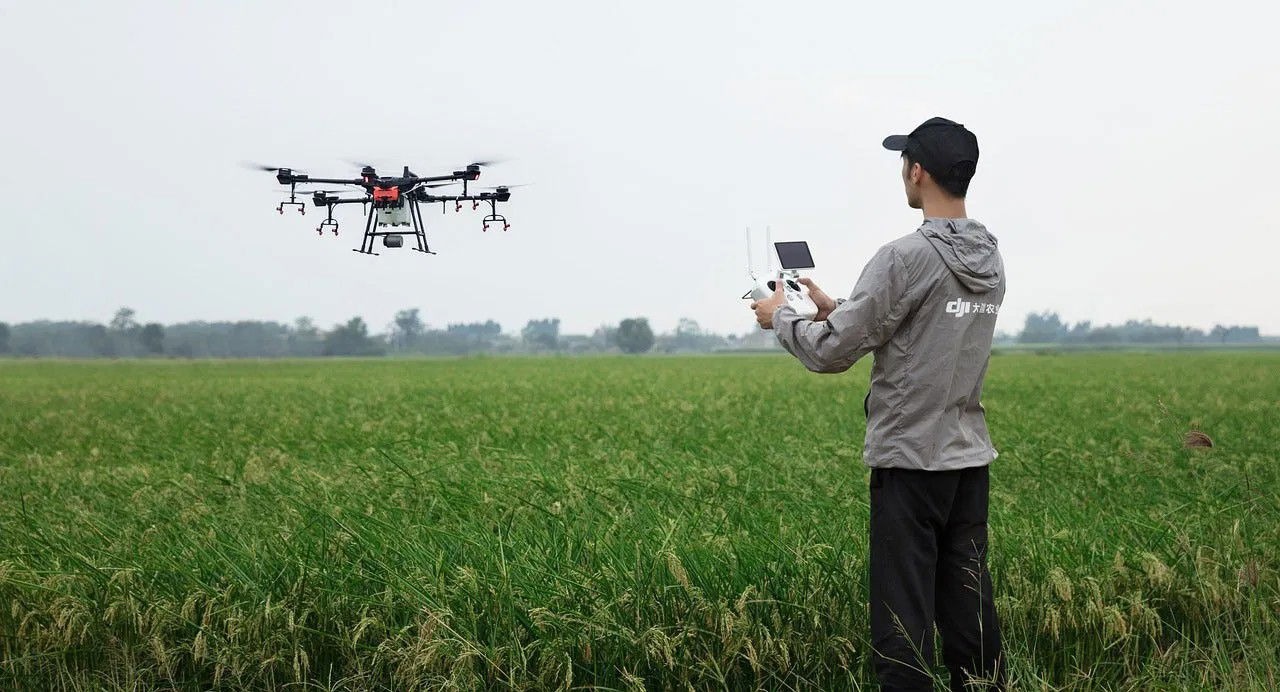

U.S. Transportation Secretary Sean Duffy unveiled a proposal for a new rule on Tuesday that would clear the way for large-scale commercial drone operations across the country.
The proposed rule, a joint effort between the Department of Transportation, FAA, Transportation Security Administration, and Department of Homeland Security, is designed to establish a structure where unmanned aerial systems (UAS) can conduct beyond visual line of sight operations (BVLOS) at low altitudes.
Currently, drone operators must obtain individual waivers from the FAA to fly BVLOS. This new rule would eliminate the restriction, opening the airspace for drone operation under a specific set of parameters.
At a press conference announcing the proposal, Duffy explained that the new measures are a crucial step for allowing America to claim air superiority in the drone space before its adversaries.
“The problem we have is that on the consumer drone market China controls 90 percent of this market,” Duffy said. “And the problem with that is we”re turning over our skies to one of our main adversaries…I think it’s only right that America lead because we have led in aviation since the very beginning from the Wright brothers to Chuck Yeager, Pan Am, TWA, the jet age, all American. We are now going to also lead in the drone space as well.”
Along with the proposed rule announcement, the agencies released a 731-page draft that outlines how exactly the ruling could take shape. Officially, what has been established is a notice of proposed rulemaking (NPRM). Industry partners will now have 60 days to submit comments and feedback to the agencies before a final rule is confirmed. While the ruling is subject to changes, the initial draft establishes a framework for what will soon become official.
The proposed rule establishes a two-tiered system in which commercial drone operations will fall under—permits or certificates. According to the draft, permits would allow package delivery, agricultural operations, aerial surveying, civic interest, and other operations subject to certain limitations on size, number of aircraft, and other operating requirements.
Certificates will be reserved for operators conducting higher risk operations due to size, weight, speed, or other parameters. Obtaining a certificate will allow for more complex commercial operations and result in greater oversight from the FAA.
Newly-appointed FAA Administrator Bryan Bedford stated that in addition to opening the national airspace to commercial drone use, the proposed rule provides a uniform regulatory system for operators to follow, as opposed granting exemptions on a case by case basis.
“The fact is we’ve got a little bit of the Wild West out there right now,” Bedford said. “So regulating to a common standard, making sure the vehicles comply with our regulations, and then surveilling that is a much better place than where we’re at today, to say the least of which is allowing people to innovate within a set of rules that we can comply with.”
Also included are provisions on what types of UAS will be able to operate. Any aircraft cannot have over a 25-foot wingspan, a gross weight of 1,320 pounds, or a ground speed of 87 knots. Manufacturers will self-certify their drones meet the outlined requirements by submitting documentation to the FAA that will then be approved by the agency.
Both Bedford and Duffy said that the proposed ruling was years in the making. In 2017 the FAA began evaluating the integration of UAS into the national airspace with the creation of the Integration Pilot Program (IPP).
After the conclusion of IPP in 2020, the agency followed up with the BEYOND program, which focuses on “understanding the potential and realized societal, economic and community benefits of drone use and streamlining the approval processes for drone integration.”
