











Long before the vertical takeoff and landing (VTOL) Hawker Siddeley Harrier, or the more recent Lockheed Martin F-35B jump jets, the concept of a fighter that could launch from a ship’s deck, fight off the enemy, and return was high on the priority list for the U.S. Navy.
Since the early 1930s warships from around the world had launched light scout planes from catapults mounted on the deck to search for the enemy and deck gun crews. However, these floatplanes eventually landed next to the ship and had to be winched back on board.

And these lightly constructed planes were no match for the frontline fighters of the day.
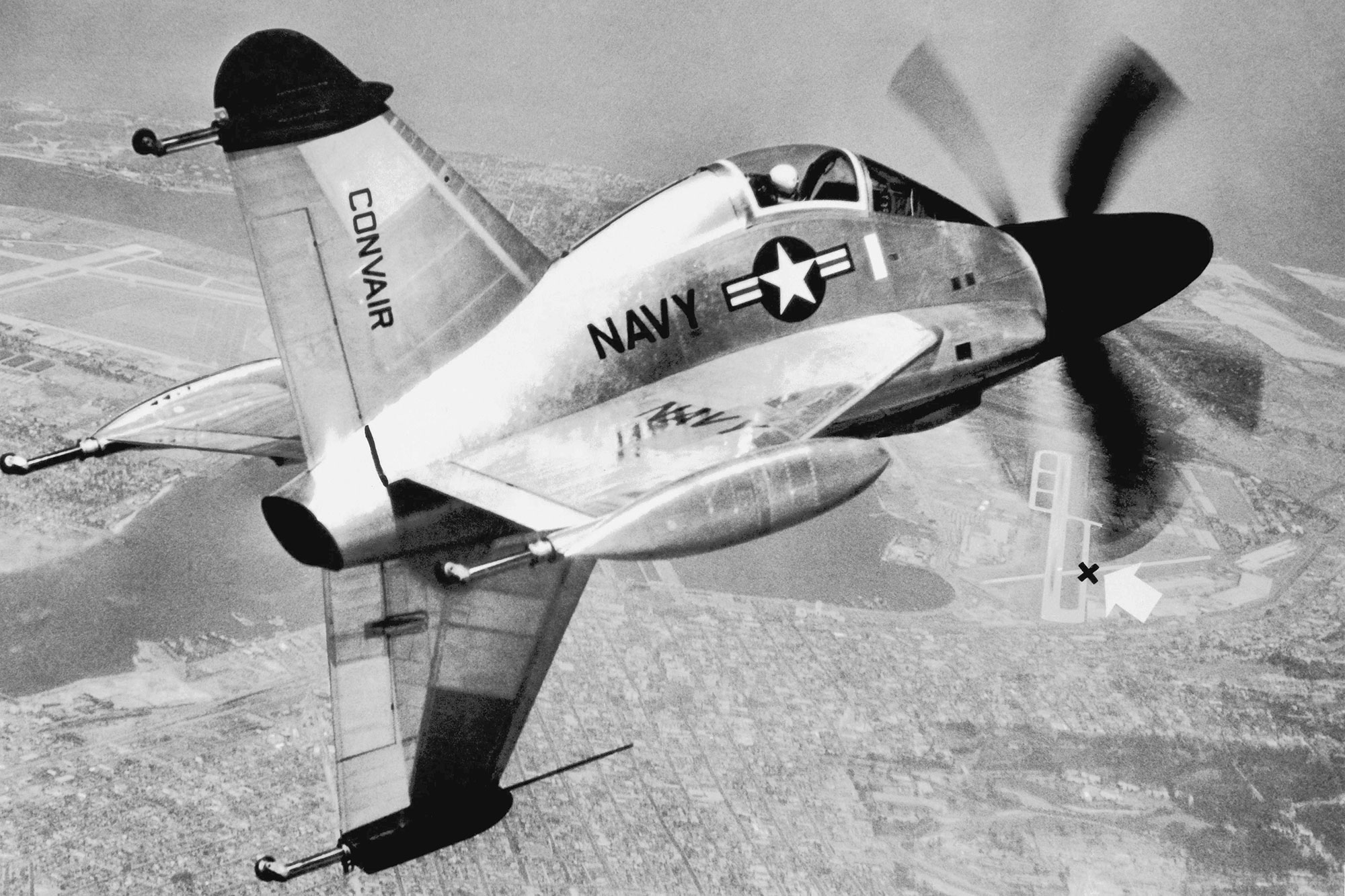
What if a powerful fighter aircraft could lift off under its own power, defeat enemy attackers, and land back on the tiny spot on the deck? This was the kind of thinking that resulted in the Convair XFY-1 “Pogo.”
One of the most amazing aspects of early 1950s aviation was that no idea was too far-fetched. If you could imagine it, an aviation company could build it.
As early as 1947, the Air Force and Navy established Project Hummingbird to study the concept of a VTOL aircraft for ship defense. So, in 1951, the Navy awarded contracts to both Lockheed and Convair to develop such a versatile ship.

The Lockheed XFV Salmon was the less successful of the two designs, due mainly to the lack of a suitably powerful engine. However, Convair’s prototype, the XFY-1, managed to meet the contract specifications and in the hands of a brave and skillful pilot put on quite a show.
The Pogo design was really quite simple. The centerpiece was the Allison XT-40 turboprop engine that sent over 7,000 hp through two contra-rotating Curtis Electric propellers. The contra-rotating blades negated the P-factor and produced enough thrust to lift the Pogo vertically.
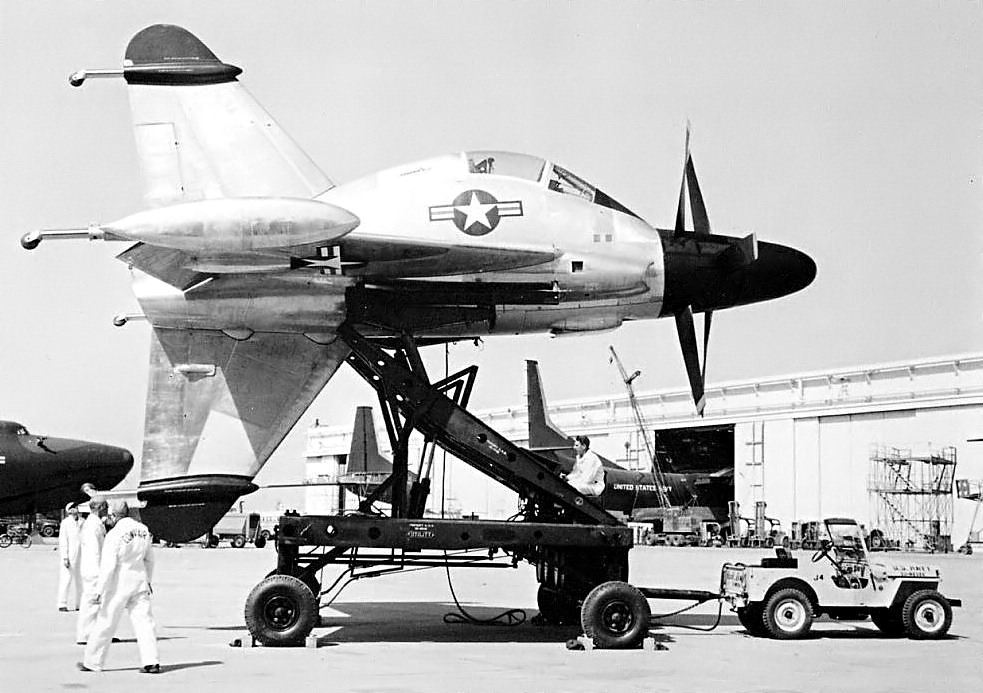
In order for the XFY-1 to stand on its tail, its designers equipped it with two 52-degree swept wings and a large vertical stabilizer and ventral fin, each equipped with full-span trailing edge control surfaces. The four lifting and control surfaces each included a gear strut mounted at the tip that compressed on landing, much like a child’s pogo stick. This allowed the entire contraption to literally sit on its tail and likely provided its unofficial moniker.
So far, this design makes eminent sense, but how could the pilot fly the airplane in normal forward flight and still be able to look out below as the XFY-1 descended to land on its tail? The solution was a fully functional ejection seat that rotated forward at a 45-degree angle for takeoff and landing and rotated back to the vertical in cruise flight.
The pilots, who were expected to land this contraption by looking over their shoulder, climbed up a 25-foot scaffold to enter the cockpit. As a precaution, the Pogo had an equally long escape rope for the pilot to shimmy down in an emergency.
Problem solved.
The daunting task of controlling this beast was left to Marine Reserve Lieutenant Colonel James “Skeets” Coleman, an experienced Convair test pilot. Initial testing was conducted in the massive Hangar One at Moffett Field in California, the same one that housed the gigantic Navy airship Macon in the 1930s.
To see if the contraption worked as advertised, tethers were connected to the propeller hub, and each of the four landing pogos. Approximately 60 hours of tethered testing inside the hangar followed before the XFY-1 was wheeled outside for its initial flights.
The first untethered flight occurred on August 1, 1954, with the Pogo taking off, hovering close to the ground, and setting back down again. Over the next few months, Coleman made over 70 flights in hover mode, with each taking the Pogo a little higher and remaining in the air a bit longer.
The next step would be a little more challenging. The transfer from vertical takeoff to horizontal flight and back to vertical flight for landing took place on November 2, 1954. Today, such a challenging event would be preceded by computer simulations and practiced in a full-featured flight simulator until satisfied the profile would work.
However, in 1954, it was up to the engineers and the test pilot to figure it out. To make matters worse, the Pogo did not have the ability to land horizontally, like the XFV Lockheed Salmon prototype, so this first effort would end in success or an ejection and loss of the prototype.
Amazingly, the flight was a complete success. Coleman took off vertically, transitioned to horizontal flight, then in a maneuver of his own design, flew in low and fast over the landing zone at idle power, pulled up to the vertical, then added power to establish a hover at nearly 1,000 feet. Now, with the seat tilted forward, he gently backed the Pogo down to a landing.
Coleman went on to fly several more flights in the Pogo, refining the transition from horizontal to landing and expanding the aircraft’s envelope.
As a fighter, the XFY-1’s powerful engine and propeller system produced excellent acceleration and maneuverability. Unfortunately, by 1955 the jets the Pogo was designed to fight were routinely breaking the speed of sound. Additionally, a single test flight by another pilot nearly ended in disaster and demonstrated that this airplane required exceptional piloting skills and significant flight training—a similar lesson learned in the early accident-filled days of the Harrier jump jet.
By now, interest in this shipboard fighter concept had waned, and the program ended. However, unlike the Lockheed Salmon, Pogo had successfully transitioned from vertical to horizontal, and back to the vertical. In all, three Pogo prototypes were constructed. However, only the second aircraft actually flew.
Today, it lives at the Smithsonian National Air and Space Museum’s Suitland, Maryland, facility. However, the incredible XFY-1 Pogo is a testament to the imagination of the mid-century aircraft designers—and the courage and skill of the test pilots who flew it.