












The story of the loss of a Cirrus SR22 yesterday due to apparent pilot incapacitation has been discussed exclusively in terms of a tragedy, and it most likely is just that. While it’s not likely, it is possible that the pilot of the SR22 could have survived an engine-out crash into the Gulf even if incapacitated. Here’s how.
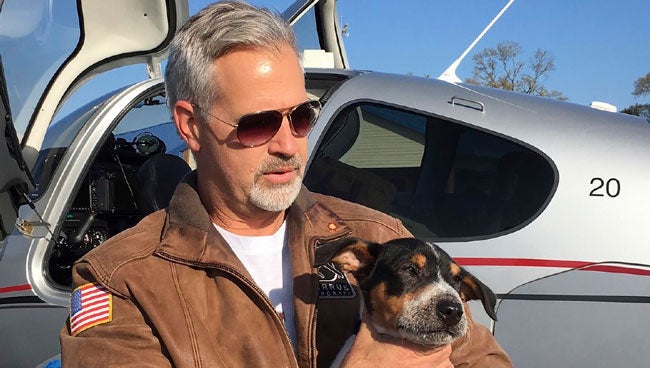
First, the backstory. A Cirrus SR22 on Thursday was lost over the Gulf of Mexico after its pilot became incapacitated while cruising on autopilot at 15,000 feet. The flight originated from Wiley Post Airport in Oklahoma City, OK, and was bound for Georgetown, TX, to pick up a dog as part of the Pilots N Paws pet rescue program. The pilot, Dr. Bill Kinsinger, was the only person aboard the plane.
After ATC alerted NORAD of the lack of response from the pilot, a pair of F-16s intercepted the plane as it continued southward, past its Central Texas destination and toward the Gulf of Mexico. After intercepting the Cirrus, the pilots attempted to attract Kinsinger’s attention, but he was unresponsive, they said. Running low on fuel, the F-16s returned to base. A pair of F-15s was dispatched to follow the Cirrus, but they could not locate the plane and returned to base without having made contact.
The F-16 pilots saw that the pilot was unresponsive. There are two most likely possible scenarios. Kinsinger suffered a medical episode and died at the controls. It happens. Kinsinger was just 55 years old, however. The other possibility is that Kinsinger lost consciousness because of hypoxia. At between altitudes of 15,000 and 19,000 feet, which is considered “very high altitude” in medical terms, incapacitation due to hypoxia would likely not have been fatal, though different people’s response to altitude sickness varies widely. Hypoxia at “very high altitudes” generally results in altitude sickness not death.
The systems in the Cirrus deserve some discussion, too. The airplane that crashed was, according to the FAA’s database, a 2016 model, which would have been outfitted with the Cirrus Perspective cockpit’s autopilot, the Garmin GFC700. The autopilot has built in envelope protection, functions that take control of the airplane under certain flight conditions to keep it from getting into envelope departures. A few of those functions would be at play in a loss of consciousness scenario. It would keep the plane from spiraling out of control, and it would prevent the plane from stalling, by keeping the speed just a couple of knots above stall speed. With no flaps, the plane would be flying at around 70 knots when it hit the water, wings level and nose mostly likely high. It’s not an ideal scenario, but it is survivable if the occupant were alive and able to escape the craft.
One wildcard is ESP’s hypoxia prevention function, which is designed to automatically descend the plane to a lower altitude if the pilot doesn’t interact with the controls for a given period of time at a high altitude. The altitude the Cirrus was cruising should have been more than high enough to activate that feature.
Cirrus did not respond to an email request for comment, although a company spokesperson did say that it was a sad day for “those involved and the entire Cirrus family.”
As of late Friday, the United States Coast Guard was searching for the plane.
We will update the story as further details emerge.
This story has been updated to include new details that have emerged since our report was filed.