


Airplane? We don’t need no stinking airplane. That seems to be the theme of a new contest that will award designers with loads of cash for coming up with a practical jet pack. GoFly with Boing as its “grand sponsor” has launched a design contest that will reward teams with a total of $2 million for their efforts in coming up with “a personal flying device that can be safely used by anyone, anywhere.” We read that and think, “jet pack.”
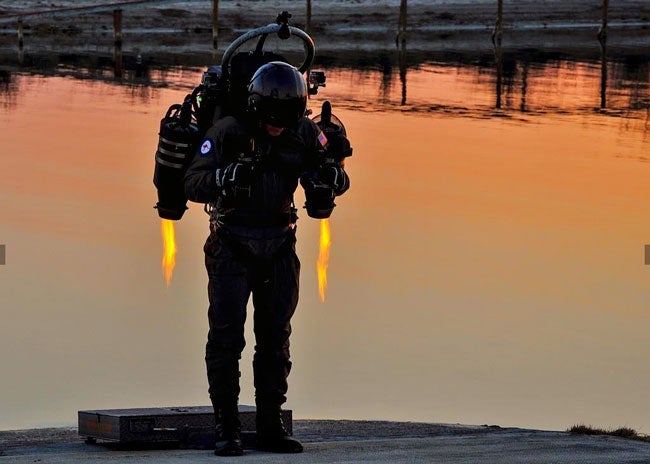
While GoFly, the organization that’s putting together the contest, isn’t using the term, its technical goals seem to demand such an approach. The challenges behind creating such a design are huge. While there have been working, truly personal flying machines built, they have been jet packs, and their shortcomings are many and critical. Doubtless, the most troubling is that in case of engine failure there’s no backup for an emergency landing. Airplanes handle this with fixed wings that allow the plane to perform powerless glides and helicopters use rotor blades that continue to spin even when not under power, to allow a descent known as an “autorotation.” Neither option is possible with a jet pack. This is in addition to jet packs being incredibly loud and difficult to control. Moreover, their endurance is measured in mere minutes. How these physics problems will be overcome is the primary challenge teams will face.
Even given the history of the challenge, GoFly’s technical specs for the contest are stunningly ambitious and call for teams to “construct safe, ultra-compact, quiet, urban-compatible, personal flying devices capable of carrying a person 20 miles without refueling or recharging with vertical, or near vertical take-off and landing capability.”
GoFly says that the competition will have three phases, a technical specifications phase, a prototype phase in which actual machines will be judged and a final, fly-off phase, schedule for the fall of 2019. Teams will have the opportunity to compete for additional prizes during the final Fly-Off, including one $100K prize awarded for disruptive advancement of the state of the art aviation technology, one $250K prize for the quietest compliant entry, and one $250K prize for the smallest compliant entry. The Grand Prize Winner will be awarded $1M for the best overall Fly-Off score, calculated by measuring speed, noise, and size. The entries,GoFly says, will be judged by Boeing experts.
Anyone is welcome to enter. The first registration deadline for teams participating in Phase I is April 4, 2018, followed by a Phase II registration deadline of December 8, 2018.
Learn more at The GoFly Prize.