










The question of whether Captains Kim and Nick Gill are hell-bent or heaven sent is subjective.
To their friends crazy enough to tag along for a work trip in Nevada to help out with their latest acquisition, the answer may lean toward the former. In the eyes of a Grumman Albatross long parked in the Silver State, the couple must certainly seem like angels on earth, the perfect combination of passion, ability, and means to bite off a project of this size.

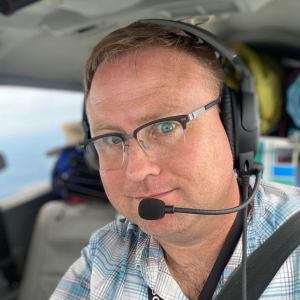
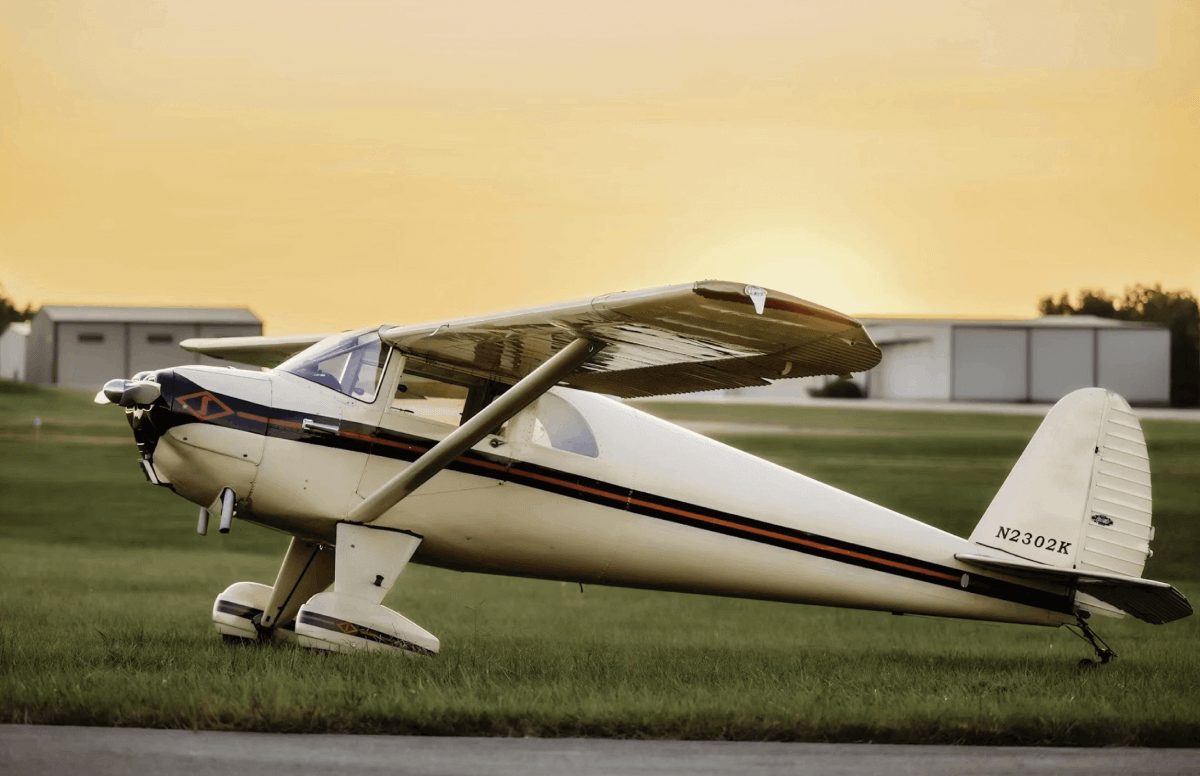
I flew as Kim’s first officer a few times before upgrading to captain, and we immediately struck a chord as small-airplane geeks. She and Nick have owned a slew of airplanes—their current fleet including an Aeronca Champ, Cessna 310, Extra 300 project, and there is some sort of sailplane hanging in the rafters as well. Oh, and a de Havilland Beaver, which the couple use as a flying RV for their trips to Oshkosh and Lakeland.
In the Mooney, I debate how many days a shirt can be worn before those downwind of me will notice. In the Beaver, the Gills bring a giant canvas expedition tent, with air conditioning, and the kitchen sink.
I try to be a fairly model citizen at my day job, but whenever our paths cross, I often have to look both ways before asking if she’s got any new pictures to share of her Beaver. You’d be surprised at how many people in an airline hold neither a deep knowledge of obscure aircraft types nor a sense of humor.
So in fall 2024 when Kim said, “We bought an Albatross,” I was surprised, but not shocked. Oh, and it’s in Nevada. And it hasn’t flown since the turn of the century. “Wanna come help work on it?”
There’s only one proper answer to that question, when you’re wired the way I am. Once the appointed week loomed, I emptied my work suitcase and repacked it with overalls, coveralls, flashlights, and batteries. I really didn’t know what to expect. I knew the goal was to remove the engines for assessment and the flight controls to have their fabric coverings replaced.
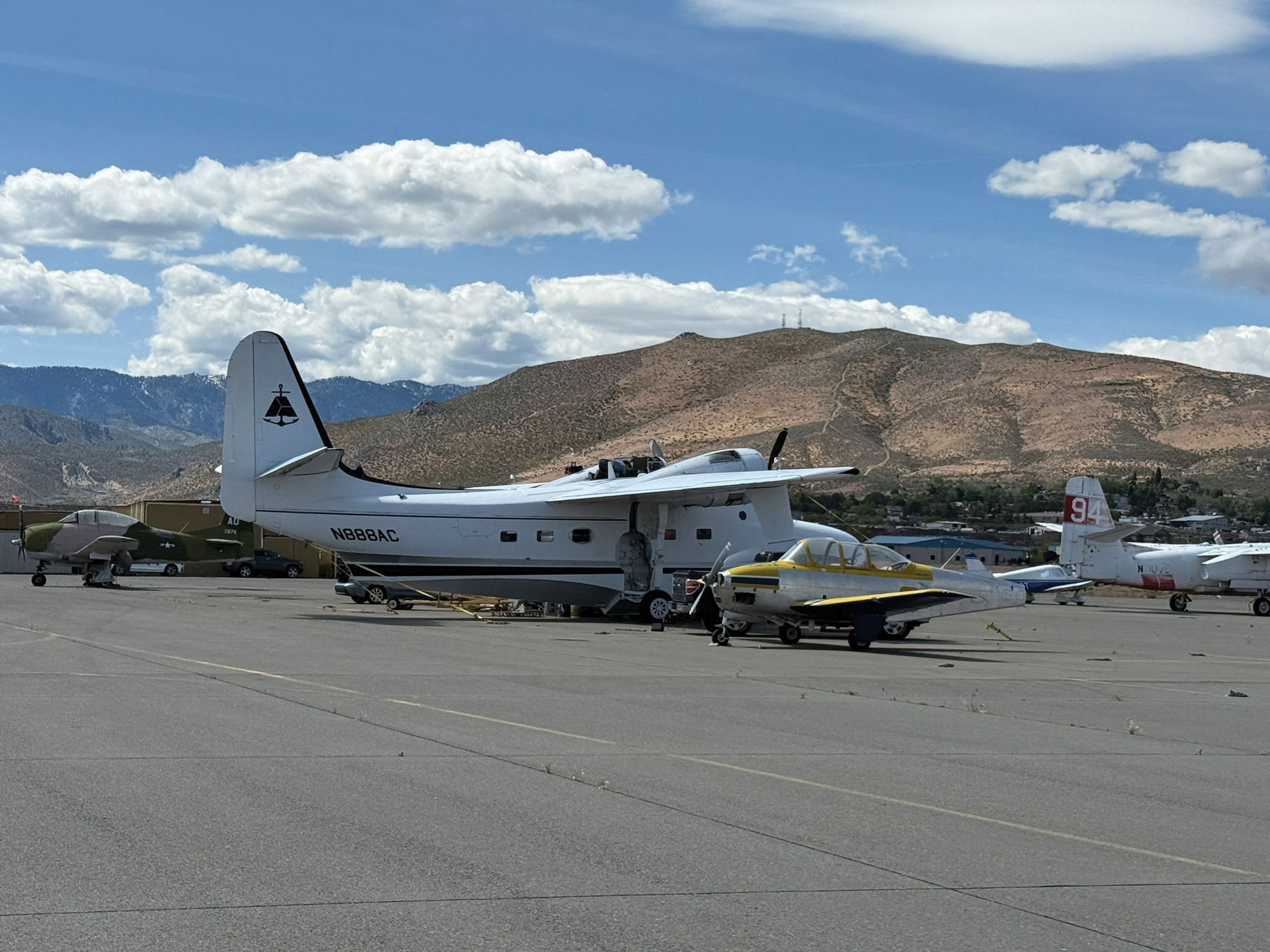
As I stepped out onto the apron, I saw two of the giant Grumman amphibians. One had no engines or flight controls. There was hardly any paint remaining. Hatches had been removed—the majestic bird now relegated to being a majestic birdhouse. It hadn’t seen a tool applied to it in years. Sitting nose-to-nose across the taxilane on the ramp, a white Albatross had a couple of cars surrounding it, and several folks up on the wing, in the fuselage, and milling about.
As I walked near, the enormity of the project began to set in. Panels were open all around as Nick, Dave, David, and Kim had already begun the push to prepare for engine removal. Behind each cowling panel and inspection port there lay straw, eggs, skeletons and poop—so much poop. I started to pitch in before realizing I was still in my uniform pants.
Back in the parking lot, I changed into a pair of overalls and dove in. We disconnected fuel and hydraulic lines, electrical Cannon plugs, propeller controls, and a few stray bits of wiring.
The Albatross, firewall forward, is set up as a “quick engine change” package, which means that the entire assembly comes off as a unit—engine, accessories, and its mount disconnect from the firewall and can be exchanged as a unit. I’m told that a small crew of sharp mechanics could change both engines in a day.
Despite two of us in the team being A&P mechanics, we were not what you’d call sharp mechanics. We were airline pilots with screwdrivers, just hoping to be more help than hindrance.
The first day I was tasked with disconnecting a supercharger control pushrod at the firewall. The pushrod was bolted to a bellcrank, which was in a bracket that prevented access except when the bolt was lined up exactly with a hole in the bracket. Now, none of us could see straight into that hole, and as I reached through a gap to “see” with my fingertips, a sharp tail of safety wire snagged my forearm, and I unknowingly became a blood donor. I made a big red blob on the wing that dried before I even noticed what had happened.
Oh, well.
The next morning, I got the same task, on the right engine. Would you believe there was a sharp edge of wire at the exact same spot? The second gash was deeper than the first. In retrospect, it might have needed stitches—or at the least a good bandage. What it got was an occasional swipe of a shop rag until the bleeding mostly stopped.
A month later, the deepest cut is still healing, and the thick scar tissue promises to leave me with a reminder that there was no clear winner that day. The other cuts left a light bit of scarring. Badges of honor, I suppose.
With my supercharger pushrods disconnected and a few Cannon plugs that had been left to me unseized, my job transitioned into bird eviction.
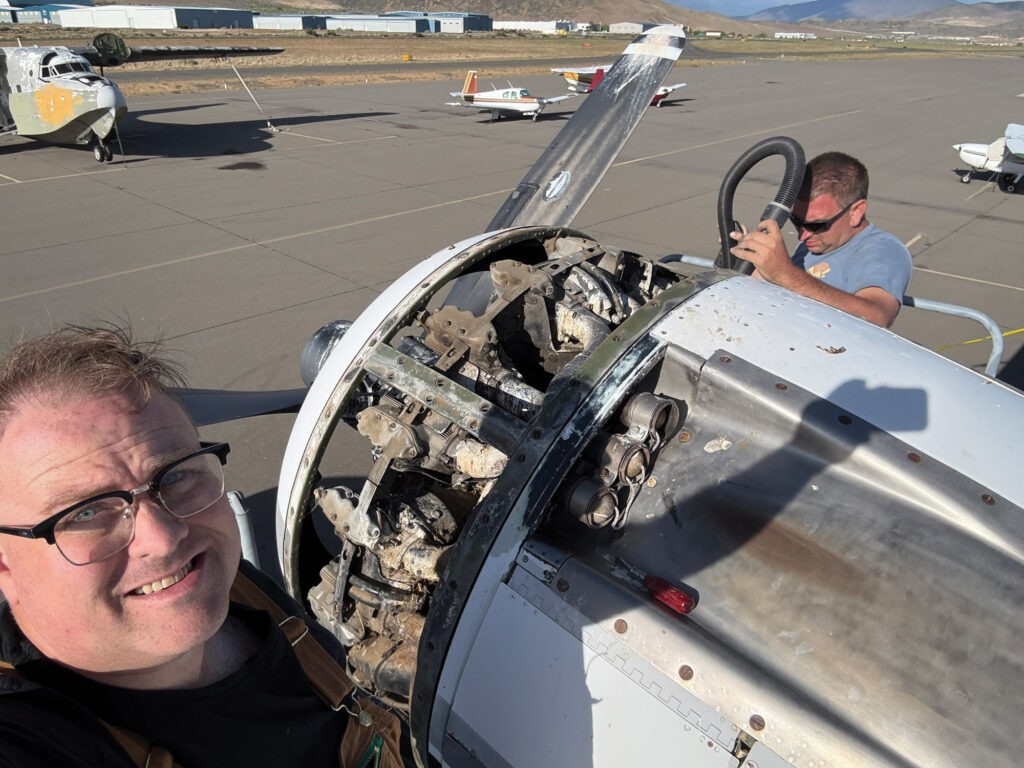
Many compartments within the engine bay were stuffed completely full of nests and waste. We burned through no telling how many shop-vac batteries as we broke the nests loose and sucked them up. Much like a water line measured inside the hull of a ship, the bottom of the cowling was filled up nearly to the lip of the inlet. I made a number of references to things being above or below the “poop line,” and nobody asked for clarification.
I removed a number of dead birds—some skeletonized, some mummified, and some preserved in radial engine oil. The intake ducts were packed solid with feces and bedding. The bird stuff was messy and disgusting, but at least it was mostly dried out from the desert air.
Meanwhile, in the cabin, Kim and Dave were waging war against a terrible odor. Kim and Nick had already removed the interior, which helped a lot, but the insulating foam glued to most of the interior skins was grungy, brittle, and smelly. It had a similar density and texture to Oasis, the hard foam used in floral arrangements to hold stems in place and wick water up from the bottom of the vase.
That foam also could have hidden a catastrophic amount of corrosion, so it had to go. Some of it pulled away nicely, still pliable. Much of it had dried to the consistency of charcoal or lava rock from a fire pit. Fingertips, abrasive wheels, and untold curses muffled by respirators conspired in a dogged effort that took most of a day before claiming victory.
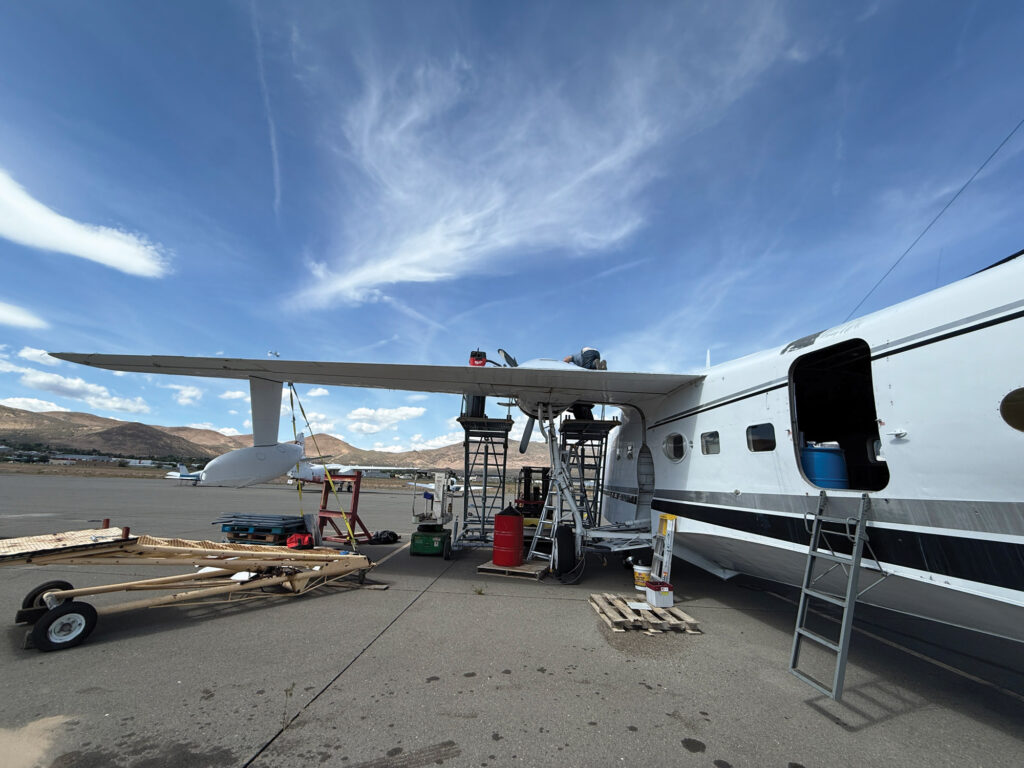
In the meantime, Nick and the other Dave had pulled the ailerons, and by the time Monday rolled around, we were ready to remove the engines. Now, quick change or not, there’s nothing trivial about the undertaking of removing two 1,500-pound engine packages off a wing where the prop hubs sit about 14 feet off the ground.
Paul Le Veque, an Albatross pilot, restorer, and mechanic joined us for engine day. Le Veque brought all the special tools for removing the propellers and disassembling them for transport, as well as the lifting cradle for the engine that attached at four points, allowing the assembly to be hoisted away on a crane.
A diesel Unimog, equipped with a crane, came in handy as we lowered the propellers, then the engines, to the ground. None of us dared take a deep breath until the last engine was bolted to the work stand at ground level. Then we all sighed deeply, wrapped up the work day, and celebrated at the hotel with a steak dinner.
The next day, we pulled the elevators, which were pretty straightforward, and then the rudder, which wasn’t. By the time we got to that, the winds were pretty gusty, and trying to wrestle the giant control surface free, even supported in a sling, posed all manner of challenges. But at that point, we’d achieved our goals, and called it a day.
Kim rode back to Sacramento, California, with me to catch a flight home on Wednesday—we both had trips starting that Friday. Nick still had another 12 days before his next trip, so he stuck around and got the engines ready to ship out for IRAN (inspect and repair as necessary), crated the propellers, and then tackled a task I feared deep down in my soul.
Hooking a power cart up to the Albatross, he flipped the master switch on. Three green lights illuminated for the landing gear position. The avionics all came to life, except for the transponder. It was way past my bedtime that night as Kim recounted watching via FaceTime video as Nick brought their bird back to life, one circuit at a time. No smoke, no sparks. I held off as long as possible before telling her that I had to call it a night. The last thing I wanted to do was cut short her celebration.
The dynamic duo still has a long road ahead of them before they push the throttles up to start the trek home, but I’ll be keeping tabs on them and pitching in when the schedule allows. You can follow along, too. Find “Albatross Alpha Charlie” on Instagram or Facebook, and join me in cheering Nick and Kim along on their quest.