










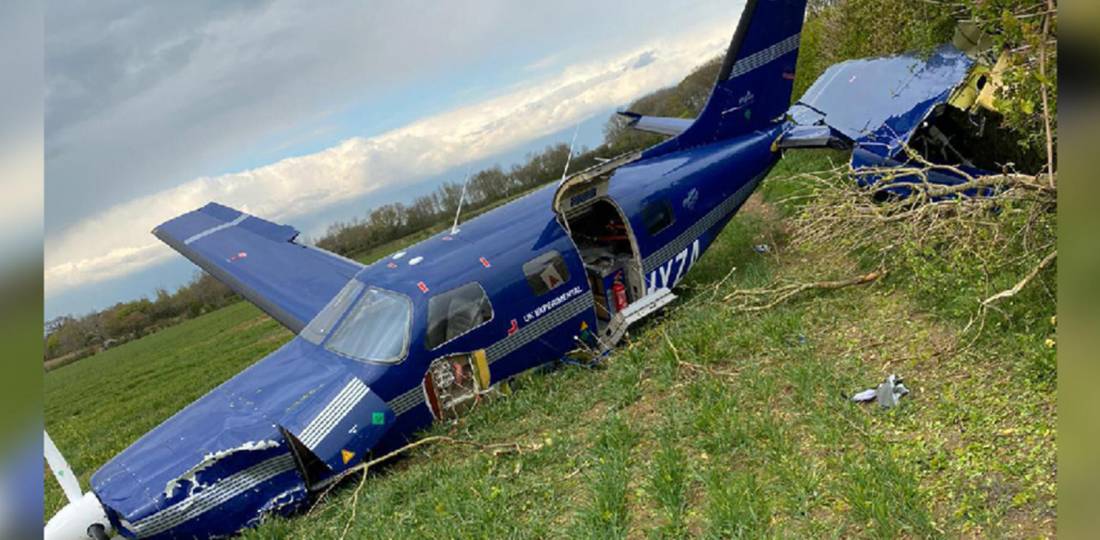

U.S/UK hydrogen-power research company ZeroAvia’s Piper Malibu Mirage test aircraft made a gear-down forced landing in a field adjacent to Cranfield Airport in England on April 29. No one was injured, according to ZeroAvia, but photos show the aircraft is heavily damaged, with its left wing separated at the root. The PA46 was on a “routine pattern test flight,” according to the company. There was no fire, which ZeroAvia cited as evidence of the safety of its hydrogen-power research to date.
ZeroAvia recently received $24.3 million in funding from investors, including British Airways. On March 31, ZeroAvia announced plans to develop a 50-seat hydrogen-powered airliner. The UK government has supported ZeroAvia and the nation’s Jet Zero Council promises “a laser focus on UK production facilities for sustainable aviation fuels and the acceleration of the design, manufacture and commercial operation of zero-emission aircraft.”
Some, however, are questioning the details behind the company’s power claims. An article in TechCrunch detailed the level of challenges that ZeroAvia faces, nothing that the aircraft is not a true hydrogen-powered model but, rather, a hybrid electric-hydrogen aircraft, with batteries supplying the majority of the plane’s power. Its Malibu Mirage’s passenger seating section is nearly completely taken up by batteries, which provide the majority of the aircraft’s power.
ZeroAvia is a U.S./UK company founded in California four years ago. It has been test-flying the Mirage since its maiden flight in September 2020 at Cranfield Airport and preparing for a 70-mile flight from Cranfield to Cotswald Airport (formerly Kemble Airfield), a former RAF base in Gloucestershire, southern England. ZeroAvia had also announced plans to fly the test aircraft sometime later this year from the Orkney Islands to the Scottish mainland, a distance of some 250 miles.
It remains to be seen how much of an impact the crash will have on the company’s development timetable. A company spokesperson told TechCrunch that ZeroAvia has launched an internal probe to fully understand why the plane crashed and what to do about it.