

Most commonly used aviation gasoline for piston engines:100LL
Dye used in 100LL:1,4-dialkylaminoanthraquinone (also called C.I. Solvent Blue 98)
Dye color:Blue
Average cost of 100LL in the U.S., April 2017:$4.75/gal.
Average cost of avgas in the U.S., 1980:$1.95
Density of avgas (all grades) at 15° C:6.01 lbs./U.S. gal.
Density of avgas (all grades) at -40° C:6.41 lbs./U.S. gal.
Freezing point of avgas:-58°C
Emission coefficient of avgas:18.4 lbs.CO2 per U.S. gal.
Octane rating:measures how much the fuel can be compressed before it spontaneously ignites (knock/detonation)
Determining factor for minimum octane rating needed in an engine:compression ratio
Benefits of higher compression ratio:more power for a given fuel burn
Tetraethyl Lead (TEL):additive mixed with gasoline to allow increased engine compression without detonation
Chemical formula of TEL:C8H20Pb
Amount of TEL per 1 gal. 100LL:1.2-2 grams
Chemist credited with discovery of effectiveness of TEL as an antiknock additive: Thomas Midgley Jr.
Year of Midgley’s discovery:1921
Also discovered by Midgley:use of ethylene bromide to expel lead in exhaust to help prevent buildup in engine
Harmful effects of TEL in humans:lead poisoning; many harmful effects including neurological, cellular and immunological damage
Exposure risk:TEL can be absorbed through skin contact with fuel or inhalation of exhaust (GA pilots most at risk due to cumulative effects of regular exposure)
Problems with TEL in engines:spark plug fouling, lead deposits in engine (especially if fuel octane rating is too high for the engine)
Amount of lead (Pb) in 1 gram TEL:640.6 milligrams
Only non-Chinese company producing TEL: Innospec Specialty Chemicals, headquartered in Englewood, Colorado
Use of TEL:banned for automotive use in many countries, including the U.S.
Reason TEL is still used in avgas:no operationally safe alternative is available yet
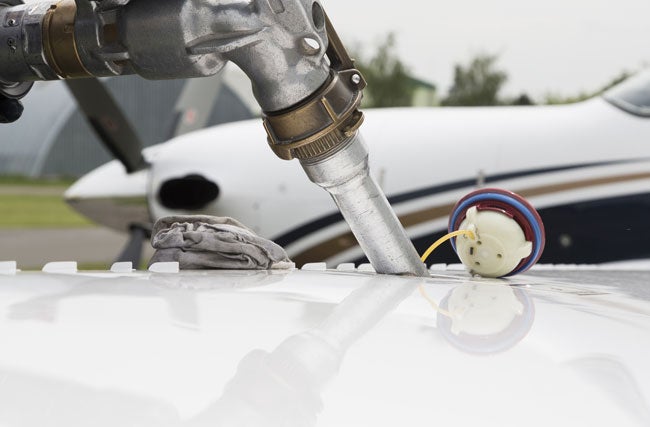
Most commonly used aviation gasoline for turbine engines:Jet A-1
Freezing point of Jet A-1:-47°C (-53°F) or below
Primary difference between Jet A and Jet A-1:Jet A-1 is required to have an anti-static additive
Density of Jet A-1 at 15°C:6.71 lbs./U.S. gal.
Type of fuel, Jet A and A-1:kerosene-based (unleaded)
Color:straw-colored
Emission coefficient of jet fuel:21.1 lbs. CO2per U.S. gal.
Average cost of 1 gallon Jet A, April 2017:$4.17
Average cost of 1 gallon Jet A, 1980:$0.87
Amount of aviation gasoline produced in the U.S., 2016:4,080,000 barrels
Amount of kerosene-type jet fuel (commercial) produced in the U.S., 2016:576,317,000 barrels
Number of U.S. gallons per barrel:42
Alternatives to traditional jet fuel:biofuel and biofuel blends
Some biofuel components:municipal solid waste, used cooking oil, jatropha, camelina and sugarcane
Alternatives to 100LL:unleaded substitutes under development via the FAA’s Piston Aviation Fuels Initiative (PAFI)
PAFI goal:finding and qualifying unleaded avgas substitutes that will safely work fleet-wide
Members of PAFI Steering Group:AOPA, EAA, GAMA, NATA, NBAA, FAA
Date PAFI began:June 2013
Original PAFI entrants:17 formulations from 6 companies
Number of formulas that made it to Phase 1 testing:4
Current status of PAFI:engine and aircraft testing of selected formulas (Phase 2 testing)
Number of formulas in Phase 2:2
Date Phase 2 began:Summer 2016
Date Phase 2 is scheduled to conclude:2018
Phase 2 Formulas:Shell UL100 and Swift UL102
Only unleaded high-octane avgas to have an ASTM Production Specification approval:Swift UL102 (ASTM D7719)
Number of U.S. GA aircraft that rely on 100LL for safe operation:Approximately 167,000