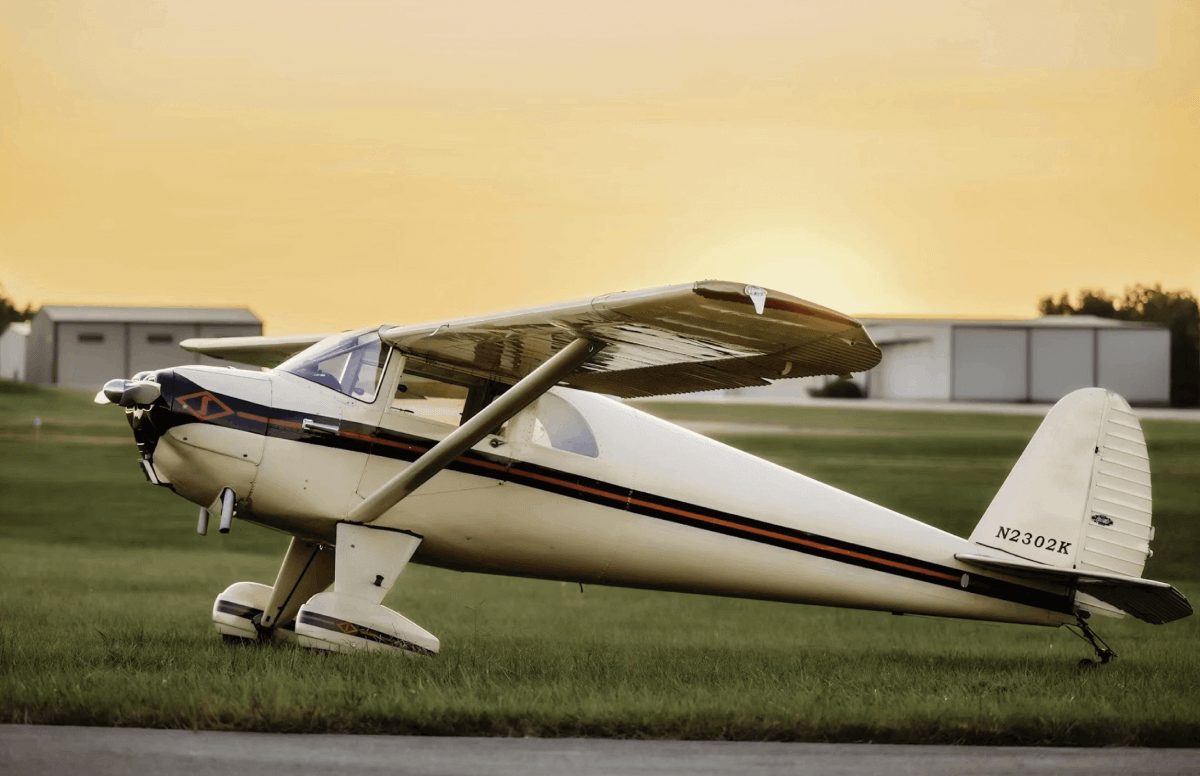











![ScaleWings’ SW-51 Mustangs power their way over Gillespie County Airport in Fredericksburg, Texas. [Credit: Glenn Watson]](https://planeandpilotmag.com/wp-content/uploads/2026/02/DSC_0321-2-Edit-1.jpg)

Is Fredericksburg my favorite Texas fly-in town?
I think so (with San Antonio, about 55 nm to the southeast, a close second). Here’s why: Enjoyment is yours from the moment you land at Gillespie County Airport (T82), because the Fredericksburg FBO offers everything you need—smiling faces, 24/7 self-serve fuel, line service, two huge insulated hangars, and easy on-site car rentals. TacAero (see Pilot Resources sidebar in this issue) offers fun, specialized pilot training.
Just remember, when flying in or out, that the surrounding hills are dotted with numerous towers, especially one that rises to 3,049 feet msl (1,149 feet agl) 17 nm southeast of T82.
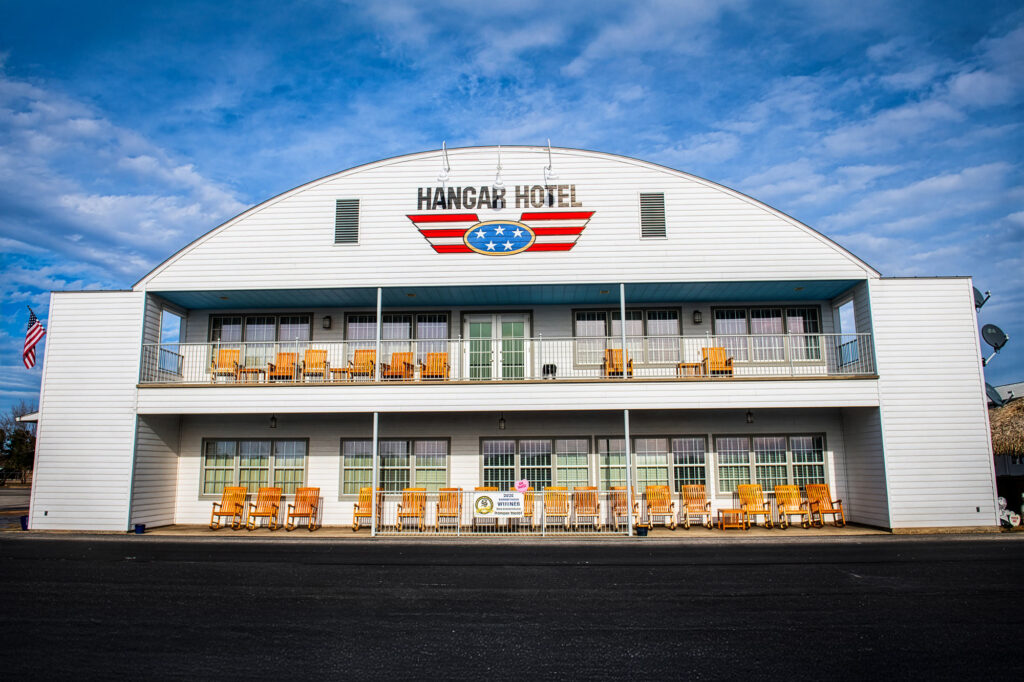
Right behind the FBO you’ll see the big Quonset hut that houses the famous Hangar Hotel, a big part of what makes a visit to Fredericksburg so memorable. Step into the lobby and step back in time—did you just walk into a classic movie set? This place may have opened in 2003, but it hasn’t missed a detail in recreating the 1940s.
Quonset huts were typical of many World War II hangars in the U.S., but many of the architectural features are modeled after the old wooden hangar at the former Brooks Air Force Base in San Antonio. Additional information and style tips were provided by staff at the nearby National Museum of the Pacific War—more on that facility later.
Behind the front desk, pigeonhole boxes hold keys and messages for hotel guests. The curved counter is paneled in rich mahogany, while sumptuous red leather chairs bask in warm light from the ceiling’s art deco chandeliers. Check out the clocks that display time zones around the world, and don’t miss the 1940s-era telephone switchboard and vintage radio that plays period tunes.
The mood continues as you open the door to your room. There’s a chair lined with bomber-jacket leather, a vintage telephone, a king-size bed topped by a classic Army blanket (made to pass inspection of the pickiest military inspector), and a classic black-and-white tiled bathroom. No worries though, the linens are high-thread count, and the bathroom fixtures and lighting are up to modern standards.
After you freshen up—and maybe dress up, why not?—you can step into the Officer’s Club for a drink, play a bit of pool, listen to the grand piano, or relax by the mahogany-and-granite fireplace.
Can’t get enough aviation? Step out to the second-floor observation deck, which offers a panoramic view of the runway. All you need now is a parade of Corsairs and Mustangs to complete the scene—well, we can wish anyway.
The ’40s theme continues in the Airport Diner, which may remind you of those you’ve seen on railcars in classic films, with its polished floor and curved ceiling of mahogany-trimmed birch.
If this is a romantic date, just snuggle into a cozy booth, which also offers views of the runway. Or perch yourself up on a stool at the granite soda fountain counter and watch the kitchen proceedings. Don’t pass up the opportunity for that perfect vanilla malt, blended with locally made ice cream, to go with the classic American cuisine—think burgers, sandwiches, and salads; or pancakes, waffles, and omelettes at breakfast.
Rested and fed, it’s time to head into town, only a few blocks away. The name and spelling of Fredericksburg should be the first clues that this town has long had a German influence.
After 1836, when Texas gained its independence from Mexico, the new republic began a far-reaching campaign to attract immigrants and other settlers. Johann Friedrich Ernst, who had been granted 4,000 acres from Stephen F. Austin’s colony, mailed a letter to a German friend, extolling the Texas Hill Country’s mild climate. Hundreds of Germans began arriving shortly thereafter, and the settlement was named after Prince Frederick of Prussia.
Despite the good climate, it wasn’t an easy transition. The settlers successfully negotiated a peace treaty with the Comanche tribe, which was never broken, but the German immigrants were often harassed by other Texans. In addition to the language barriers, the now German Americans generally opposed both slavery and Prohibition. Then there were the two World Wars, both fought against Germany.
But the town and its people prospered despite the challenges, as can be discovered through exploration. Stroll down Main Street and stop for fresh-baked strudel served with good strong coffee. Pick up a handmade wooden nutcracker or German “smoker”—a whimsical figure that opens up so a small cone of pine-scented incense can be placed inside. The smoke wafts out of the nose.
Oktoberfest is year round here, so try a good old-fashioned German lager at one of the biergartens.
The Marktplatz sits at the center of town, where the Vereins Kirche Museum can be found exhibiting 18th-century German artifacts and buildings. A maypole serves as a timeline of the city.
Don’t miss the 55,000-square-foot National Museum of the Pacific War, the only museum in the country dedicated to the Pacific Theater of WWII. Did you know that U.S. Navy Fleet Admiral Chester Nimitz was born and raised in Fredericksburg?
My parents, who immigrated to the U.S. from Denmark in the early 1950s, lived through the Nazi occupation of Denmark in their youth, and I grew up with stories from that part of the war. But only decades later did I learn that my best friend’s father, Robbie Robinson, had flown a TBM Avenger in the Pacific Theater and survived a fiery crash. Plus, one of our late local pilots in Idaho served in the same squadron as then 19-year-old George H.W. Bush. Hellcat pilot Nat “Blackie” Adams was instrumental in saving the future president after Bush’s TBM was shot down.
I wrote about both these heroes for the High Sierra Pilots Club (Google “High Sierra Pilots 271 Days of Combat” or “High Sierra Pilots in the Navy”), so this museum, with its TBM Avenger on display, newly renovated Bush gallery, and more, hits home for me.
Head east for 20 minutes (I prefer the more scenic Olive Street route over U.S. 290) to the Lyndon B. Johnson national and state historical parks, known during LBJ’s tenure as president as the “Texas White House.” Johnson purchased this land in stages, eventually amassing nearly 3,000 acres, which includes a private airport.
At the state park visitors center, a two-hour guided tour is offered to see the ranch, family cemetery, Official Texas State Longhorn Herd, and wildlife such as deer and bison. I’m old enough to clearly recall Lady Bird Johnson’s “Keep America Beautiful” campaign to plant wildflowers along U.S. highways. I even have some of the original 6-cent U.S. first class postage stamps—and if you visit in spring, which I recommend, you’ll see bluebonnets, Indian paintbrushes, and many other wildflowers in full bloom.
If you drive back on 290, stop at Wildseed Farms for more flowers, along with wine tasting, gourmet gifts, and the Brewbonnet Biergarten for a Frito pie, German taco (it’s bratwurst) or barbecue brisket sandwich.
Speaking of the first lady, if you’re a golfer, play at the Lady Bird Johnson Golf Course adjacent to the airport. But my taste is for wine—and wildlife. So, for something completely different, visit Grapetown Vineyard and Farm and hang out with the zebras, kangaroos, and other animals and/or taste the wines.
If you’re a fan of giraffes, check in to Longneck Manor, where the tall creatures are just outside your second-floor window.
Who knew you could find all these unique adventures in one little town?
This article first appeared in the March/April 2026 issue of Plane + Pilot magazine.