










 |
Determining aircraft types isn’t as easy as it used to be, when seeing a hump on the front meant it was a 747, and three tail-mounted engines indicated you were in for a noisy 727 departure. Today, many aircraft look fairly similar, and as a private pilot, when that air traffic controller tells you to watch out for that traffic of an Airbus A340, you should know what it is that you’re looking out for.
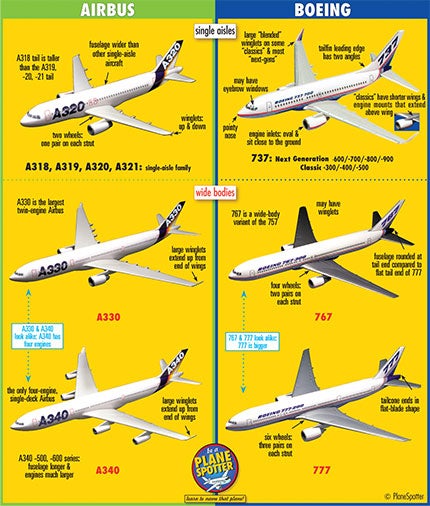
The heavy workhorses from Airbus and Boeing can get confusing in a hurry if you don’t know what to look for. First, if you see a set of four engines on the wings without a hump, you’re no doubt looking at an Airbus A340. Another feature of this aircraft is the way its winglets aren’t straight up, but rest at a slightly outward 45-degree angle. Its sister ship, the A330, is nearly identical, but with only two engines as opposed to four.
The Boeing 777 is a twin-engine aircraft that has a noticeably wider fuselage, wider-still engines and the surefire feature of a bladed tailcone. Slightly smaller is the 767, which is a fairly simple and featureless tube. You can eliminate it from a 777 because of its rounded tailcone, but winglets tell you even more. The 767 may or may not have winglets, and if you see none, it’s definitely not an Airbus. If it has tall, thin winglets that stick straight up, then that’s a way to know that you’re looking at a “six seven.”
The accompanying diagram from www.planespotter.com explains the differences on how the nose, tailcone, empennage, winglets and even windows and struts will help you determine which is what. Plane Spotter guides are laminated aircraft-identification guides that feature a comprehensive collection of airliners. You can purchase one at www.nycaviation.com/store to show off your knowledge and be aware of your surroundings in the sky.
Phil Derner, Jr., is president of www.nycaviation.com, an aviation news and resource site geared toward aviation enthusiasts and industry professionals.