











 |
| STANDARD DATA: (690B) Seats 7-10. Gross wt.10,250. Empty wt. 6,195. Fuel capacity 389. Engines 700-shp Garrett AiResearch turboprops. PERFORMANCE: Top mph 330. Cruise mph 321. Stall mph 89. Initial climb rate 2,849. Range 1,458. Ceiling 33,000. Takeoff distance (50′) 1,666. Landing distance (50′) 2,084. STANDARD DATA: (681B) Seats 8-9. Gross wt.9,400. Empty wt. 5,647. Fuel capacity 286-337. Engines two 605-shp AiResearch turboprops. STANDARD DATA: (Hawk) Seats 8-10. Gross wt.9,400. Empty wt. 5,783. Fuel capacity 286-337. Engines two 605-shp AiResearch turboprops. |
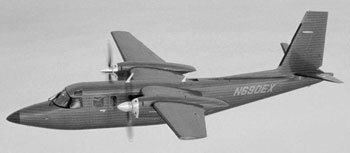
The Turbo Commander first appeared in 1965 as a pressurized version of the Grand Commander. Power was supplied by twin 605-shp AiResearch turboprop engines, each driving a three-blade constant-speed reversible-pitch propeller. This model became known as the Turbo Hawk and was built until 1971 when it was replaced by the Turbo Commander 681B, another pressurized version similar to the Shrike Commander. A pair of 605-shp turboprops were still used until the 690 was introduced in 1972 with 717-shp powerplants. The Turbo Commander cabin can be pressurized to 5.2 psi. and the operational ceiling is 31,000 feet. Interior temperature is controlled by a high-volume climate system, and heated windshields provide maximum visibility in all weather conditions. The Turbo Commander is also certified for flight into known-icing conditions, and all deicing equipment is standard. While the 690A is just minutes slower that most business jets on a 900- to 1,000-mile business trip, fuel consumption is about 50% less.
The combination of reversible props, tough landing gear, high-wing, and 14-inch prop clearance are custom-tailored for short, rough landing strips. Engines that are flat-rated from 840 shp, to a nominal 700 shp help the 690A climb directly to the best cruise altitude without lengthy step climbing. The 690B was offered in the Executive I and Executive II models. Many features that are usually considered optional are standard equipment in the Executive I, including avionics and cabin accommodations. The Executive II was for owners who wanted to select their own avionics and interior appointments.