











 |
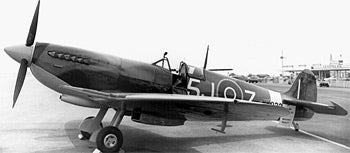
| STANDARD DATA: (Spitfire 1) Seats 1. Gross wt.5,332. Fuel capacity 102. Engine Rolls-Royce Merlin III. PERFORMANCE: Top mph 367. Initial climb rate 3,000. Range 500. Ceiling 40,000. |
Six years of war proved the basic Spitfire design to be highly successful. In actuality, the first Spitfire was outfitted with a 600-hp Goshawk engine and fixed landing gear. The name was later transferred to the more familiar aircraft that was the product of high-speed design features borrowed from three successive Schneider Cup Trophy Contest winners that set three world speed records. Powered by one of the earliest Merlin engines turning a fixed-pitch prop, the prototype classed itself as the fastest military plane of its day.
The Spitfire I saw the early Merlin replaced by a Merlin III and the two-blade wooden prop exchanged for a three blade controllable-pitch metal prop. Subsequent Spitfires housed Merlin XII, 32, 45, 46, 47, 61- 66, 70, 71, 77, Griffon III, IV, and 65 engines. Standard wings were elliptical in design; however, some were fitted with shorter square-tipped or pointed wings. Some later versions were equipped with a bubble-type rearview canopy.