

We rolled into the gate at William P. Hobby Airport (KHOU) in Houston a few hours late. I was frazzled. The day began with a round trip to Columbia, South Carolina, where a solid shaft of rain parked on the airport as we were being vectored to the approach. The long runway was out of service. The only runway remaining with a precision approach had a 5-knot tailwind, which was legal, but the wet runway, combined with a modest length, added a couple of variables that we didn’t want to tangle with.

The GPS approach into the wind needed one and three-quarters miles of visibility. Tower was reporting a half mile.
So, we took a vector to hold. “Hey, it looks good over this way,” approach offered, and sent us to a holding point on the missed approach. Looking good on his scope and looking good out our windows were two different things, as a bolt of cloud-to-ground lightning flashed past just off the wingtip.
When you hear the thunder in a jet, you’re too close to the action.

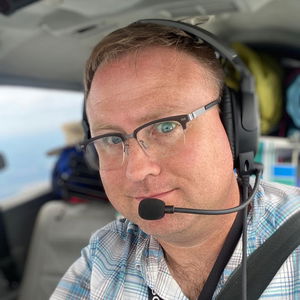
In writing his final Words Aloft column for Plane & Pilot, Jeremy King shared a gallery of photos with coworkers and
colleagues during his nine-year stint with the magazine, including a selfie with
current associate editor Cayla McLeod.
We told the approach controller we were going to take our holding somewhere else. He basically offered us the sky. Other than some random Cirrus and a regional jet that had gone missed off the approach ahead of us, we had it to ourselves.
“Tell me where you want to go, and I’ll tell you the nearest fix to hold at,” the controller said. The dispatcher had blessed us with a lot of extra fuel, just in case, and it made our waiting game a lot less stressful.
The storm passed and we got in, but the next two legs had their share of weather challenges putting us farther and farther behind schedule. By the time we landed in Houston, we just wanted a quiet place to lay our heads—and it was still a half-hour van ride away.
The gate agent stuck her head through the door as we parked. “Hey, friends, heads up. The FAA is here to audit our cleaning and overnight procedures.”
The feds weren’t there to judge us—they likely didn’t know the landing light switch from the landing gear lever, but still, I wanted to ensure all details were perfect. Once we completed the shutdown checklist, the first officer headed down to the ramp for the postflight inspection, and I continued to the second phase of the checklist—to power the jet down for the night.

The secure checklist is the next and final step before we can call it a day. It systematically powers down the airplane. We turn off the inertial navigation systems, shut down the air conditioning and the auxiliary power unit (APU), set up the electrical system to keep the cabin lights powered for when we turn the last few things off, including the emergency power, emergency lights, external power switch, and battery master switch.
The problem is, if I got too far down that list and had the emergency power and lights off while passengers are still deplaning, and the plug drops out of the external power port, the plane goes dark, folks can’t see their way to the exits, and that’s an unsettling situation as you sit in a dark airplane fumbling to restore lights. I’m speaking from experience here. And I dang sure didn’t want that happening with prying eyes of the FAA standing just outside the door. So I held that step.
We got to the hotel at 1 a.m. At 3 a.m., I should have been asleep, not kicking myself for being unable to recollect whether I’d finished the checklist before we walked away. I didn’t get a meaningful bit of sleep until 5:15 a.m. rolled around and the flight departed on time.
If I hadn’t shut things down, the emergency batteries would have been depleted, and they would have still been waiting on the system to recharge. With that validation that I’d properly put the plane to bed, I finally slept a few hours with a clear conscience, waking only with the thinnest of margins to catch the free breakfast at the hotel before it closed down for the day.
We’re taught checklist discipline from day one. But some seem to carry more weight than others—certainly lowering the landing gear before landing is more important than turning the landing lights off as you clear the runway.

However, they all carry some degree of weight, and the checklist to shut down the plane after a long day of flying is a challenging one, even for the professionals, when you just want to get to a seat that’s not bolted to a moving object, and eat a meal that’s not handed to you on a tray. The final click of a jet’s relays as you kill the electrical power is a jolt to the senses when you’ve been accustomed to the hum of cooling fans and the noise of the radios.
Richard Bach wrote a beautiful line summing the end of his epic flight one night in an F-84 in Europe, more than 50 years ago: “My airplane is quiet, and for a moment still an alien, still a stranger to the ground, I am home.”
Nine years ago, I joined Plane & Pilot, writing as a regional jet first officer. To say the landscape has changed is an understatement.
In addition to sharing tales of Mooney adventures and the flyers I’ve known over the years, I’ve shared the journey through three airlines and the upgrade to captain last year.
My heart is the grassroots flying. At Oshkosh or Lakeland, you’ll find me favoring the interactions on the flight line, meeting pilots, learning their stories, drooling over beautiful flying machines, and sharing in the love of flight. I’ve shared their stories and mine, trying to lean into the experiences and the people more than the products and the posh lifestyle that many insist on associating with planes and pilots.
Many at my day job ask how I manage to tell a story every month. My challenge is narrowing the tales to one a month, or else I’d be at the keyboard anytime I don’t have a yoke or a wrench in hand.
As I reach for a figurative power switch, I sincerely thank every single reader and friend I’ve made along the way. Maybe we’ll meet again in words, in person, or in another life.
Secure checklist complete.