











 |
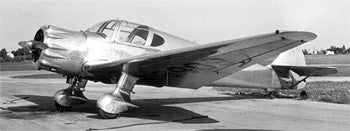
| STANDARD DATA: Seats 3. Gross wt. 2,150. Empty wt. 1,350. Engine 145-hp Warner Super Scarab radial or 150-hp Supercharged Menasco. PERFORMANCE: Top mph 152. Cruise mph 140. Stall mph 45. Initial climb rate 900. Ceiling 19,400. Range 520. |
The Ryan Aeronautical Co. was the successor to the old Ryan Company that produced Charles Lindbergh’s Spirit of St. Louis. The original company, known as Ryan Airlines, began operations in 1922, and rapid expansion took place after their transatlantic success; however, the Depression took its toll, and in 1931 T. Claude Ryan reentered the industry by forming the Ryan Aeronautical Co. Production of the SC all-metal three-seat cabin monoplane began in 1938. The aircraft was either fitted with the 145-hp Warner Super Scarab seven-cylinder radial or the 150-hp Menasco supercharged inline engine. The wings were detachable, supported by an all-metal structure and covered by stressed Alclad metal. Accommodations were for three under a sliding canopy: two up front and one in the rear.