











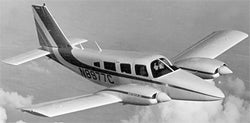
 Seneca II | 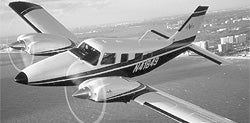 Seneca V |
| STANDARD DATA: Seneca II Seats 6. Gross wt. 4,570. Empty wt. 2,839. Fuel capacity 98-128. Engines two 200-hp turbocharged counter-rotating Continentals. PERFORMANCE: Top mph 226. Cruise mph 219. Stall mph 70. Initial climb rate 1,340. Ceiling 25,000. Range 627-903. Takeoff distance (50′) 1,240. Landing distance (50′) 1,860. | STANDARD DATA: Seneca V Seats 5-6. Gross wt. 4,570. Empty wt. 3,413. Fuel capacity 122. Engines two 220-hp turbocharged Continental TSIO-360-RB. PERFORMANCE: Top Cruise 197 kts. Stall 61 kts. Initial climb rate 1,550 fpm. Ceiling 25,000. Range 730-820 nm. Takeoff distance (50′) 1,707. Landing distance (50′) 2,180′. |
The Piper Seneca was first produced in 1972 and was sold alongside the Twin Comanche until 1973 when the latter was discontinued. More Senecas are powered by twin Teledyne Continental counter-rotating engines with full-time turbocharging. The engines are rated at 200 hp at sea level and develop 215 hp at 12,000 feet, which allows for a 75-percent cruise speed of 218 mph. With the extended-range tanks, it’s possible to travel 900 miles and arrive with a 45-minute fuel reserve. At economy power it’s possible for the Seneca to get 55 seat miles per gallon with a load of six. Full-time turbocharging helps increase the Seneca’s gross weight and climb performance. With turbocharging, power output is actually increased as the airplane gains altitude. Piper did away with the costly hydraulic wastegate system often found on other turbochargers and uses a low-cost fixed-bypass instead.
The ailerons were also lengthened to improve handling and slow-speed characteristics. A large utility door was located aft of the rear passenger door. The Seneca III added positive slow-speed characteristics. A new bobweight in the stabilator control system has heightened dynamic stability and reduced downspring forces. In the rudder, an antiservo tab helps increase directional stability and rudder effectiveness. The ailerons are long and aerodynamically balanced. Senecas also offered conference seating in a wide-ride cabin, measuring four feet in width. Five standard and four optional interior packages were available with several new aerodynamic speed enhancers.
Major additions in 1979 included optional threeblade propellers and a propeller synchrophaser. The three-blade props reduced cabin noise and vibration. The synchrophaser electronically seeks and maintains synchronization of the propellers to further reduce cabin noise levels. The Seneca II and III are certified for flight into known icing conditions when equipped with the appropriate optional deice package, which was available for both two- and three-blade models. A heavy-duty brake option reduced landing distance over a 50-foot obstacle from a standard 2,110 feet to 1,860 feet.
The Seneca III was replaced by the IV in 1994, when New Piper added some aerodynamic refinements (including axisymetric engine inlets in the cowlings) and some upgrades to the interior. In 1997, the Seneca V was introduced with its turbocharged, intercooled L/TSIO-360-RB engines. The turbos allowed the Seneca to produce its rated power all the way up to 19,500′. In an effort to make the Seneca V more marketable as both personal and corporate transportation, New Piper replaced a seat with a workstation/entertainment center with an optional phone/fax.