











 |
| STANDARD DATA: Seats 4. Gross wt. 3,800. Empty wt. 2,354. Fuel capacity 110. Engines two 180-hp Lycomings. PERFORMANCE: Top mph 193. Cruise mph 191. Stall mph 63. Initial climb rate 1,340. Ceiling 17,100. Range 898. Takeoff distance (50′) 1,400. Landing distance (50′) 1,190. STANDARD DATA: (Turbo) Seats 4. Gross wt. 3,925. Empty wt. 2,430. Fuel capacity 110. Engines two 180-hp turbocharged Lycomings. |
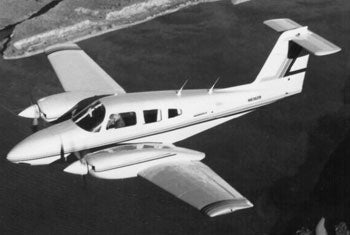
In the light-twin field, Piper has always dominated the industry with the Apache, Twin Comanche, and Senecas. While the Seminole was more than a simple homogenization of existing Piper components, it did borrow most of its fuselage from the Arrow III, from what would be the forward firewall to the aft cabin bulkhead. The T-tail was actually developed on the Seminole first, but introduced on the Lance II. The wings are basically beefed-up versions of the semi-tapered Arrow III to within four feet of the tip. Like the Seneca II and the Navajo C/R, the Seminole uses counter-rotating propellers for balanced thrust, and optional three-blade propellers in 1979 provided a quieter ride. Also in the same year, a propeller synchrophaser further reduced cabin noise levels.
Two 54-gallon fuel tanks are fitted in the engine nacelles. At 75% power and 7,000 feet, the Seminole cruises at 191 mph. When leaned to 65%, best-economy power cruise speed is 181 mph, and range is 898 miles with a 45-minute reserve. At 3,800 pounds gross, the Seminole weighs the same as Gulfstream American’s Cougar, which flies between a pair of 160-hp engines; thus, each Seminole horsepower must heft only 10.6 pounds compared to the Cougar’s 11.9 pounds/hp loading. From the beginning, Piper intended the Seminole as a relatively inexpensive alternative to high-performance singles.
In the middle of 1980, Piper introduced a turbocharged version of the Seminole powered by twin Lycoming TO-360 counter-rotating engines. At 65-percent power economy cruise, the Turbo Seminole can travel at 194 mph over a distance of 920 miles burning fuel at a rate of 19 gph. Standard equipment includes a built-in oxygen system that consists of a rear-mounted bottle with easy-to-reach overhead outlets, night-lighted pressure gauge, oxygen masks, and a control-wheel mike button. Piper’s financial troubles brought Seminole production to an end in 1990. Five years later, New Piper Aircraft resumed making the entry-level twin, the only remaining T-tail aircraft in the line.