











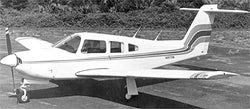
 Piper Arrow IV | 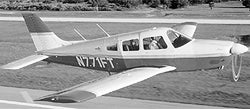 New Piper Arrow |
| STANDARD DATA: (Arrow) Seats 4. Gross wt. 2,750. Empty wt. 1,593. Fuel capacity 77. Engine 200-hp Lycoming. PERFORMANCE: Top mph 175. Cruise mph 165. Stall mph 63. Initial climb rate 831. Ceiling 17,000. Range 932. Takeoff distance (50′) 1,600. Landing distance (50′) 1,525. | STANDARD DATA: (Turbo Arrow) Seats 4. Gross wt. 2,900. Empty wt. 1,638. Fuel capacity 77. Engine 200-hp turbocharged Continental. PERFORMANCE: Top mph 205. Cruise mph 198. Stall mph 66. Initial climb rate 940. Ceiling 20,000. Range 897. Takeoff distance (50′) 1,620. Landing distance (50′) 1,555. |
First introduced in 1967 with a 180-hp Lycoming, Piper offered a 200-hp Arrow in the latter half of 1969. Both the 180-hp and 200-hp Arrows were sold through 1971, but in 1972 an all-new Arrow II was announced in Lock Haven. The Arrow II had a number of refinements over the former Arrows. The fuselage was stretched for more passenger leg room, a bigger stabilator was added for stability and better control, a modified upswept rudder was added, and the wing span was increased by two feet to increase gross weight, takeoff run, and rate of climb. Wider cabin windows, a wider cabin door, and a new paint job improved the exterior cosmetics of the Arrow II.
In 1977, the Arrow got the newest Piper wing, making it the Arrow III. In 1979, Piper introduced the Arrow with a T-tail. Models were given the Arrow IV and Turbo Arrow IV designators. Piper claimed, the long popular, high-performance Arrow benefited from the new tail with advanced handling characteristics and reduced cabin noise. But moving the stabilator out of the prop wash also created a decrease in pitch control at slower landing approach speeds. Piper abandoned the Arrow’s T-tail by the end of the 1980s, and from then on relied on a more conventional empennage.