











 |
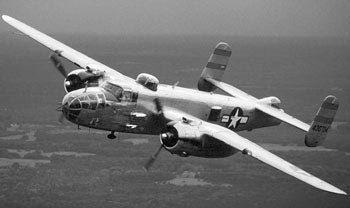
| STANDARD DATA: Crew 6. Gross wt. 33,500. Empty wt. 21,100. Engines two 1,708-hp Wright Cyclones. PERFORMANCE: Top mph 303. Cruise mph 230. Landing mph 95. Initial climb rate 1,110. Range 1,350. Ceiling 24,200. |
The prototype of the B-25 was flown for the first time in 1940. It and the first few B-25s off the production line had wings with a constant dihedral from the fuselage to the tips. Only after the 10th one were the wings redesigned with the characteristic gull configuration. Its armament included four .30-caliber machine guns, one in the nose and three amidships, and a single .50-caliber gun in the tail. The usual bomb load was 2,000 pounds with a maximum overload of 3,600 pounds. Several models of the B-25 were produced in subsequent years. The B-25A was fitted with self-sealing fuel tanks and armor for the pilot. The B replaced the midship and tailguns with electrically operated turrets. Each turret had two .50-caliber machine guns. The lower turret was remote-controlled. The C and D were provided with automatic flight control equipment. The E and F were fitted with experimental deicing equipment. The G was the first model to carry a 70mm cannon. The H increased its armament to four .50-caliber guns in an armored nose and two pairs of.50-caliber guns on each side of the fuselage. The B-25J was produced in the largest numbers. It was the precision bomber version of the H; the crew increased to six to include a bombardier.