












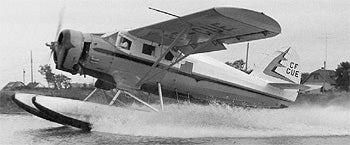
NOORDUYN “NORSEMAN”(C.C.F.)

1935’€“59

Gemini Sparkle

Key Takeaways:

  • The Norseman aircraft, designed by Robert B.C. Noorduyn and entering production in Canada in 1935, was primarily developed as a lightweight freighter and transport for the Canadian bush.
  • During World War II, the Norseman IV, equipped with a 550-hp Pratt & Whitney Wasp engine, was widely used by both the R.C.A.F. and the U.S. Air Corps (UC-64) for utility transport and navigational training.
  • Production of the Norseman continued for an extended period, starting in 1935 and lasting until 1959 under the Canadian Car and Foundry Co. after acquiring the original Noorduyn Co. assets.
See a mistake? Contact us.
STANDARD DATA: Seats 6-8. Gross wt. 7,540. Empty wt. 4,700. Fuel capacity 120. Engines 550-hp Pratt & Whitney Wasp.
PERFORMANCE: Top mph 155. Cruise mph 141. Stall mph 68. Initial climb rate 714. Range 464. Ceiling 17,000.

The Norseman was designed by Robert B.C.Noorduyn in 1934 and entered production in Montreal, Canada, in 1935. Designed primarily for use in the Canadian bush as a lightweight freighter and transport, the Norseman IV with the Pratt & Whitney Wasp engine was used during World War II by both the R.C.A.F. and the U.S. Air Corps as a utility transport and navigational trainer. Altogether 759 aircraft were supplied to the Air Corps under the UC-64 designation. After the war, the Canadian Car and Foundry Co. acquired the assets of the Noorduyn Co. and continued production of an improved Norseman until 1959.

Plane & Pilot

Plane + Pilot is general aviation’s only adventure-based magazine. From where to go, to how to get there, and everything in between, your next great adventure awaits.
Subscribe to Our Newsletter

Get the latest Plane & Pilot Magazine stories delivered directly to your inbox

SUBSCRIBE