










One of the most successful airplane designs of all time is the Quicksilver. Van’s Aircraft of RV fame has delivered more kits, yet with 10,869 RVs presently flying, Quicksilver still remains far ahead with more than 15,000 flying. Naturally, such market success spawned other builders.
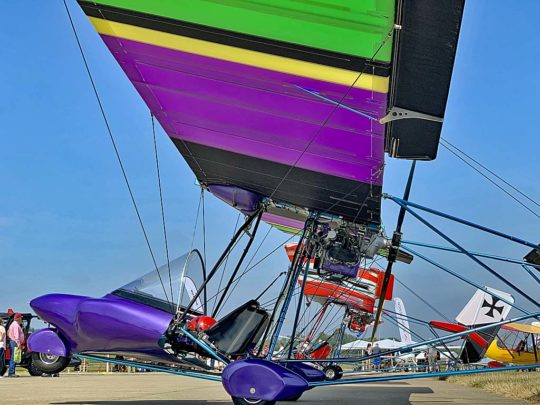 Those who attempted to copy and duplicate Quicksilvers have mostly faded away but some enterprises (see at bottom) built a business out of supplying parts and components that Quicksilver itself never offered.
One of the most successful of these is Tri-State Kite Sales, based in Mt. Vernon, Indiana — and no, not Mt. Vernon, Illinois where the Midwest LSA Expo is held every September.
Andy Alldredge started his Falcon project 18 years ago when he was a lad of 20. The airplane looked good enough that I thought it was something new but, nope. This is a well flown aircraft that has been well maintained.
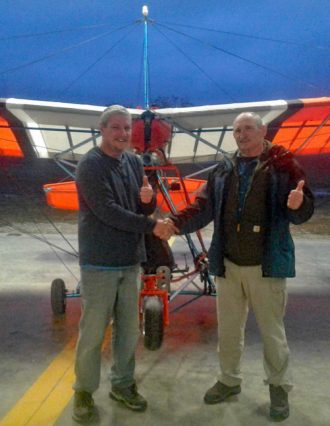
Let’s be fair. Andy has not exclusively labored on Falcon for 18 years. He said, “It was about a five year project, but I worked on it when I had spare time.” Based on my several inquiries since learning more about Tri-State Kite Sales* I have discovered this Indiana company has a very loyal following (mostly from their region) and they have an active, functioning enterprise.
At this point, I want to give credit to the founder of this business. Mark Smith was the man behind Tri-State and he started out making various components for Quicksilver aircraft that the then-California company chose not to pursue.
Quicksilver maintained their business focus on fabricating kits. They were amazingly successful at selling their line. Not only did they ship more than 15,000 kits over many years but in 1982 and 1983, they often claimed deliveries of more than 200 units per month!
Regretfully, Mark Smith died in July of 2017 but his longtime friend, Andy, kept the business going strong. Mark’s nephew Tom Smith also works with the business, handling most of the fiberglass work. The enterprise was and still feels like a family operation.
More on CP Falcon 503
“I wanted to thoroughly test it,” Andy said. Yeah, I guess! Eighteen years is a long development cycle but it was not originally intended for market. Yet, this once-personal project took on a life of its own.
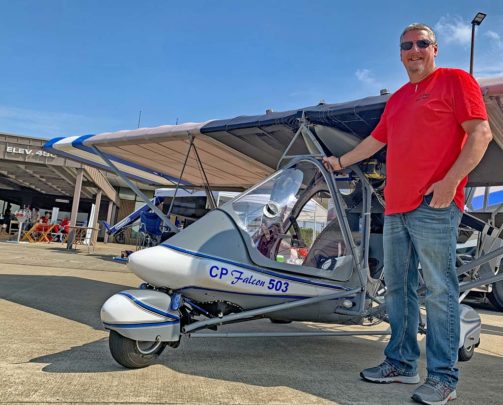 “Now that I think I’ve got it perfected,” Andy expressed, “we’re going to start production on this in 2021.”
Falcon has a lot of components so it will be more expensive. “Yes,” Andy agreed, “it will be a little higher priced aircraft — it takes a lot of time to assemble — but it will fly like a Quicksilver, so those pilots who want to fly faster now have a choice.”
A Quicksilver-type design like the standard “Smithsilvers” that Tri-State makes from scratch typically cruise 40-60 mph where Falcon is as much as 50% faster.
“Yes, this will be a little higher-priced aircraft,” Andy observed, “and it must be built as an Experimental Amateur Built.” Let’s put it in perspective, noting that all prices mentioned below are subject to change.
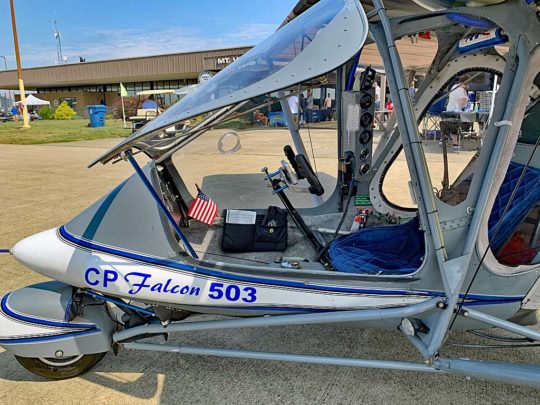 A standard single place Smithsilver by Tri-State Kite Sales assembled for fly away costs about $28,000, said Andy. A two-place with all the extras gets into the high $40,000s and Falcon with a Rotax 503 may come out at about $75,000 equipped as extensively as the one pictured nearby. For those with genuine power lust, a Rotax 582 is also available for about $10,000 more. Contact Tri-State (see near end) for an exact quote and delivery times.
“I created Falcon to be a comfort cruiser for cross country flying,” Andy related. Falcon and the other Smithsilvers may look a lot like a Quicksilver but they are fully Tri-State creations after many years of operation.
 Mark Smith founded the company in the late 1970s and formally organized in 1981. In those 40 years, Tri-State has delivered more than 200 complete aircraft and an uncounted number of aircraft served with replacement parts or Tri-State accessories from fiberglass nose pods to new wing covers and everything in between.
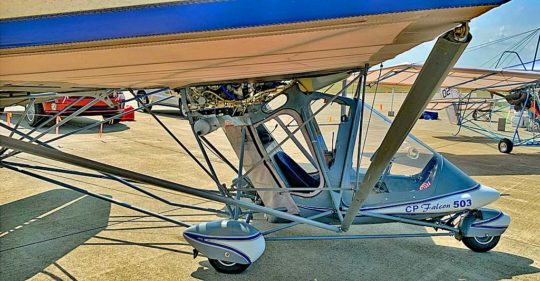
Of all these, Falcon may be the most advanced and sophisticated. It may look like a simple Quicksilver or a Tri-State Smithsilver but Falcon is a step beyond on many ways, for example, creature comforts.
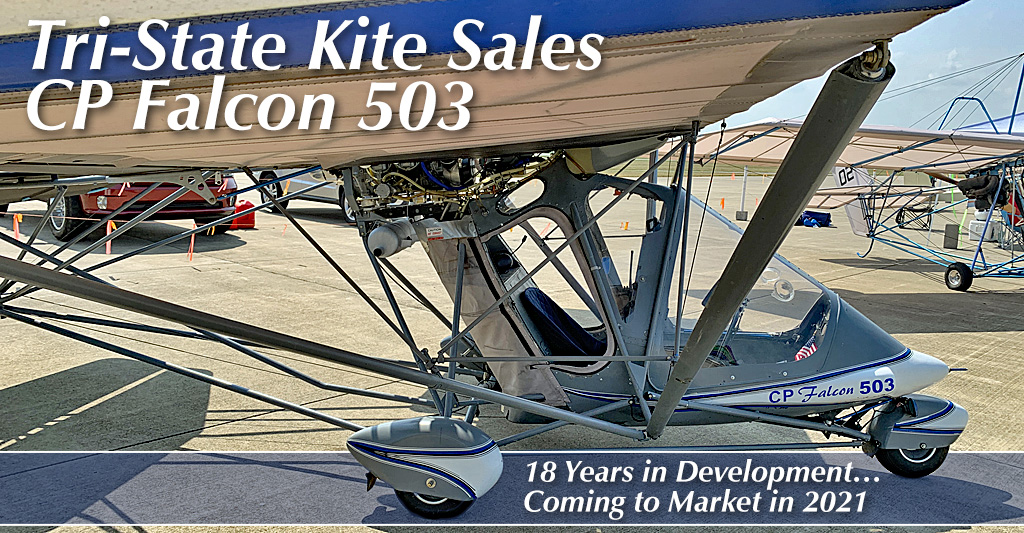
 Falcon has a full enclosure, front to back, and even has cabin heat. “I tested this down to 17 degrees ambient temperature, and you can stay about 70 degrees inside the cockpit.” While the snow swirls around Tri-State and much of the country, that climate control sounds inviting.
Cross country flying is one of the stated purposes. How fast can Falcon fly?
“I can hit 93 miles an hour,” exclaimed Andy, “and cruise is a solid 80 mph.” For those unfamiliar with a standard Quicksilver or Smithsilver, that’s a substantial increase, more than 20 miles an hour faster on average.
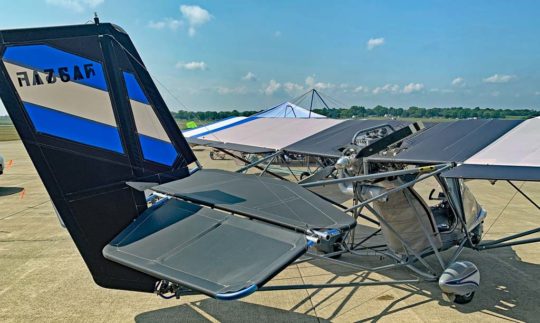
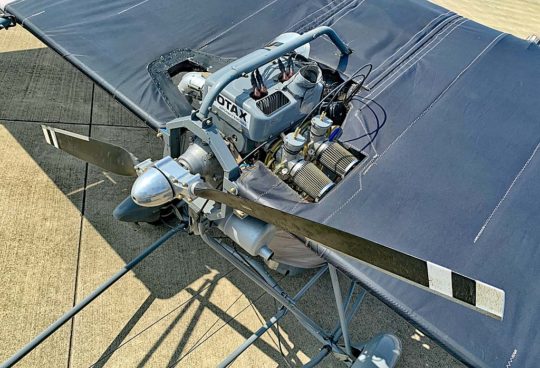 As a nearby image shows, the Rotax 503 engine is nestled down in the aft wing center section because Andy wanted to lower the thrust line to a more neutral position. This means the dual-carb Rotax 503 and its 50 horses push the airplane forwards with less pitch influence, which is a significant part of how it can achieve higher speeds.
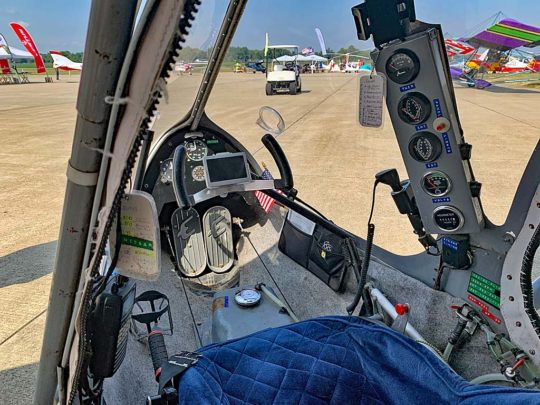
“Falcon’s standard instrument panel has all your flight information,” explained Andy, “while all the engine instrumentation is housed on the right vertical support strut. Above your head are all the electric switches for electric flaps, ignition switches and lighting controls.”
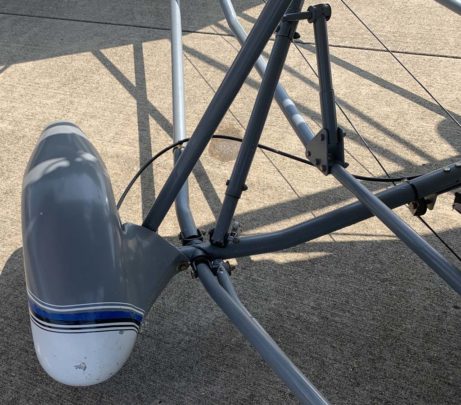 Unlike every Quicksilver or Smithsilver, Falcon has a control yoke as does Quicksilver’s GT500 and GT400 models. However, unlike those Quicksilver models, this yoke has been configured specially to make entry much easier.
Falcon has a door that props open but when I looked at, I thought entry looked rather challenging. What I missed were the steps Andy took in designing a yoke that neatly folds out of the way. When so retracted, entering Falcon looks easy.
Once in place you pull the yoke back toward you and it latches securely into position. With details like this, no wonder Any spent years getting Falcon right on paper and three more to get the pieces and parts in the right place.
Falcon’s cabin even has a hat rack …or in this case, a headset rack as that’s what Andy puts in this location.
Want More Info?
At this time, Tri-State is making a much-needed update to their website.
 Andy referred to the current one as a “nostalgia website” because it holds extensive commentaries written by Mark Smith, the patriarch of Tri-State. His words make a fun, and historic, read but what the vintage website does not do is provide clear navigation to the various aircraft models and component parts or assemblies that Tri-State builds. The new website will address these shortcomings while hopefully keeping all Mark’s original musings.
Until the new website is finished, visit Tri-State’s “Hangar Talk” Facebook page. If you want more or are ready to act, use these contacts:
In this video, I interview Andy Alldredge about his Falcon at Midwest LSA Expo 2020.
* Tri-State Kite Sales is a name dating to the earliest days of Quicksilver, when the company that birthed this design was called Eipper-Formance (one of the original partners was named Dick Eipper). In those formative days of the mid-1970s, hang gliders were often generically called “kites.” Since the very first Quicksilver was an unpowered glider, early buyers casually called them kites as well. The name stuck even if it does not mean much these days.
Another large and very successful supplier of component parts and accessories for Quicksilver airplanes is Air-Tech, Inc., run by Gene “Bever” Borne and his son, Ken. They’re still at it but the Louisiana business now owns the entire Quicksilver line (excluding GT500) and continues to supply new kits, fully-built 103s, Special Light-Sport Aircraft models, and lots of parts and accessories needed by Quicksilver owners.