











 |
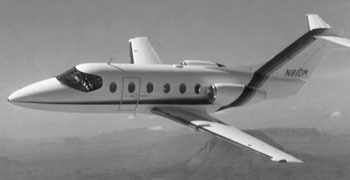
| STANDARD DATA: Seats 9-11. Gross wt. 13,890. Empty wt. 8,050. Fuel capacity 662. Engines two 2,500-lb. s.t. Pratt & Whitney Aircraft of Canada JT-15D-4 turbofans. PERFORMANCE: Top speed 0.78 Mach. Cruise mph 322. Minimum control mph 103. Range 1,800. Takeoff run 4,100. Landing roll 2,700. |
The Diamond I was introduced in 1979 as Mitsubishi’s example of a 500-mph-plus executive fanjet. Its twin turbofans are rated at 2,500 lbs. s.t. for takeoff and 2,375 lbs. s.t. for maximum continuous operation. The two Diamond I prototypes underwent 350 hours of test flying in Japan before their arrival in the United States for FAA certification. A Diamond offers the performance characteristics, cabin size, and comfort level of the medium-class swept-wing jets plus the low cost and economy associated with light jets and some turboprops. The Diamond I wing design, with its advanced flight control system of full-span flaps, wing spoilers, and T-tail empennage, is built for optimum performance. (For more, see HAWKER 400XP).