











 |
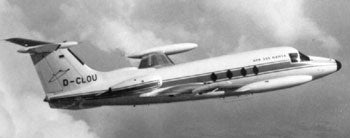
| STANDARD DATA: Seats 15. Gross wt. 20,280. Empty wt. 11,960. Fuel capacity 1,099. Engines two 3,108-lb. s.t. General Electric turbojets. PERFORMANCE: Top mph 513. Cruise mph 420. Stall mph 111. Initial climb rate 4,250. Range 1,472. Ceiling 40,000. Takeoff distance (50′) 2,740. Landing distance (50′) 4,429. |
The first production Hansa Jet flew on February 2, 1966, and received FAA certification on April 7, 1967. The Hansa 320 is one of the most distinctive commercial jet designs and is easily identified by the 15-degree forward sweep of the wings. Aerodynamically, the forward sweep of the wings performs the same function as the rearward sweep. The forward sweep forestalls the undesirable control problems that occur as the upper- wing airflow reaches transsonic speed by directing the airflow spanwise. The Hansa can be used as an executive transport or as a 15-passenger feeder liner. Production of the Hansa was initiated by Hamburger Flugzeugbau and carried the name of Messerschmitt- Bolkow-Blohm (MBB) when the two large German aircraft companies merged in 1969.