











 |
| STANDARD DATA: Martin 202 Seats 40. Gross wt. 39,900. Empty wt. 26,930. Engines two 2,100-hp Pratt & Whitney. PERFORMANCE: Top mph 311. Cruise mph 286. Stall mph 76. Initial climb rate 2,200. Range 635. Ceiling 33,000. Takeoff distance (50′) 1,565. Landing distance (50′) 1,720. STANDARD DATA: Martin 404 Seats 52. Gross wt. 44,900. Engines two2,400-hp Pratt & Whitney R- 2800. |
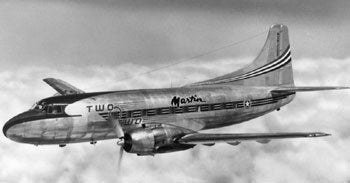
The prototype of the Martin 202 flew in 1946. Power was provided by twin Pratt & Whitney 18-cylinder air cooled radial engines capable of developing a normal output of 1,800 hp, 2,100 hp for takeoff or 2,400 hp with water injection. The engines turned Hamilton Standard three-blade reversible-pitch airscrews. The “Two- O-Two” was the first twin-engine airliner of postwar design to receive certification for airline use. Accommodations provided for a crew of three or four plus 36 to 40 passengers. Another version of the 202 was outfitted with larger fuel tanks to increase its range to 2,365. The subsequent 4-0-4 was introduced in 1950 with a fuselage 39 inches longer, slightly more powerful engines, and pressurization. As the name implies, Martin’s 404 was a bigger and better version of the popular Martin 202. The four engine airliner was unveiled in 1949 and immediately ordered by a variety of air carriers. The onset of the Korean War suddenly made airplane materials significantly more expensive, and Martin found itself filling orders at a loss and stopped production.