











 |
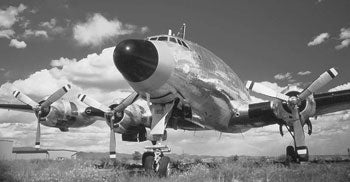
| STANDARD DATA: Seats 94. Gross wt. 133,000. Empty wt. 73,016. Fuel capacity 6,550. Engines four 3,250-hp Wright Turbo Compound radials. PERFORMANCE: Top mph 352. Cruise mph 331. Stall mph 99. Initial climb rate 1,140. Range 4,820. Ceiling 23,000. Takeoff distance (50′) 4,600. Landing distance (50′) 3,550. |
The Lockheed Constellation L.749 variation was a long-range version of the earlier L.049. The earliest Constellation was initially flown in January 1943. Designed for commercial transport, the first Constellations were produced for the U.S. Air Force as C-29s. The first Constellation placed in airline service was the L.749 series. This aircraft differed from earlier versions in its increased fuel capacity and takeoff weight. The L.749 provided for 44 to 64 passengers and was powered by four 2,500-hp Wright Cyclone 18-cylinder air-cooled engines.
A stretched version of the L.749, the L.1049 Super Constellation, was introduced in 1950. Gross weight was increased substantially when the fuselage was expanded by 18.4 feet and 3,250-hp Wright engines were fitted. The stretched “Connie” held up to 91 passengers; with tip tanks, range was increased to 5,840 miles. The L.1049C model had structural modifications to allow a gross weight of 150,000 pounds, provided that more powerful engines were available. Lockheed built 286 Super “Connies,” then followed with production of the L.1619 Starliner, the ultimate in Constellation design. With a range of 7,200 miles, the Starliner became popular on long international routes for TWA and Air France. Only 43 Starliner Constellations were built, and most of those were short lived, bowing out gracefully for the introduction of the jet age. A historical note about the Connie’s heritage: the tri-tailed airliner was the first Air Force One.