











 |
| STANDARD DATA: Seats 168-186. Gross wt. 357,000. Empty wt. 146,390. Fuel capacity 26,420. Engines four 23,150-lb. s.t. Kuznetsov turbofans. PERFORMANCE: Top mph 560. Cruise mph 510. |
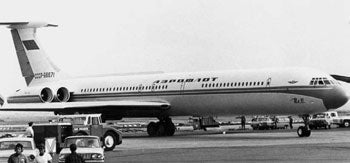
Landing mph 137. Range 4,160. Takeoff run 10,660. Landing roll 9,185. Produced in Kazan, Russia (formally U.S.S.R.), the 174-foot airliner first flew to North America on September 15, 1967, on a maiden flight from Moscow to Montreal. It replaced the older TU-114, the giant turboprop transport, on Aeroflot’s intercontinental routes. In July 1968, the IL-62 began service from Moscow to New York and would subsequently fly on all of Aeroflot’s long-range flights, such as Moscow to Tokyo. The airliner is capable of carrying more than 150 passengers and reserve fuel on a flight of more than 4,800 miles. The basic IL-62 was announced in September 1962 during Khrushchev’s regime; the aircraft will carry up to 186 passengers, but other seating arrangements provide more leg room with 114 or 168 passengers.
Shown first at the Paris Air Show in 1971, the IL- 62M200 is a high-density version of the IL-62 that seats a maximum 198 economy-class passengers or 161 in a mixed-class configuration. The newer deluxe model has the same outer dimensions as those found on the basic model, but an additional fuel tank in the tail of the plane plus improved turbofan engines give the airplane greater range and payload.
Looking very much like the British VC-10, the IL- 62 has its four engines horizontally mounted on the fuselage at the tail. Aside from airline markings, the easiest way to tell the two aircraft apart is by the two tail wheels mounted on a tall spindly strut just aft of the engine exhaust on the IL-62. The Russian airliner has two airflow guide vanes on the forward section of the fuselage, while the VC-10 builders placed air guide vanes on the top wing surface.