











 |
| STANDARD DATA: (H-295) Seats 4-6. Gross wt. 3,400. Empty wt. 2,080. Fuel capacity 120. Engine 295-hp Lycoming. PERFORMANCE: Top mph 167. Cruise mph 165. Stall mph 30. Initial climb rate 1,150. Range 660. Ceiling 20,500. Takeoff distance (50′) 6 10. Landing distance (50′) 520. STANDARD DATA: (H-250) Seats 6. Gross wt. 3,400. Empty wt. 1,890. Fuel capacity 120-270. Engine 250-hp Lycoming. |
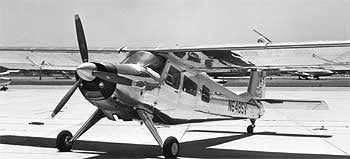
The Helio Courier, which has the ability to take off and land at 30 mph on unimproved landing strips less than 500 feet long, has established itself firmly in the general aviation market. A certificated STOL (Short Take Off and Land) aircraft, the Courier series displays an aptitude for safe, almost stall-proof, slow-speed flight, as well as the range and cruising speed of comparable conventional aircraft. Leading-edge wing slats automatically extend or retract in response to changes in air pressure to prevent stalls or spins. Aileron-linked airflow interceptors provide excellent lateral control while large slotted flaps on the trailing edge, working in conjunction with the slats on the leading edge, double the lift of the wing.
Also, its full cantilever construction eliminates the wasteful drag created by strut braces. With an all-moving stabilator for pitch control and a tall, swept fin, and rudder for its direction control, the two Courier models possess maximum stability during slow flight. The original Courier prototype was a converted Piper Vagabond; from this was created the H-391, which was powered by a 260-hp Lycoming and offered seating for four to five. The H-395 followed in 1959 with its 295-hpengine and five seats. The H-295 first appeared in 1965 and featured increased seating and the same 295-hp engine. Its counterpart was the H-250 powered by the 250-hp Lycoming.
The two current commercial versions of the Helio are the Super Courier H-295 with nonretractable conventional landing gear and the Tri-gear 54-Courier HT-295 with nonretractable tricycle gear. Three models are flown, by the U.S. Air Force: the U-10A with a fuel capacity of 60 gallons; the U-1013, a long-range version with tankage for 120 gallons; and the U-10D, an improved long-range version with a fuel capacity of 120 gallons and a gross weight boosted to 3,600 pounds.