











 |
| STANDARD DATA: (Series 50) Seats 139. Gross wt. 121,000. Empty wt. 55,700. Fuel capacity 3,700. Engines two 15,500- or 16,000-lb. s.t. Pratt & Whitney turbofans. PERFORMANCE: Top mph 576. Cruise mph 561. Initial climb rate 2,850. Range 932. Takeoff distance (35′) 7,750. Landing distance (50′) 4,720. |
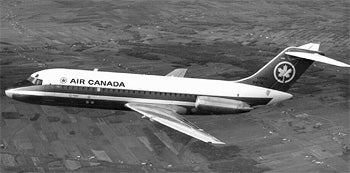
The DC-9 is the McDonnell Douglas short-tomedium-range rear-engine jet transport. It was designed to operate on shorter routes in and out of smaller airports. It stands lower to the ground than its larger brother, the DC-8. This facilitates passenger and baggage access at airports where there are no large terminal complexes with built-in loading and unloading ramps. The DC-8 Series 10 was the initial version powered by 12,250-lb. s.t. turbofans. The Series 20 was designed for operation in hot climates or high-altitude conditions with a longer wingspan similar to the Series 30 but with a shorter body similar to the Series 10. The Series 30 increased in size with 14,000-lb. turbofans and larger 150-passenger load. The Series 40 with still larger engines, 14,500 lbs. s.t., had increased fuel capacity and accommodations for up to 125 passengers.