











 |
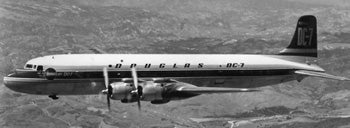
| STANDARD DATA: (DC-6) Seats 64-92. Gross wt. 106,000. Empty wt. 49,767. Fuel capacity 3,992-5,512. Engines four 2,500-hp Pratt & Whitney Double Wasps. PERFORMANCE: Top mph 360. Cruise mph 307. Landing mph 93. Initial climb rate 1,120. Range 3,860. Takeoff distance (50′) 4,500. Landing distance (50′) 3,010. STANDARD DATA: (DC-7) Seats 62-99. Gross wt. 143,000. Empty wt. 72,763. Fuel capacity 7,824. Engines four 3,400-hp Wright Turbo Compound radials. PERFORMANCE: Top mph 406. Cruise mph 346. Stall mph 97. Climb rate (20,000 ft.) 240. Range 4,635. Ceiling 21,700. Takeoff distance (50′) 6,360. Landing distance (50′) 5,100. |
The Douglas DC-6 is essentially a stretched, more powerful, and pressurized version of the DC-4 with three-blade props. The DC-7 is merely a stretched DC-6 with four-blade props and retaining all aerodynamic and structural features. The only difference between the DC-6 and the DC-4 in exterior appearance is that the DC-6 is extended an additional seven feet and the windows are square instead of the earlier porthole style. This new version also provides for up to 62 passengers, 20 more than the DC-4. The DC-7 was increased 3 feet 4 inches longer than the DC-6. It provided for the accommodation of 69 first-class passengers or 95 coach passengers. The DC-7’s engines further increased its gross weight. The DC-7B, a later version, was basically an intercontinental aircraft.