











 |
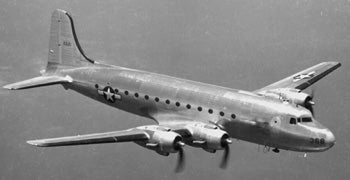
| STANDARD DATA: Seats 42. Gross wt. 65,000. Empty wt. 35,000. Fuel capacity 2,100. Engines four 1,000-hp Pratt & Whitney Twin-Wasps. PERFORMANCE: Top mph 285. Cruise mph 222. Stall mph 80. Initial climb rate 1,200. Range 3,500. Ceiling 25,000. |
The DC-4 design was the product of a group effort involving the technical departments of five of the largest airline companies in the United States in 1939. Its service tests were carried out under the supervision of United Airlines. The first model had seating for more than 50 passengers and was powered by Pratt & Whitney Twin-Wasp engines. Unfortunately, it was sold to Japan where it was involved in a crash. Its extensive service testing resulted in a somewhat smaller design with seating for approximately 40 passengers. This version was placed in production in 1940. At the outbreak of World War II, the military ordered large-scale production of the DC-4 and gave it the designation of C-54. The military version was powered by 1,350-hp Twin-Wasps and was outfitted to carry troops, trucks, and other heavy equipment. The C-54 was also provided with its own facilities for field loading.