












 |
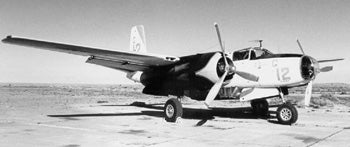
| STANDARD DATA: A-26-15-DL Seats 3. Gross wt. 37,000. Empty wt. 22,370. Engines two 2,000-hp Pratt & Whitney R-2800- 2718-cylinder radials. PERFORMANCE: Top mph 355. Cruise mph 284. Initial climb rate 1,250. Range 1,400. Ceiling 22,100. |
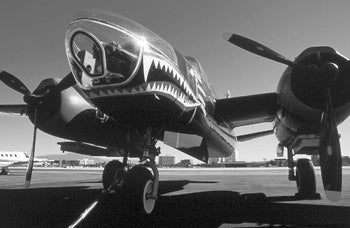 |
| STANDARD DATA: A-26B-60-DL Seats 3. Gross wt. 41,800. Empty wt. 22,362. Engines two 2,350-hp Pratt & Whitney R-2800-79 air-cooled water injected radial engines. PERFORMANCE: Top mph 355. Cruise mph 284. Initial climb rate 1,250. Range 1,400-3,200 nm. Ceiling 22,100. |
The A-26 Invader was originally built in three different prototypes, one as a light bombardment and attack airplane, one as a modification for use as a night fighter, and one as an attack bomber with a large-caliber mounted cannon. The prototype of the basic bomber and attack plane was flown for the first time in 1942. In testing, it actually carried nearly twice the bomb load required by the original specifications submitted by the military. In addition, it exceeded every performance guarantee and was 700 pounds under its designed empty weight. The Invader went into action with the Ninth Air Force in the European Theater in 1944. Its armament included six fixed .50-caliber machine guns in the nose, eight paired .50-caliber guns under the wings, and two two-gun electrically-operated turrets. One turret was above and one turret was below the fuselage; both turrets were remotely controlled from a gun-sighting position behind the wings. The upper gun turret could be locked in the forward position and fired by the pilot. The Invader also had internal bomb bays, external bomb racks, and self-sealing fuel tanks. The A-26 featured a variety of configurations throughout the war, including a transparent nose. The A-26B-DL model was configured with eight machine guns in the nose, and six .50 inch guns were mounted in the wings. Bombs and rockets could also be attached to hard points. In 1948, the A-26B was redesignated the B-26B so as not to be confused with the Martin B-26 Marauder.