











 |
| STANDARD DATA: Gross wt. 34,000. Empty wt. 17,564. Fuel capacity 1,750. Engines two 1,200-hp Pratt & Whitneys. PERFORMANCE: Top mph 196. Cruise mph 125. Stall mph 76. Initial climb rate 1,111. Range 2,520. Ceiling 15,800. |
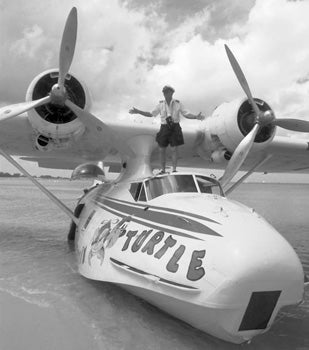
The PBY-5 flying boat went into service in the U.S. Navy in 1939 and was soon adopted by the RAF, which in turn dubbed it the “Catalina.” This name was later recognized by the U.S. Navy in 1941. Over the years, numerous improvements were made to the design. An amphibious version, the PBY-5A, was developed in 1939, through the addition of a retractable tricycle undercarriage. The PBY-6A featured hydrodynamic improvements designed by the Naval Aircraft Factory. The Soviet Union produced a license-built version for their Navy called the GST and powered by Mikulin M- 62 radial engines. Boeing Aircraft of Canada built the PB2B-1 and PB2B-2 (“Canso”), and a derivative of the PBY-5A was built by Canadian Vickers. In U.S. Army
Air Force service, the aircraft was known as the OA- 10A (PBY-5A) and OA-10B (PBY-6A). The Royal Air Force’s Coastal Command flew Catalinas under the designations Catalina Mk I/II/III/IV. In addition to the aircraft’s primary role as a patrol bomber, the Catalina has been used as a torpedo carrier, night bomber, antisubmarine weapon, long-range reconnaissance plane, and air/sea rescue plane. Catalinas also have exceptional load carrying ability with a cargo capacity of 15,000 pounds. Due to their versatility, PBYs have been widely used commercially and militarily throughout the world.