











 |
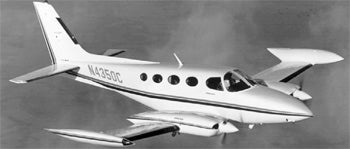
| STANDARD DATA: Seats 6. Gross wt. 5,990. Empty wt. 3,921. Fuel capacity 102-207. Engines two 310- hp turbocharged Continentals. PERFORMANCE: Top mph 281. Cruise mph 231. Stall mph 82. Initial climb rate 1,650. Ceiling 29,800. Range 506- 1,325. Takeoff distance (50) 2,175. Landing distance (50) 1,850. |
The Cessna 340 is a pressurized six-place twin featuring center-aisle seating, an air-stair door, and top cruise performance. Developed from the 310, it utilizes a similar landing gear and tail unit. Its wings are borrowed from the Model 414. Until 1976, power for the 340 was generally quoted as 285 hp. It used the same turbocharged engines as the T310. But power in subsequent models is rated at 310 hp during takeoff for the 285-hp engine. Propellers with a shorter diameter were added in 1976 to reduce tip speeds, thereby lowering sound levels. In addition, a propeller synchrophaser maintains phase of the blades engineto- engine by controlling prop RPM. With a fuselage five feet longer than the 310, the 340’s big selling point is a spacious interior with pressurization. It was the first light twin to offer pressurization, and it was Cessna’s hope that the 340 would make this option accessible to light-twin owners. Allowable baggage in the airplane is 930 pounds with storage bins located in the nose, behind the seats, and in nacelle lockers. Since 1975, the Model 340 II and 340 III were added to the line with their packages of special avionics and instruments. For 1981, a McCauley threadless blade propeller had become standard, resulting in a 12-pound weight saving per airplane. In 1979, Cessna offered a less expensive version of the 340, the unpressurized 335. The model also featured a slight decrease in power with the 300hp TSIO-520- EB engines. The airplane enjoyed only modest success on the market, and it was taken out of production in 1980. The Cessna 340 would continue until 1984.