











 |
| STANDARD DATA: (320F) Seats 4-6. Gross wt. 5,300. Empty wt. 3,273. Fuel capacity 102-184. Engines two 285-hp turbo-supercharged Continentals. PERFORMANCE: Top mph 275. Cruise mph 256. Stall mph 78. Initial climb rate 1,924. Range 845. Ceiling 29,000. Takeoff distance (50′) 1,190. Landing distance (50′) 1,513. STANDARD DATA: (320A-C) Seats 5. Gross wt. 4,990. Empty wt. 3,190. Fuel capacity 102-133. Engines two 260-hp Continentals. PERFORMANCE: Top mph 265. Cruise mph 245. Stall mph 77. Initial climb rate 1,850. Ceiling 27,200. Range 855- 1,430. Takeoff distance (50′) 1,470. Landing distance (50′) 1,770. |
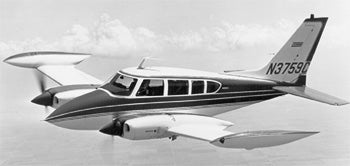
The Cessna Skyknight, which has the numerical designation of 320, was an attempt by Cessna to establish a heavier version of the 310 design. The original Skyknight was developed from the 310 with supercharged engines giving increased performance. In 1963, the canted wingtip tanks were added. Horsepower was boosted in 1966 from 260 to 285. The more recent models also had extended engine nacelles to increase baggage capacity, a stretched cabin with greater glass area, and other refinements. Despite all these extras, the Skyknight actually has a gross weight of only 100 pounds greater than that of the comparable Cessna 310 and an empty weight differential of only 100 pounds more. Further, the fuel consumption at economical throttle settings was not substantially different. Yet the Skyknight offered a cruise speed almost 17% greater due to its ability to operate efficiently at higher altitudes. Starting in 1963, its second model year, the Skyknight also carried alphabetic designations, beginning as the 320-A and continuing without interruption through the 320-F in 1968.