












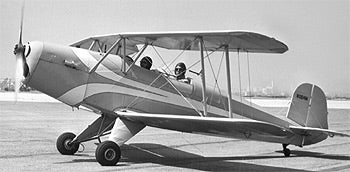
BUCKER BU131 “JUNGMANN”€

1939’€“56

Gemini Sparkle

Key Takeaways:

  • The Bucker Jungmann, first introduced in Germany in 1934, became one of the most popular two-seat, tandem aerobatic biplanes globally.
  • Thousands were produced at the Bucker factory and under license in Spain, Switzerland, and Czechoslovakia.
  • Originally powered by an 80-hp Hirth, it later standardized on a 105-hp Hirth engine, with some U.S. adaptations using larger American engines.
  • It is highly valued for its remarkably graceful and precise aerobatic capabilities and remains in great demand.
See a mistake? Contact us.
STANDARD DATA: Seats 2. Gross wt. 1,474. Empty wt. 836. Engine 105-hp Hirth.
PERFORMANCE: Top mph 115. Cruise mph 106. Stall mph 51. Initial climb rate 650. Range 400. Ceiling 14,000.

The Bucker Jungmann, which first appeared in Germany in 1934, has proved to be one of the most popular two-seat, tandem aerobatic biplanes in the world. Several thousand were produced at the Buckerfactory near Berlin during the 1930s and 1940s and many others were constructed under license in Spain, Switzerland, and Czechoslovakia. Originally, the Jungmann was powered by an 80-hp Hirth engine. Later in 1936, the 105-hp Hirth became the standard engine. Several Jungmanns have found their way into the United States, and some have been adapted to larger American engines. The biplane is capable of performing remarkably graceful and precise aerobatics and is in great demand.

Plane & Pilot

Plane + Pilot is general aviation’s only adventure-based magazine. From where to go, to how to get there, and everything in between, your next great adventure awaits.
Subscribe to Our Newsletter

Get the latest Plane & Pilot Magazine stories delivered directly to your inbox

SUBSCRIBE