












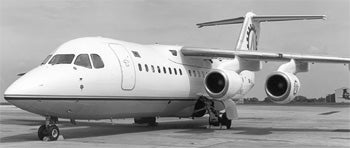
BRITISH AEROSPACE “BAe-146″€

1983’€“1993

Gemini Sparkle

Key Takeaways:

  • The BAe-146, originating as the HS-146 in 1973 under government subsidy, became one of Britain's most successful airliners, with development progressing under British Aerospace by 1978.
  • It evolved through several models, including the stretched -200 and -300 versions, which offered increased cargo space and gross weight capacities.
  • The versatile aircraft fulfilled multiple roles, serving as both passenger and freight haulers, and was also utilized in military versions by the Royal Air Force.
See a mistake? Contact us.
STANDARD DATA: (146-300) Seats 128. Gross wt. 97,500. Empty wt. 54,848. Engines four 6,970-lb. ALF 502-5 turbofans. PERFORMANCE: Max speed Mach 0.73. Cruise 426 kts. Range 1,040-1,520 nm. Ceiling 35,000

One of Britain’s most successful airliners, the HS- 146 began in 1973 under the leadership of Hawker Siddeley under subsidy from the British government. Economic pressures made development slow, and was not until 1978, under the larger umbrella of British Aerospace, that the four-engine airliner really took shape. The version -200, a stretch of the prototype -100, featured more cargo space and allowed for the resulting increase in gross weights. Later a -300 model was certified, with even more such increases. The BAe-146s flew two roles, as both passenger and freight haulers. Military versions were also operated by the Royal Air Force.

Plane & Pilot

Plane + Pilot is general aviation’s only adventure-based magazine. From where to go, to how to get there, and everything in between, your next great adventure awaits.
Subscribe to Our Newsletter

Get the latest Plane & Pilot Magazine stories delivered directly to your inbox

SUBSCRIBE