











 |
| STANDARD DATA: B-757-200 Seats 290. Gross wt. 300,000. Empty wt. 176,200. Fuel capacity 13,900. Engines two 48,000-lb. s.t. Pratt & Whitney JT9D-7R4D. PERFORMANCE: Top mph 557. Cruise mph 528. Ceiling 40,000+. Range 6,210. Takeoff distance 5,650. Landing distance 4,750. STANDARD DATA: B-757-300 Seats 210-350. Gross wt. 401,000. Empty wt. 198,800. Engines two 52,500-lb. CF6-80C2B2 turbofans. |
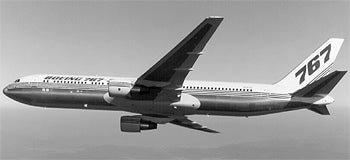
The 767 makes use of advanced technology to offer exceptional efficiency to help offset rising operational costs while bringing twin-aisle passenger-cabin convenience to routes that were never served by wide-bodied aircraft in the past. Because of its twin-aisle design, the 767 offers 87% of available seating either at a window or on an aisle.
The 767-200 was developed at the same time as the Boeing 757; in fact the Boeing 767-100 (the first model) was never launched, due its similar capacity to the 757. The 200 model was awarded FAA certification on July 30, 1982 just a few months earlier than the 757. Both aircraft share early EFIS flightdecks.
After release of the 200, Boeing immediately announced the development of the stretched 767, the 300. The model entered service in late 1986. Both the 200 and 300 series 757 were made in an ER (extended range) version, which increased fuel capacity and higher MTOWs.
The 767-300ER made way for the yet another fuselage stretch—the 767-400. This Boeing model was designed to compete more directly with the Airbus A330-200. This was the first project for Boeing after merging with McDonnell Douglas in 1997. The 400 featured the same flightdeck as the B-777 and made its first flight in 1999.