











 |
| STANDARD DATA: (Bellanca) Seats 2. Gross wt. 1,650 Empty wt. 1,110. Fuel capacity 35. Engine 150-hp Lycoming. PERFORMANCE: Top mph 130. Cruise mph 129. Stall mph 51. Initial climb rate 1,120. Range 560. Ceiling 17,000. Takeoff distance (50′) 630. Landing distance (50′) 755.
STANDARD DATA: (Champion) Seats 2. Gross wt. 1,650. Empty wt. 980. Fuel capacity 26. Engine 100-hp Lycoming. PERFORMANCE: Top mph 117. Cruise mph 112. Stall mph 50. Initial climb rate 725. Ceiling 12,000. Range 728. Takeoff distance (50′) 890. Landing distance (50′) 755. |
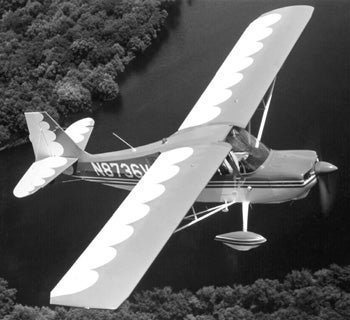
The name “Citabria” is actually “airbatic” spelled backward. The Champion 7ECA Citabria was a modernized version of the Champion Model 7EC Traveler. Champion’s first Citabria flew as a prototype in May 1964. Its production as a replacement for the Traveler began in August of the same year. The Champion two seat aircraft was powered by a 108hp Continental fourcylinder engine. When Bellanca introduced its version of the 7ECA, the airplane was fitted with a 115-hp Lycoming. The Citabria’s basic wing, fuselage, and undercarriage are similar to previous tandem two-seaters. Major changes to the aerobatic, high-winger include the enlarged rear cabin windows, the square-cut vertical tail surfaces, and low-drag wheel spats similar to those on the Champion 7KC Olympia. Models 7GCAA, 7KCAB, and 7GCBA are generally similar to the Citabria 7ECA, with the exception that they are all powered by a 150-hp Lycoming engine. In addition, the 7KCAB has special fuel and oil systems for inverted flying, and the 7GCBC is fitted with flaps. The Citabria was the country’s first aircraft certified for aerobatic flight by the FAA and is still the lowest priced production aircraft with these capabilities. Production of the Citabria was discontinued in 1980 when Bellanca Aircraft Corp. declared bankruptcy.