











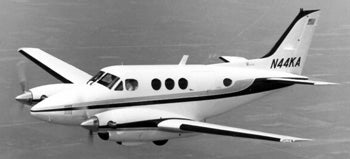
 Beechcraft King Air E90 |
| STANDARD DATA: (E90) Seats 6-10. Gross wt. 10,100. Empty wt. 6,052. Fuel capacity 474. Engines two 550-shp Pratt & Whitney reverse-flow free turbines. PERFORMANCE: Cruise mph 287. Stall mph 89. Initial climb rate 1,870. Ceiling 27,620. Range 1,507. Takeoff distance (50′) 2,024. Landing distance (50′) 2,110. STANDARD DATA: (F90) Seats 7-10. Gross wt. 10,950. Empty wt. 6,549. Fuel capacity 470. Engines two 750-shp Pratt & Whitney PT6A-135. |
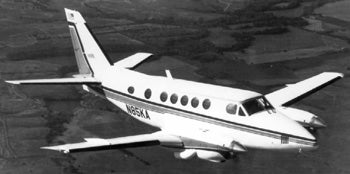 Beechcraft King Air 100 |
| STANDARD DATA: (A100) Seats 8-15. Gross wt. 11,500. Empty wt. 6,797. Fuel capacity 470. Engines two 680-shp Pratt & Whitney reverse-flow free turbines. PERFORMANCE: Cruise mph 285. Stall mph 86. Initial climb rate 1,963. Ceiling 24,850. Range 1,481. Takeoff distance (50′) 2,681. Landing distance (50′) 2,109. STANDARD DATA: (B100) Seats 8-15. Gross wt. 11,800. Empty wt. 7,088. Fuel capacity 470. Engines two 715-shp AiResearch fixed-shaft turbines. |
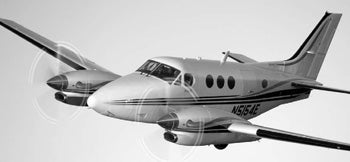 Beechcraft King Air C90B |
| STANDARD DATA: (B90) Seats 0-40. Gross wt. 9,650. Empty wt. 5,685. Fuel capacity 384. Engines two 500-shp Pratt & Whitney turboprops. PERFORMANCE: Cruise mph 260. Stall mph 87. Initial climb rate 1,900. Ceiling 27,000. Range 1,480. Takeoff distance (50′) 1,420. Landing distance (50′) 2,300. STANDARD DATA: (C90) Seats 6-10. Gross wt. 9,650. Empty wt. 5,765. Fuel capacity 384. Engines two 550-shp Pratt & Whitney reverse-flow, free turbines. STANDARD DATA: (C90B) Seats 6. Gross wt. 10,160. Empty wt. 6,803. Fuel capacity 384. Engines two 550-shp Pratt & Whitney PT6A-21. |
One out of every four turbine-powered aircraft— turboprop and pure jet—in business and executive use in the United States is a King Air. Many are in commercial airline, government, or military use in the United States and internationally. This impressive record is a tribute to the outstanding qualities of the King Air. A full range of optional avionics includes autopilot and complete Category II landing system capability. The 90, A90, and B90 are all powered by 500 shp. In 1970, the B90 was fitted with a 550-shp Pratt & Whitney, which was subsequently used on the C90. The 100 series was introduced in 1969, and the E90 became part of the lineup in 1972. Both employed the same 680-shp Pratt & Whitney turboprops. All have full-feathering reversible propellers. The pressurized three-compartment interior can be maintained at sea-level atmosphere pressure to flight levels as high as 10,500 feet.
The C90 is one of the industry’s lowest priced turboprops, and the E90 is virtually a more powerful version of the C90. The King Air F90 is a fuel-efficient version, thanks in part to the Pratt & Whitney engines with improved turbine blades that extract more power from the engine. At 300 mph true air speed, it burns less than 70 gallons per hour. Slower turning props also reduce interior noise levels. The F90 was the first King Air in the 90 series to make use of the T-tail. The dual-wheel gear are fitted with brake deice systems. The pressurization differential of 5.0 psi provides a sea-level cabin at 11,000 feet. The King Air 100, technically a variant of the King Air 90, was announced in May 1969. It featured a stretched fuselage (slightly more than 4′). The model A was built for military use, and the B was for civilian aircraft. Only about 350 of the longer models were built before production ended. Of all the iterations of the 90 series King Air, the latest model, C90B has stood the test of time. Though it is dimensionally unchanged since its birth in 1964, dramatic improvements have derived from all the previous models. The biggest change came in 1991 when Raytheon changed over to the four-blade McCauley propellers, which significantly reduced the level of cabin noise.