











 |
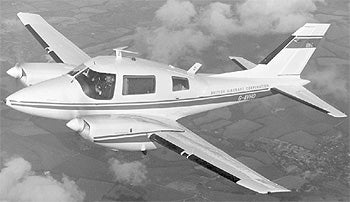
| STANDARD DATA: Seats 5-8. Gross wt. 7,125. Empty wt. 4,380. Fuel capacity 234. Engines two 340-hp Rolls Royce/Continentals. PERFORMANCE: Top mph 258. Cruise mph 220. Stall mph 80. Initial climb rate 1,590. Range 1,600. Ceiling 27,100. Takeoff distance (50′) 2,390. Landing distance (50′) |
The Beagle B.206 was built in several versions, of which the most prominent are the Series I, Series II, and Basset C.C.I, the latter being the military version. The Series II differs from the Series I in that it is powered by twin 340-hp engines instead of the smaller 310-hp, engines used in Series I. This Beagle is basically a light twin-engine transport with accommodations for five to eight persons. The first prototype flew in 1961. The first flight of the Series II was in June 1965. The most current version of the Series II has an extended cabin with an additional rear window and a large passenger or cargo door on the port side. The Beagle B.218 closely resembles the B.206 but is considerably smaller in overall size. Accommodations provide for four (seated in pairs), and power is supplied by two 145-hp Rolls Royce/Continentals. Plastics are used extensively in the airframe where stress is not a problem.