











 |
| STANDARD DATA: (500) Seats 7-9. Gross wt. 9,500. Empty wt. 4,681. Fuel capacity 500. Engines one 850-shp Pratt & Whitney Aircraft of Canada turboprop and one 2,200-lb s.t. Pratt & Whitney Aircraft of Canada turbofan. PERFORMANCE: Maximum cruise mph 460. Economy cruise mph 403. Stall mph 88. Initial climb rate 4,950. Ceiling (forward engine only) 25,000. Ceiling (both engines) 40,000. Range (both engines) 1,290. Range (forward engine only after reaching cruising altitude) 2,875. Takeoff distance (50′) 1,500. Landing distance (50′) 1,500. STANDARD DATA: (400) Seats 7. Gross wt. 6,000. Empty wt. 3,500. Fuel capacity 290. Engines one 850-shp Pratt & Whitney Aircraft of Canada turboprop and one 640-lb s.t. Teledyne turbojet. |
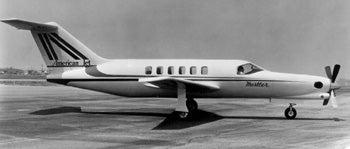
The prototype of the Hustler 400 first flew in 1978. Its unique powerplant setup allows the cruising economy of a single-engine turboprop with the safety of a twin and the landing/takeoff performance of a STOL airplane. Up front is a turboprop rated at 850-shp turning a four-blade constant-speed reversible prop. Aft is a standby power source in the form of a 640-pound s.t. turbojet intended to enhance safety by enabling the Hustler to maintain 170 mph at an altitude of 15,000 feet with the nose propeller feathered. Also, on takeoff, the aft jet is activated automatically by a torque-sensing device on the turboprop. In situations where a short field forewarns of the need for extra boost, the aft jet can be left at idle.
The cabin is pressurized to permit operation at altitudes up to 35,000 feet. STOL operation is made possible by a supercritical wing with full-span Fowler trailing edge flaps and spoilers in place of ailerons for lateral control. For the Model 500, the fuselage was extended to make room for a larger, 2,200-pound s.t. turbofan engine, and wingtip tanks were added to augment the standard fuel supply. Also, ailerons were added, thereby requiring that the full-span flaps be trimmed. The larger aft turbofan makes it possible for the Model 500 to be certified as a twin-engine airplane.