











 |
| STANDARD DATA: Seats: 128-144; Gross weight: 385,000 lbs.; Empty weight: 169,000 lbs.; Fuel capacity: 30,985 gals.; Engines: four 38,050 lb. Olympus 593 turbojets. PERFORMANCE: Top cruise: 1,450 mph; Initial climb rate: 5,000; Range: 4,500 nm; Ceiling: 60,000 ft. |
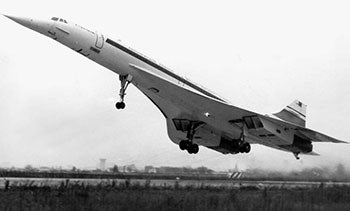
As a joint venture between the French company Aerospatiale and British Aircraft Corporation, the Concorde Super Sonic Transport (SST) took the lead in sales orders over its rival, the Russian TU-144. With costs, responsibility and work on the Concorde divided fairly between the two partners, deliveries of the four-engine airliner started in 1974. Production finally got underway after extensive testing on prototypes over the first four years of development.
With the very look of speed, the shark-nosed giant was designed to cruise at Mach 2.05 for a maximum range of 4,020 miles. Accommodation for 100 economy-class passengers was available, although most airlines reduced seating and included a first-class section.
Construction of the Concorde prototypes began in 1965 with the first flight on March 2, 1969. Aerospatiale was responsible for the following Concorde items: rear cabin section, wings and wing control surfaces, hydraulic system, flight controls, navigation systems, and radio and air-conditioning systems. BAC was responsible for the rest of the airliner except engines and the autopilot. The Olympus engines were produced jointly by Rolls-Royce and SNECMA; the autopilot was designed jointly by Elliott in the UK and SFENA in France. Due to noise restrictions and environmental activist groups, flights into U.S. airspace were restricted during its transcontinental flight career.
A typical subsonic trip from New York to London takes 7-8 hours on a conventional airliner. On February 8, 1996, the Concorde made the trip in 2 hours 52 minutes and 59 seconds. 20 Concordes were built and 14 entered airline service. After more than two decades of safe service, in July 2000 a Concorde crashed after runway debris ruptured the left main tires, which ultimately lead to fire and engine failure. After modifications to bolster the tires and to protect the fuel cells, the Concorde returned to service between New York, London and Paris in November 2001 for less than two years before retirement.