











 |
| STANDARD DATA: Seats 2. Gross wt. 1,670. Empty wt. 1,064. Fuel capacity 32. Engine 112-hp Lycoming. PERFORMANCE: Top mph 130. Cruise mph 125. Stall mph 53. Initial climb rate 718. Ceiling 12,000. Range 502. Takeoff distance (50′) 1,460. Landing distance (50′) 1,374. |
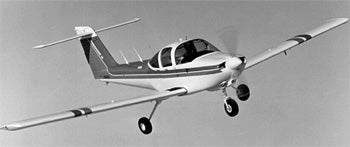
The sleek all-metal Tomahawk was the first trainer to meet all FAA requirements of 14 CFR Part 23, Amendment 16. It combines a number of innovative design elements, including a jet-age T-tail that positions the fixed horizontal stabilizer and interchangeable elevators in air undisturbed by propeller slipstream. The T-tail facilitates quieter, smoother, and more stable flight with minimal pitch change at any speed. As an end plate for the vertical fin, the “T” also provides more positive rudder control. The “T” permits precise spin training, and the positive response gives the student excellent conditions for practicing stalls.
The Tomahawk’s modern low-wing design is an adaptation of NASA’s Whitcomb airfoil and provides optimum inflight visibility, ground handling, safety, and landing ease. The design consists of a constant thickness and a rectangular platform with a high aspect ratio chosen for its low drag that permits excellent speed and high lift. The Tomahawk also features a bubble canopy and a door both sides of the cabin. For cost and time-efficient maintenance, the Tomahawk’s engine is accessible through a wide double opening cowling, and if necessary, the engine can be removed without detaching the propeller. The most significant refinement for the Tomahawk in 1980 was the reduction in the forces necessary to extend the flaps, carried out with the intention of reducing the student pilot’s workload. In keeping with the T-tail design, there is no pitch-up tendency with flap extension.